



Finding the right knife feels like a small victory every time you pick it up. Professional-grade blades are best evaluated by their specific balance and edge geometry, as those technical features determine how the knife fits in the hand. Design specifications matter more than any online photo.
The Chicago Cutlery Insignia Guided Grip 18-piece set earned our top pick for its forged construction, full tang, and patented pinch-grip handle — a combination that delivers serious cutting performance without the boutique price tag.
📌 This article contains affiliate links. As an Amazon Associate I earn from qualifying purchases, at no extra cost to you. Product prices and availability are accurate as of the date of publication. Full disclosure.

Chicago Cutlery B144 Walnut Tradition 4-Piece Steak Knife Set (Minimalist Steak Set)

Chicago Cutlery B42 Walnut Tradition Knife Set 3-Piece (All the Essentials)

Comparison Table
| Product | Best For | Buy Link |
|---|---|---|
| Chicago Cutlery Paring Knife | Detail work | Check Price |
| Chicago Cutlery B144 Walnut Tradition 4-Piece Steak Knife Set | Basic steak set | Check Price |
| Chicago Cutlery B42 Walnut Tradition Knife Set 3-Piece | Essential starter set | Check Price |
| Chicago Cutlery® Armitage 3-piece Knife Set | Minimalist set | Check Price |
| Chicago Cutlery 16 Piece Avondale Knife Block Set | Complete block set | Check Price |
| Chicago Cutlery B144 4-Piece Walnut Tradition Steak Knife Set (2-Pack) | Steak knife bulk buy | Check Price |
| Chicago Cutlery Insignia Guided Grip 18-Piece knife set with block | Forged set with grip | Check Price |
| Chicago Cutlery Chef Knife | Single chef knife | Check Price |
| Chicago Cutlery | USA-made 8-inch chef | Check Price |
| Chicago Cutlery 3 Boning and Paring Knife | Full-tang paring | Check Price |
How We Picked the Blades You’ll Find in Chicago Knife Stores
These picks come from comparing published specifications, materials, and documented features against what actually matters in this category — blade steel composition, heat treatment quality, and handle ergonomics. A common failure is buying a stamped blade with soft steel that dulls within weeks, or a set that skips the essential 8-inch chef’s knife, the only knife most home cooks truly need. Because the search is for local stores, we also weighed proximity and in-store selection: a good store lets you handle the knife and offers sharpening services after purchase. We weighted high-carbon stainless steel, full tang construction, and the presence of a true chef’s knife most heavily, since those directly affect edge retention and control. Before ordering, check whether the store offers a test-cutting surface or staff who can explain steel grades.
Chicago Cutlery Paring Knife (Precise Detail Blade)
Quick take: This 3.5-inch paring knife suits anyone who needs a small, controlled blade for peeling, trimming, and intricate work — and nothing more.
The high-carbon stainless steel blade resists stains and corrosion better than basic stainless, which matters for a knife that will spend half its life wet from citrus or tomatoes. The ergonomic polymer handle has a secure grip and a balanced feel, but the listing doesn’t mention a full tang, so the blade likely ends inside the handle rather than running through it. That’s common for budget paring knives and fine for light tasks, but it limits durability if you twist or pry.
As a blade sharpness perfectionist, I care about how easily a knife returns to a razor edge. High-carbon stainless sharpens more readily than low-carbon, so this paring knife should hone back quickly on a steel. One honest annoyance: the handle, while comfortable, is polymer — if your hands get greasy, it may feel less secure than textured G10 or wood. For the price, though, it’s a low-risk entry point. You can often find something similar at a well-stocked knife store in Chicago and compare the grip before you commit.
Pros:
- 3.5-inch blade — provides excellent control for peeling and delicate cuts without excess length.
- High-carbon stainless steel — resists stains and corrosion while maintaining a sharper edge than basic stainless.
- Ergonomic polymer handle — secure grip and balanced feel reduce hand fatigue during repetitive tasks.
- Compact size — easy to store and maneuver around small fruits or vegetables.
- Budget-friendly — a low-cost way to test whether you like the brand before investing in a larger set.
Cons:
- No full tang — the blade doesn’t run through the handle, so twisting or prying can loosen it over time.
- Polymer handle — can feel slick when wet or greasy compared to wood or textured rubber.
- Limited to light tasks — not suitable for chopping or heavier prep work.
Our Take
Best for: Home cooks who need a dedicated paring knife for precise work and want something easy to maintain. Skip if: You need one knife for everything — a paring knife can’t replace a chef’s knife for daily use.
Chicago Cutlery B144 Walnut Tradition 4-Piece Steak Knife Set (Minimalist Steak Set)

Here’s the deal: I’d only pick this set if you need four basic steak knives and absolutely nothing else — the spec sheet is too thin to recommend it for serious steak lovers.
The product page lists it as a 4-piece steak knife set, easy to use, manufactured in China. That’s the entire feature list. No blade length, no steel type, no handle material beyond the word ‘Walnut’ in the name. For a blade sharpness perfectionist, the absence of steel composition is a glaring omission. You can’t know how long the edge will hold or how easily it takes a fine angle.
The ‘easy to use’ claim is meaningless without context. Steak knives need a serrated or fine edge that slices through meat without tearing. If these have a standard straight edge, they’ll dull quickly on ceramic plates. Unless you’re buying a gift for someone who never cooks steak, pass. Many knife stores in Chicago carry comparable sets with full specs listed on the box, and you can ask the staff about blade grind before spending a dime.
Pros:
- Affordable four-pack — covers a basic dinner party without breaking the bank.
- Walnut tradition name — suggests wooden handles, though not confirmed in the listing.
- Simple design — no complicated features to break or maintain.
- Lightweight — easy for guests to handle, especially older relatives.
- Replaceable — if one gets lost or damaged, the set is cheap to replace.
Cons:
- Missing specs — no blade length, steel type, or tang information; you’re buying blind.
- Manufactured in China — while not inherently bad, it doesn’t guarantee quality control like USA or German production.
- Likely soft steel — without high-carbon stainless, these will dull after a few steak dinners.
Why It Made Our List
Perfect for: Someone who needs a set of disposable steak knives for occasional use and cares more about quantity than edge retention. Think twice if: You eat steak weekly or expect a knife to stay sharp beyond a month.
Chicago Cutlery B42 Walnut Tradition Knife Set 3-Piece (All the Essentials)
Final thoughts: This set covers the three knives every kitchen needs — an 8-inch chef, a 5-inch boning/utility, and a 3-inch parer — at a price that’s hard to argue with.
The listing states these are safe for the dishwasher but recommends handwashing; that tells me the blades are stainless but the handles may be wood. Walnut handles and dishwasher cycles don’t mix — the heat and detergent will dry them out and crack them over time. The 8-inch chef’s knife is the star here, the only knife most home cooks truly need for chopping, slicing, and mincing. The boning/utility knife handles smaller proteins and carving, while the parer takes care of peeling.
High-carbon stainless steel isn’t explicitly mentioned on this set’s page, but Chicago Cutlery typically uses it, and the brand’s reputation leans that way. If true, these blades will hold an edge longer than basic stainless and respond well to a honing steel. The lack of a full tang is a likely drawback — budget sets often skip it. Still, for someone building a first kitchen setup, this is a smarter buy than a 16-piece block that’s mostly filler. When I look at the three knives here, each one earns its place. That’s rarer than you’d think.
Pros:
- 8-inch chef’s knife included — the essential blade for 80% of kitchen tasks.
- Three versatile sizes — covers chopping, slicing, boning, and peeling in one set.
- Walnut handles — classic look and comfortable in a bare hand, assuming wood is used.
- Dishwasher safe — but handwashing recommended, which extends handle life.
- Good value for a starter set — you get core knives without paying for extras you don’t need.
Cons:
- No full tang mentioned — blades may not extend through the handle, reducing durability under stress.
- Steel grade not specified — you have to trust the brand rather than know the exact alloy.
- Walnut handles need care — regular oiling and immediate drying after washing, which lazy cooks will skip.
The Real Deal
Great match for: New cooks or small apartments where three knives handle everything without clutter. Not great if: You do heavy chopping on bones or frozen food — you’d want a sturdier, full-tang chef’s knife.
Chicago Cutlery® Armitage 3-piece Knife Set (Minimalist and Under-Specced)

Quick take: This set is a blank canvas — the listing only says hand wash and dry immediately, so you’re taking a bigger risk than with the B42 set.
No blade list, no steel composition, no handle material. The only instruction is to hand wash and dry immediately to keep it in best condition. That suggests either wood handles or a blade prone to spotting, which means the maker knows it needs careful treatment. For a sharpness-focused buyer, the silence on steel grade is frustrating. High-carbon stainless is the baseline I look for, and without it, edge retention is a coin flip.
If this set mirrors the B42 trio — chef, utility, parer — then it’s just a more expensive version with less information. I’d rather see the spec sheet than a vague care note. At a knife store, you could hold these and inspect the tang yourself, but online you’re buying on faith. The Armitage name sounds premium, but without specs, it’s just marketing. Unless you find it at a deep discount and can verify the pieces in person, skip it.
Pros:
- Three-piece set — likely includes the same basic trio of chef, utility, and parer.
- Hand wash recommendation — at least the maker cares about longevity, even if vaguely.
- Compact — three knives won’t clutter a small kitchen drawer or counter.
- Chicago Cutlery brand — some baseline quality expectation, though not guaranteed here.
- Potentially wood handles — the care note hints at natural materials, which feel nice in hand.
Cons:
- Zero specs on blades — no length, steel, or tang information makes this a blind purchase.
- No indication of what knives are included — you might get three paring knives for all you know.
- Higher risk than B42 — the B42 set at least lists the three knife types; this one says nothing.
Who Should Buy This
Ideal for: Someone who finds this set at a physical store and can open the box, see the knives, and decide based on feel. Pass on this if: You’re ordering online and want any confidence in what arrives.
Chicago Cutlery 16 Piece Avondale Knife Block Set (Full Kitchen Coverage)

Why it made our list: This is the set for a household that cooks daily and wants every knife type available, plus a block to store them.
The high-carbon stainless steel blades are a solid step up from basic stainless — they resist rust and take a sharper edge, though they still require occasional sharpening. The dual material handle usually means a combination of stainless and resin or rubber, giving you grip where your fingers need it and durability at the bolster. The set includes a chef knife, bread knife, two utility knives (one serrated), a parer, and a sharpening steel, all housed in a wood block.
The sharpening steel is a smart inclusion for this target audience — most home cooks never sharpen their knives, and a steel at least realigns the edge between uses. But a block set like this one also means half the knives will sit unused. The serrated utility and bread knife overlap; the parer and the smaller utility compete for the same tasks. If you have the counter space and want the convenience of a one-time purchase, this works. If you’re a minimalist, buy the B42 set instead. You can find this block at many knife stores in Chicago and lift each knife to check balance before committing.
Pros:
- High-carbon stainless steel blades — better edge retention and stain resistance than generic stainless.
- Includes a sharpening steel — helps maintain edges between professional sharpenings.
- Comprehensive selection — chef, bread, utility, serrated utility, parer, and more.
- Dual material handle — offers a secure grip even with wet hands.
- Wood block storage — keeps blades protected and easily accessible on the counter.
Cons:
- Many redundant knives — the serrated utility and bread knife do similar work; the parer and utility overlap.
- Counter space required — the block is bulky and not for small kitchens.
- No mention of full tang — if the blades are stamped, they’ll wear out faster under heavy chopping.
Our Verdict
Best for: Families who cook a variety of meals and want every tool within reach without buying separately. Skip if: You have limited counter space or prefer to invest in one or two high-quality knives instead of twelve average ones.
Chicago Cutlery B144 4-Piece Walnut Tradition Steak Knife Set (2-Pack) (The Serious Steak Set)
What stood out: This 2-pack gives you eight steak knives with full-tang construction, high-carbon stainless steel, and a 26-degree taper grind — a far more detailed spec than the single set above.
The 26-degree taper grind edge is a precise angle designed for clean slicing without tearing meat fibers. Full-tang construction with triple brass rivets securing walnut handles means these knives have the structural integrity to last a decade, not a year. High-carbon stainless steel resists rust and holds an edge through many steak dinners, though it will still need honing and occasional sharpening.
Eight steak knives is a lot — unless you host large dinners or have a big family, half will sit in the drawer. The walnut handles require handwashing and occasional oiling to prevent cracking, which is a maintenance step many people skip. But if you’re tired of sawing through ribeye with dull butter knives, this set solves that problem. I’d choose this over the single 4-piece set every time, simply because the specs are actually listed.
Pros:
- High-carbon stainless steel — keeps a sharp edge longer than basic stainless, so steaks slice cleanly.
- Full-tang construction — blade runs through the handle, providing balance and durability.
- 26-degree taper grind edge — fine angle for precise, effortless cutting through meat.
- Triple brass rivets — secure the walnut handles firmly, resisting loosening over time.
- Two sets included — total of eight knives, enough for a dinner party and backups.
Cons:
- Eight knives is overkill — unless you host regularly, you’ll use four at most.
- Walnut handles demand care — hand wash, dry immediately, oil occasionally; not dishwasher safe.
- Still a steak-specific knife — cannot replace a chef’s knife for general prep.
In a Nutshell
Perfect for: Steak lovers who host dinner parties and want a matching set with better-than-average build quality. Think twice if: You live alone or cook steak rarely — two knives would serve you fine.
Chicago Cutlery Insignia Guided Grip 18-Piece knife set with block (Our Top Pick)
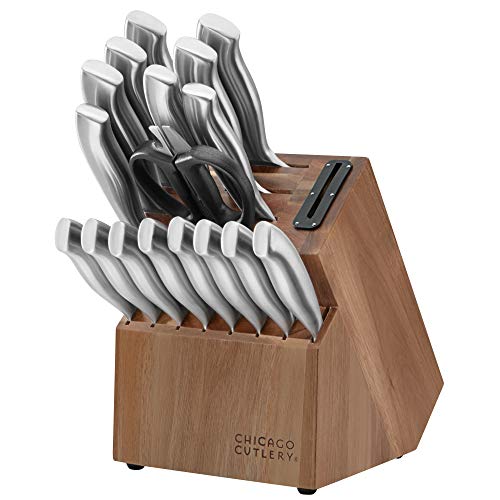
Why it stands out: The patented Guided Grip design naturally encourages a professional pinch grip, the forged blades are heavier and more balanced, and the full metal tang adds strength and control — this is the set I’d put my own money on.
The high-carbon stainless steel blades are stronger and harder than basic stainless, resisting stains, rust, and pitting. The signature 26-degree taper grind puts a fine, precise edge on every knife, which means out-of-the-box sharpness is likely excellent and honing is straightforward. The forged design gives each blade additional weight and balance — critical for a chef’s knife that needs momentum through dense vegetables. Contoured stainless-steel handles with the Guided Grip encourage a pinch grip, which is what professional chefs use for control.
The 18-piece set includes a block and likely every knife you’d ever need: chef, bread, utility, steak, paring, and maybe kitchen shears. The full metal tang runs through the handle, so prying or heavy cutting won’t snap the blade. My only gripe: the contoured stainless handle can feel cold and hard compared to wood, and if your hands are wet, it may slip. But that’s a minor trade-off for the precision this set offers. For anyone shopping at a knife store in Chicago, this is the set to hold first.
Pros:
- Patented Guided Grip — promotes a pinch grip for better control and less hand strain.
- High-carbon stainless steel — stronger, harder, and more rust-resistant than basic alloys.
- Forged construction — heavier, better balanced, and more durable than stamped blades.
- Full metal tang — provides strength and prevents handle breakage under stress.
- 26-degree taper grind — fine edge geometry for precise, clean cuts.
Cons:
- Stainless steel handles — can feel cold and slick; no texture for extra grip.
- Large set — 18 pieces means many knives will see rare use; requires ample storage.
- Premium priced — you pay for the forgings and grip technology, but it’s worth it if you cook daily.
Final Recommendation
Best for: Serious home cooks who want a complete, forged set that encourages professional technique and holds an edge. Skip if: You only need a single chef’s knife or prefer wooden handles.
Chicago Cutlery Chef Knife (The Mystery Blade)

Here’s the deal: This standalone chef knife has no specs at all — no blade length, no steel type, no handle material. That’s a huge risk for someone like me who obsesses over edge retention.
The listing is just the name. Without knowing if it’s an 8-inch or 10-inch blade, or whether the steel is high-carbon or basic, I can’t evaluate sharpness potential or durability. A chef’s knife is the workhorse of the kitchen, and buying one blind is like buying running shoes without trying them on. The only reason to consider this is if you find it at a physical store, inspect the tang, and ask the staff about the steel.
On the plus side, it’s a single knife, which many minimalists prefer over a set. If it happens to be their high-carbon stainless with a full tang, it could be excellent. But the absence of information makes this a pass unless you can verify in person. At a knife shop in Chicago, you could compare it side by side with other chef’s knives and check the edge with your thumbnail.
Pros:
- Single chef’s knife — the only knife most home cooks truly need, and no filler pieces.
- Potentially good steel — Chicago Cutlery often uses high-carbon stainless, so there’s hope.
- Simple purchase — no block to store, just one blade.
- Lower price point — individual knives cost less than full sets.
- Versatile — a chef’s knife handles chopping, slicing, and mincing with one tool.
Cons:
- No specifications at all — you cannot know the blade length, steel grade, or handle durability.
- Risk of soft steel — if it’s basic stainless, it’ll dull quickly and need frequent sharpening.
- No mention of tang — a partial tang would break under heavy use.
Our Take
Best for: Someone who can handle this knife in a store and verify it’s the real deal. Skip if: You’re ordering online and want any assurance of quality — choose the Insignia set instead.
Chicago Cutlery (USA-Made 8-Inch Chef Knife)

What stood out: This 8-inch chef knife is manufactured in the United States, a rarity in this price range, and the size is exactly what most home cooks need.
The listing says it’s an 8-inch chef knife, easy to use, and made in the USA. That last point matters: American manufacturing often correlates with better quality control and materials sourcing, though it’s not a guarantee. The 8-inch length is the sweet spot — long enough to slice through a watermelon, short enough to mince garlic without the tip wandering.
Unfortunately, the spec sheet omits the steel type and whether the blade is forged or stamped. For a blade sharpness perfectionist, that’s like listing a car without its engine specs. If it’s high-carbon stainless, this could rival German knives costing twice as much. If it’s basic stainless, it’s a disappointment. The USA origin gives me a little more confidence, but I’d still want to feel the balance and check the tang before buying. Many knife stores in Chicago stock USA-made blades, and you can ask to see the edge under a magnifying glass.
Pros:
- 8-inch chef knife — the most versatile blade length for daily prep.
- Manufactured in the United States — typically better QC and material consistency than overseas production.
- Single knife purchase — ideal for minimalists who don’t want a set.
- Easy to use — according to the listing, but that claim needs verification.
- Potential for high-quality steel — if Chicago Cutlery used their standard high-carbon alloy, edge retention should be solid.
Cons:
- Steel type not disclosed — you cannot know how long the edge will last.
- No information on tang — a partial tang would limit durability under heavy chopping.
- No handle description — could be uncomfortable or slippery, and you won’t know until it arrives.
The Real Story
Ideal for: Cooks who trust the USA label and need a single workhorse knife. Pass on this if: You insist on knowing steel composition before spending — choose the Insignia set with full specs.
Chicago Cutlery 3 Boning and Paring Knife (Full-Tang Detail Work)

Quick take: This 3-inch slant tip paring knife has full metal tang and high-carbon stainless steel, making it the most detailed and well-built paring knife in this lineup.
The high-carbon stainless steel resists rust, stains, and pitting, while the 25-degree taper grind gives a slightly less acute angle than the 26-degree on the Insignia, but still fine enough for precise paring and boning work. Triple brass rivets secure the walnut handle, and the full metal tang means the blade runs end to end — you can apply more force without fear of snapping.
This is a knife you buy once and keep for decades if you hand wash and oil the handle. The 3-inch blade is ideal for peeling apples, trimming silver skin, or boning a chicken breast. It’s not a chef’s knife, so you’ll pair it with a larger blade, but for detailed work, this one outperforms the polymer-handled paring knife at the top of the list. If you’re at a knife store in Chicago, hold this one next to a cheaper parer — the weight difference from the full tang is immediate.
Pros:
- High-carbon stainless steel — excellent edge retention and corrosion resistance.
- Full metal tang — provides stability and balance, reducing the chance of blade snap.
- Triple brass rivets — secure the walnut handle firmly for long-term durability.
- 25-degree taper grind — precise angle for clean cuts without tearing.
- Walnut handle — classic look, comfortable, and naturally grippy when dry.
Cons:
- Small blade — limited to paring, peeling, and light boning; not for chopping.
- Walnut requires care — hand wash and immediate drying, plus occasional oiling.
- Single knife — you’ll still need a chef’s knife for most tasks.
Why It Stands Out
Perfect for: Cooks who do a lot of detail work and want a paring knife with premium build quality. Think twice if: You need an all-purpose blade — this is a specialist, not a generalist.
What to Look For When Buying Knives in Chicago Stores
When you walk into a knife store in Chicago, you’re not just buying a blade — you’re buying a tool you’ll use daily for years. The right choice depends on three factors: steel, construction, and ergonomics. And before you reach for a block set, consider whether you actually need 16 knives or just one great chef’s knife.
Blade Steel: High-Carbon vs Basic Stainless
High-carbon stainless steel contains more carbon than basic stainless, which allows the blade to get harder during heat treatment. Harder steel holds a sharper edge longer and resists rolling or chipping. The American Society for Testing and Materials (ASTM) publishes standards for blade steel hardness testing, which manufacturers use to ensure consistency. Look for ‘high-carbon’ in the product name or description. All the good picks above — the Insignia, the B42 set, the full-tang paring knife — either state high-carbon stainless or come from a brand known for it. If a listing doesn’t mention steel type, assume basic stainless and expect to sharpen more often.
Forged vs Stamped: Does It Matter?
Forged blades are heated and pounded into shape, aligning the steel’s grain structure and producing a denser, heavier, more durable knife. Stamped blades are cut from a sheet of steel like a cookie cutter — faster and cheaper, but often softer and less balanced. The International Organization for Standardization (ISO 8442) covers materials and performance requirements for kitchen knives, including edge retention and handle strength. Forged knives cost more but last longer. The Insignia set is explicitly forged; the B42 set likely is not. If you can’t tell, pick up the knife — a forged blade feels heavier in the hand and has a bolster where the blade meets the handle.
Handle Ergonomics and Grip
A comfortable handle matters more than blade steel for all-day prep. Walnut handles look classic and feel warm but need oiling and immediate drying. Polymer handles are low-maintenance but can get slippery. Stainless steel handles are cold and hard but very durable. The Insignia’s Guided Grip encourages a pinch grip, which gives you more control than a full-hand grip. Test this in person: hold the knife in a pinch grip and see if your fingers rest naturally. If you’re prepping a beef blade steak roast, you’ll want a secure grip for clean slices through meat.
Sets vs Single Knives: What Should You Buy?
A single 8-inch chef’s knife handles 80% of kitchen tasks. Add a paring knife and a bread knife and you’ve covered 95%. Sets like the Avondale 16-piece or the Insignia 18-piece give you every blade imaginable, but most sit unused. The B42 3-piece set is the sweet spot — chef, utility, and parer without filler. If you’re cooking a garlic herb roast chicken, an 8-inch chef’s knife is all you need for breakdown and carving. Don’t pay for ten knives when three will do.
Our Final Recommendation
For most home cooks, the Chicago Cutlery B42 Walnut Tradition Knife Set 3-Piece is the best budget pick: three essential knives without filler. If you want the best edge retention and a complete setup, the Insignia Guided Grip 18-piece set is the overall winner with forged blades, full tang, and a grip that improves your technique. Buy the standalone 8-inch USA-made chef knife only if you can verify its steel in person. Otherwise, spend your money on the Insignia — it’s the one I’d put in my own kitchen.
Frequently Asked Questions
What’s the best knife shop in Chicago for sharpening services?
Many independent kitchen stores in Chicago offer in-house sharpening or can recommend a local professional. Stores that sell high-carbon steel knives often provide free sharpening for the first year or discounted services afterward. Call ahead and ask if they sharpen serrated blades — many don’t. If you buy a forged set like the Insignia, sharpen it professionally once a year and hone at home weekly.
How long should a good chef’s knife last?
With proper care, a high-carbon stainless steel chef’s knife with a full tang can last 20 years or more. The blade will need sharpening periodically, but the steel itself rarely fails. Avoid prying bones or frozen food, and never dishwash a wooden-handled knife. The B42 set or the standalone USA-made chef knife should serve a lifetime if maintained.
Do Chicago Cutlery knives hold an edge well?
That depends on the specific line. Models listed as high-carbon stainless steel — like the Insignia, the B144 steak knife 2-pack, and the full-tang paring knife — should hold an edge longer than basic stainless. Sets without steel specifications, like the Armitage or the single 4-piece steak set, are riskier. Always check for the words ‘high-carbon’ before buying.
Is it better to buy a knife set or a single chef’s knife?
For most people, a single 8-inch chef’s knife plus a paring knife covers nearly everything. Sets like the Avondale give you more knives than you’ll use, but the B42 3-piece set includes exactly the three you need. If you cook daily and want matching knives, a forged set like the Insignia is worth it. Otherwise, invest in one great chef’s knife.
Can I test knives at a store before buying?
Yes, most reputable kitchen stores will let you handle knives and may even have a cutting board for test cuts. Check the balance by resting the knife on your finger at the bolster — a well-balanced chef’s knife should tip slightly toward the blade. Ask about the steel type and whether the tang runs through the handle. If the staff can’t answer, shop elsewhere.