



Nothing kills the mood on a successful hunt faster than a blade that folds halfway through a deer’s hip joint, or a bargain kit that shows orange rust freckles before the season closes. Most game knives sold online are soft stainless dressed up with a flashy handle and an edge that quits on the first tough tendon. The steel and the grind decide everything here, and the marketing almost never tells you either number.
Out of all four, the ESEE Ashley Game Skinner is the one I’d stake my own money on — the 1095 high carbon steel and the plainly stated specs are why. Want the short version? That’s it. Want to know what fits your pack and your budget? Keep reading.
📌 This article contains affiliate links. As an Amazon Associate I earn from qualifying purchases, at no extra cost to you. Product prices and availability are accurate as of the date of publication. Full disclosure.
| Product | Best For | Buy Link |
|---|---|---|
| ESEE Ashley Game Skinner | Serious skinning | Check Price |
| Outdoor Edge WildLite 6-Piece | Balanced field kit | Check Price |
| GVDV 15-Piece Set | Budget completeness | Check Price |
| KNINE Outdoors Dressing Kit | Full processing | Check Price |
What Separated These Picks From The Rest
These four came out of comparing published steel types, blade hardness, dimensions and documented handle features against the one thing that decides a hunting blade’s worth: edge retention. That’s set by blade hardness, grind angle and carbide structure — soft alloys roll over on gristle and bone, and a dull edge tears hide instead of parting it cleanly. I weighted steel type and stated Rockwell hardness most heavily, because a knife you resharpen every twenty minutes in the cold is a knife you’ll leave home. Next came handle grip and field visibility, since a blood-slick handle is a safety problem, not a comfort one. Blade count mattered least; a fifteen-piece box impresses on a screen and gathers dust in a truck. One thing to confirm yourself before ordering: check whether the listing actually names the steel and its hardness. If a set won’t say, assume the cheapest alloy that fits the price. None of these were handled or field-dressed with — this is spec-sheet judgment, stated plainly.


ESEE Ashley Game Skinner (1095 Carbon Steel)
Why it made our list: The hunter who wants one honest blade that outlasts three cheap sets, and doesn’t mind wiping it down after use.
This is a lean, purpose-built skinner at 8.25 inches overall with a 3.5-inch blade and a .156-inch spine, tipping the scale at just 5.1 ounces. That short, controllable blade is exactly what you want when you’re separating hide from muscle rather than hacking through joints. Light in the hand, easy to steer with your fingertips near the edge.
The real story is the steel. 1095 high carbon steel at 55-57 Rc sits on the softer, tougher end of the hardness scale, which means it takes a frighteningly keen edge and lets you bring that edge back with a few passes on a stone in the field. Softer carbon won’t chip on bone the way a brittle, over-hardened blade can. The catch is honest and unavoidable, and it’s the same one every 1095 blade carries.
Pros:
- 1095 high carbon steel — takes a razor edge and resharpens fast on a pocket stone, even with cold hands.
- 3.5-inch blade length — short enough for precise skinning control around the pelvis and shoulders.
- .156-inch thick spine — stout enough to lean on without flexing when you hit a tough seam.
- Included sheath at 5.1 ounces — packs light and rides on a belt without dragging.
Cons:
- Carbon steel rusts — 1095 will spot and patina if you sheath it wet; it needs a wipe and a film of oil after every use.
- It’s a single knife — no boning blade, no gut-hook, so you’re buying a skinner, not a processing kit.
Who Should Buy This
Great match for: The buyer who values one blade that holds and restores a real edge over a drawer of gadgets. Think twice if: You want a grab-and-go set that survives neglect — carbon steel punishes people who put it away dirty.
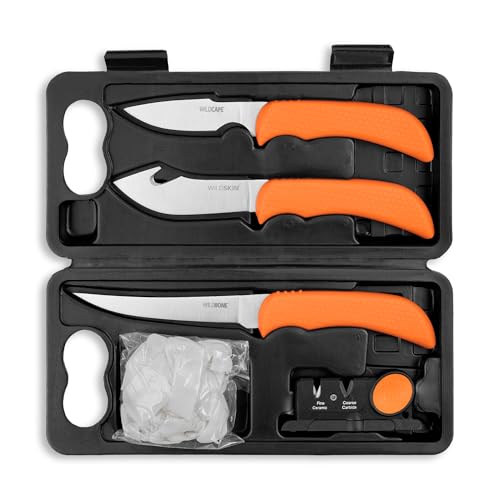
Outdoor Edge WildLite 6-Piece Field to Freezer Set
Quick take: The hunter who wants a matched set of fixed blades that stay findable when they’re dropped in leaf litter or slick with blood.
This is a 6-piece fixed-blade set built around the tools that actually get used from gut pile to freezer, and its standout feature is grip. The rubberized, nonslip TPR handles in blaze orange are the smart detail here: high-visibility color so a dropped knife doesn’t vanish, plus a textured surface that stays put when your hands are wet. Ergonomically shaped to cut hand fatigue when you’re an hour into processing.
Fixed blades over folders is the right call for game work, since there’s no hinge to trap tissue and no lock to fail under load. Where I’d push back is on the spec sheet itself. The listing calls the knives razor sharp and well balanced, all true and useful, but it never states the steel type or the hardness — and for edge retention, that’s precisely the number you’d want before spending. Compared to the ESEE, you gain coverage and lose transparency.
Pros:
- Six fixed blades — covers caping, skinning and boning without swapping a single tool.
- Blaze-orange TPR handles — easy to spot in brush and grippy when covered in fat or blood.
- Ergonomic handle shaping — built to reduce hand fatigue over a long processing session.
- Balanced fixed-blade design — no folding joints to pack with tissue or work loose.
Cons:
- Steel type is never stated — with no alloy or Rockwell figure listed, edge retention is a guess until you own it.
- Six fixed blades take space — more sheaths and storage than a solo skinner or a folder.
Our Take
Ideal for: Hunters who process in low light or wet conditions and want handles they won’t lose. Pass on this if: You need to know your steel before you buy — the listing won’t tell you.
GVDV 15-Piece Hunting Knife Set (5Cr15MoV Stainless)
Here’s the deal: The first-time hunter or gift-buyer who wants every conceivable tool in one case for the least money.
Fifteen pieces is the headline, and the appeal is obvious: gutting, skinning and processing tools all boxed together for a beginner who doesn’t yet know what they’ll actually reach for. The blades are 5Cr15MoV high carbon stainless steel, heat treated, with a finger-concave ergonomic handle that gives a positive index point so your hand knows where the edge is.
Now the honest part. 5Cr15MoV is a soft, corrosion-friendly stainless — it shrugs off rust far better than the ESEE’s 1095, but it won’t hold an edge nearly as long, so plan on frequent touch-ups during a big processing job. As a no-nonsense tool evaluator, I’ll say it straight: a lot of those fifteen pieces are single-task filler you’ll never carry into the woods. If you already know your workflow, a tighter kit beats a crowded case.
Pros:
- 15-piece completeness — nothing missing for gutting, skinning and quartering a deer.
- 5Cr15MoV stainless — resists rust and neglect far better than carbon steel.
- Finger-concave handles — give a consistent grip index so the edge stays oriented.
- Comes cased — stores and travels as one organized unit.
Cons:
- Soft edge retention — 5Cr15MoV dulls quickly on hide and bone and needs regular sharpening.
- Padded piece count — several tools are single-task extras most hunters won’t use.
Final Thoughts
Perfect for: Newcomers who want the full toolkit at a friendly price. Not great if: You value edge-holding over sheer numbers — this steel trades one for the other.
KNINE Outdoors Field Dressing Kit (7Cr17MoV Steel)
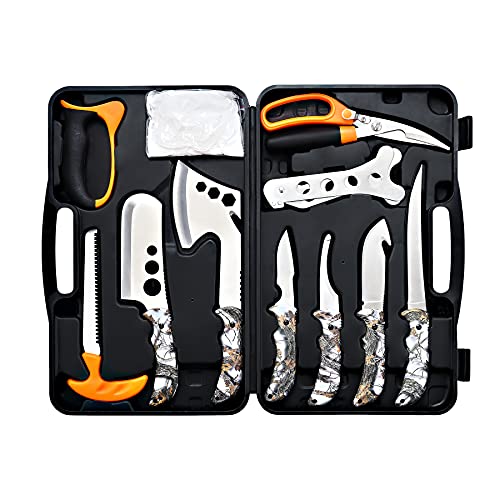
What stood out: The hunter who processes their own animals start to finish and wants a butcher axe in the same kit as a caping knife.
This set leans into full processing. It bundles a 12-inch boning knife, a gut-hook skinner, a hawkbill blade, a caping knife and a gut-hook butcher axe — genuinely different tools for genuinely different cuts, not five near-identical blades. The 7Cr17MoV steel is a step up in carbon content from the GVDV’s 5Cr15MoV, so on paper it should take and hold a slightly better edge while keeping stainless corrosion resistance.
The manufacturer states the blades are heat-treated seven times for hardness, though no Rockwell figure is given, so treat that as marketing rather than a number you can compare. My one real gripe is the handles. They’re ergonomic and nonslip, which is good, but the black-and-blue camo coloring is the opposite of the Outdoor Edge’s blaze orange — drop one in the field and you’ll be on your knees hunting for it. That butcher axe, though, is a legitimately useful inclusion for splitting a pelvis or sternum.
Pros:
- Distinct tool set — boning, caping, hawkbill and gut-hook blades each do a different job.
- 7Cr17MoV steel — higher carbon than basic 5Cr alloys for a modestly better edge.
- Gut-hook butcher axe — handles splitting work a knife alone struggles with.
- Nonslip camo handles — grippy in wet, messy conditions.
Cons:
- Camo handles hide when dropped — poor field visibility compared to a blaze-orange set.
- No hardness stated — “seven times heat-treated” tells you nothing measurable about edge retention.
Why It Stands Out
Best for: DIY processors who quarter and butcher their own game and want the axe included. Skip if: You hunt where a dropped dark-handled knife is gone for good.
How to Choose Game Knives That Earn Their Keep
The gap most hunting-knife listings leave wide open is the one that matters most, so let’s close it. A blade is only as good as the steel it’s ground from and the grip that keeps it under control when things get slippery.
The Steel Is the Whole Story
Edge retention lives and dies on blade hardness and carbide structure. 1095 high carbon steel at 55-57 Rc, like the ESEE, sharpens easily and won’t chip, but it rusts if you neglect it. Stainless alloys like 5Cr15MoV and 7Cr17MoV resist corrosion and forgive lazy owners, at the cost of holding an edge for shorter stretches. Any set that won’t publish its steel or hardness is telling you something by its silence.
Multi Function Hunting Knives vs One Great Blade
This is the real fork in the road. Multi function hunting knives and full sets, like the GVDV and KNINE kits, hand you a tool for every cut and a case to store them. A single purpose-built skinner like the ESEE asks you to sharpen and maintain one blade you’ll actually master. If you process whole animals, the set wins; if you want one knife that outlives everything else in the drawer, buy the better steel. If you also outfit your kitchen, the same logic shows up in our breakdown of budget Japanese chef knives worth owning, where steel hardness decides value there too.
Grip, Visibility and Field Safety
A blood-slick handle is a laceration waiting to happen, which is why nonslip TPR and textured grips matter more than looks. High-visibility handles, like the Outdoor Edge’s blaze orange, also keep a dropped knife findable. Clean tools matter for more than the edge: the USDA publishes handling guidance for wild game to reduce contamination risk, and the CDC notes that field dressing with clean, sharp equipment lowers the chance of spreading pathogens from animal to meat. A sharp blade is a safer blade — it goes where you aim instead of skating off tough hide.
Our Final Recommendation
For the overall win, the ESEE Ashley Game Skinner takes it — real 1095 steel at a stated 55-57 Rc beats mystery alloys every time, and one great blade outlasts a box of soft ones. On the budget end, the GVDV 15-Piece Set gives newcomers every tool at a friendly price, provided you accept frequent sharpening. If you process whole animals and want a matched kit with honest grip, the Outdoor Edge WildLite 6-Piece is my runner-up. The KNINE kit earns a nod for including a butcher axe, but those camo handles cost it in the field.
Frequently Asked Questions
How do I keep a high carbon game knife from rusting?
Wipe the blade dry immediately after use, never sheath it wet, and rub on a thin film of food-safe mineral oil before storage. The ESEE’s 1095 steel will spot within hours if you skip this. Forcing a stable patina with vinegar or mustard also helps by replacing reactive red rust with a protective oxide layer that shields the surface.
Are 15-piece game knife sets actually worth it, or just padding?
For a first-time hunter, a big set like the GVDV is useful because you learn which tools you reach for. Experienced processors usually find several of the fifteen pieces are single-task filler that stay in the case. Buy the count for the variety and the price, not for the assumption that more blades means better blades — steel quality does not scale with piece count.
What steel holds an edge longest for field dressing?
Among these, the ESEE’s 1095 high carbon at 55-57 Rc takes the keenest edge and restores fastest, though it needs oiling. Between the stainless sets, 7Cr17MoV edges out 5Cr15MoV thanks to slightly higher carbon content. Neither stainless alloy is a premium edge-holder, so expect to touch them up partway through a large deer or elk.
Do game knives need to be razor sharp straight out of the package?
Ideally yes, since a sharp edge parts hide cleanly and skates less, which is safer. Most game knives ship with a factory edge that’s serviceable but rarely optimal, so plan to hone them on a stone before opening day. Regardless of steel, a quick strop before each session keeps the edge biting and reduces the ragged cuts that spoil meat.