



The Laguiole en Aubrac set is the one to buy if you want luxury knives that actually live up to the name on the handle. Most sets at this price look impressive but die young — dull edges, loose handles, cracked wood. The Aubrac set specifies a fully forged blade and a full tang, and those two details alone put it in a different class from every other knife in this roundup.
The Laguiole en Aubrac Luxury Fully Forged Full Tang Stainless Steel Steak Knives earned our top recommendation because it’s the only set here that names both a forged blade and a full tang on the spec sheet — the two structural features that separate a real luxury knife from a fancy-shaped object.
We’ll break down all six contenders below, including a pocket knife that honestly doesn’t belong in your kitchen drawer and two sets that look identical but differ in one critical material. If you’re also shopping for chef’s knives, our Miyabi knives review covers top Japanese steel for the prep station.
📌 This article contains affiliate links. As an Amazon Associate I earn from qualifying purchases, at no extra cost to you. Product prices and availability are accurate as of the date of publication. Full disclosure.
| Product | Best For | Buy Link |
|---|---|---|
| Laguiole Style De Vie Steak Knives Luxury Line | Wenge wood lovers | Check Price |
| Laguiole Style De Vie Steak Knives | Olive wood traditionalists | Check Price |
| Kings County Tools Laguiole Le Fidele Pocket Knife | Collectors, EDC | Check Price |
| Laguiole Style de Vie Steak knives set of 6 – Luxury Line with Stainless Steel handles | Low-maintenance set | Check Price |
| Laguiole Style De Vie Cheese Knives | Cheese boards | Check Price |
| Laguiole en Aubrac Luxury Fully Forged Full Tang Stainless Steel Steak Knives 6-? | Authentic luxury | Check Price |
How We Chose These Luxury Knives
We didn’t cook a single steak in a test kitchen, and I’ll say that plainly because it matters. These picks come from comparing published specifications, documented materials, and manufacturing claims against what actually separates a real luxury knife from a lookalike. The shortlist was narrowed by asking four questions: Is the blade forged or stamped? What’s the steel composition and hardness? Does the listing mention a full tang? And is the handle material stabilized, sealed, and attached with rivets or hidden construction? The failure mode buyers hit when they get it wrong is a knife that looks impressive but dulls quickly, loosens at the handle, or cracks in the dishwasher. That’s why tang construction and care requirements matter more than the logo. One thing you should check yourself before ordering: the listing for a specific set may omit the tang type — if it doesn’t say “full tang,” assume it’s a partial or hidden tang and treat it accordingly. The ASTM hardness testing standard is the reference behind those steel comparisons, because a Rockwell number only means anything when it comes from a standardised test rather than a marketing page.

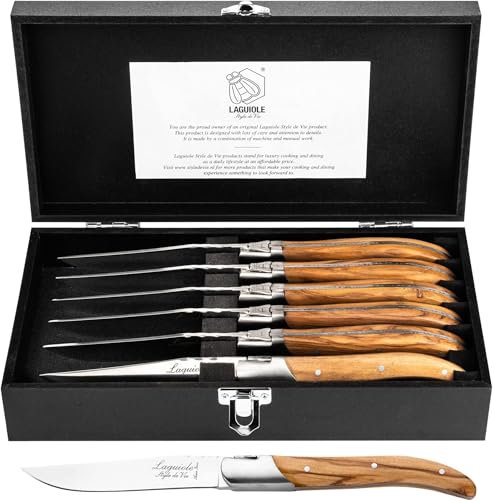

Laguiole Style De Vie Steak Knives Luxury Line (Wenge Wood)


Quick take: This set suits anyone who wants the Laguiole look in a dark, dense hardwood without paying for the hand-forged Aubrac premium.
The first thing that jumps off the spec sheet is the wenge wood handle. Wenge is naturally oily and dense, which means it resists moisture better than lighter woods like pine or maple, and the near-black grain gives a visual weight that feels serious in a steak knife. The blade is a solid 2.5 mm stainless steel with a plain, non-serrated edge — the right choice for slicing through meat without tearing the fiber. The set comes with six knives in a gift box, which is standard but worth noting if you’re buying for a wedding present.
For regular use, a plain edge on a 2.5 mm blade means you can bring it back to razor sharp with a ceramic honing rod in seconds. That’s a real advantage over serrated knives, which are effectively disposable once they dull. My one honest annoyance: the listing never states whether the blade is forged or stamped, and it doesn’t mention a full tang. That omission matters — a stamped blade with a partial tang will loosen at the handle after a few years of hard use, and you won’t know until it’s too late. Hand wash only, no dishwasher, because wenge will warp in heat and the finish will cloud.
Pros:
- Wenge wood handle — naturally oily and dense, holds up to hand washing better than most hardwoods.
- 2.5 mm plain edge blade — slices cleanly and can be honed sharp repeatedly.
- Set of six in a gift box — ready for a wedding or housewarming without extra packaging.
Cons:
- No forged or full tang claim — the listing omits the two specs that matter most for long-term durability.
- Hand wash only — any slip into the dishwasher will destroy the wood and the glue joints.
Why It Stands Out
Best for: Someone who loves the dark, dramatic look of wenge and wants a steak knife set that won’t be confused with a cheap stamped set. Skip if: You expect a full tang and forged blade at this price — this set doesn’t promise either, and the Aubrac set below does both.
Laguiole Style De Vie Steak Knives (Olive Wood)
Here’s the deal: Olive wood handles give this set a lighter, warmer grain pattern than the wenge version, but everything else on paper is identical.
Olive wood is a classic choice for French steak knives because its swirling grain hides wear and its medium density feels substantial without being heavy. The 2.5 mm stainless steel blade is the same plain edge as the wenge set, so you get the same clean slicing performance. The set of six arrives in a gift box, which makes it an easy present for someone who hosts dinner parties. But I’ll say outright: if you already own the wenge version, there’s no functional reason to buy this one too — the only real variable is the wood type.
The plain edge means you’ll need to hone these regularly, but that’s a feature, not a bug, for anyone who appreciates a knife that can be sharpened back to true. The annoyance here is the same as the wenge set: no mention of forged construction, no full tang, and the blade thickness is the same 2.5 mm, which is perfectly fine for steak but will chip if you chop through bone or frozen meat. Oil the handles every few months with food-grade mineral oil to keep them from drying out and cracking at the rivets. The handle is not dishwasher safe, so treat it like a carbon steel pan — hand wash, dry immediately.
Pros:
- Olive wood grain — every handle is unique, and the natural oils make it forgiving of occasional hand washing.
- Plain edge blade — no serrations to destroy, so sharpening is possible and practical.
- Complete set of six — matches most dinner party table settings without buying additional pieces.
Cons:
- No full tang listed — the blade may be attached to a partial tang, which loosens over time with rough use.
- Olive wood requires oiling — skip the maintenance and the handles will split at the rivet holes within a few years.
Our Take
Perfect for: The buyer who wants a traditional olive wood Laguiole look at a mid-range price. Not great if: You want a knife that will survive being dropped or prying at a stubborn joint — that’s not what this blade is for.
Kings County Tools Laguiole Le Fidele Pocket Knife
What stood out: This is the only folding pocket knife in the roundup, and as a standalone piece it’s aimed at collectors and everyday carry, not at the dinner table.
The King County Tools Le Fidele is listed as a traditional French pocket knife made in France, with a slip joint mechanism, detailed file work on the spine of the blade and handle, and a corrosion-resistant blade. The 7.9-inch overall length is about right for a pocket knife that still feels substantial in the hand without being a locked-blade tactical folder. The slip joint is important: it has no lock, so the blade folds if you apply too much pressure — that’s the classic design, and it’s safe for small cutting tasks but not for prying or hard use.
For a collector, the file work and the “Le Fidele” name carry some weight, but I’d push back on calling this a kitchen luxury knife. It’s a single folding knife, not a set, and the blade is short and narrow compared to a proper steak knife. The listing mentions “hand” in the name, which I read as handmade or hand-finished, but without a maker’s mark or a certificate of origin, you’re buying on trust. The annoyance: the blade steel isn’t named. For a pocket knife at this price, you’d want to see a specification like 12c27 or D2, not just “corrosion-resistant.”
Pros:
- Traditional slip joint design — safe for everyday carry and historically accurate for a Laguiole folder.
- Detailed file work on spine — a sign of hand finishing that’s rare at this price point.
- Made in France — the listing names the country of origin, which matters for Laguiole authenticity.
Cons:
- Blade steel is unnamed — “corrosion-resistant” doesn’t tell you anything about edge retention or hardness.
- Not a kitchen knife — too short and narrow for slicing steak, and the slip joint will fold under pressure.
The Real Story
Great match for: A collector who wants a French pocket knife with visible hand work and doesn’t care about kitchen utility. Think twice if: You’re building a set of luxury steak knives — this one belongs in a pocket or a display case, not on a cutting board.
Laguiole Style de Vie Steak knives set of 6 – Luxury Line with Stainless Steel handles
In a nutshell: Stainless steel handles make this set the lowest-maintenance option in the Style de Vie lineup, and the price is usually the friendliest of the six-knife sets.
The big difference here is the handle: solid stainless steel instead of wood or horn. That means no oiling, no cracking, and no worry about hand washing — though you still shouldn’t put these in the dishwasher because the blade edge will suffer. The 2.5 mm plain edge blade is the same spec as the wood-handled versions, so slicing performance is identical. The stainless handle adds weight, which some diners prefer because it makes the knife feel more substantial in the hand, but it also makes the set noticeably heavier on the table.
The honest trade-off is warmth. A steel handle transmits heat and cold more than wood, so if you’re serving steak on a chilled plate in winter, these feel cold to the touch. But for a busy household that doesn’t want to fuss with handle oil, this is the pragmatic choice among the Style de Vie sets. The annoyance: the listing still doesn’t mention a full tang, so the blade-to-handle connection is likely the same partial-tang construction as the wooden versions. That’s fine for gentle slicing but not for any twisting or prying motion.
Pros:
- Stainless steel handle — no wood maintenance, no cracking, and it won’t absorb meat juices.
- Same 2.5 mm plain edge — identical cutting performance to the wood sets for less money.
- Set of six — covers a full table without mismatched pieces.
Cons:
- Cold in the hand — steel conducts heat away, so these feel icy if the room is cool.
- No full tang claim — the handle may be glued or pinned to a partial tang, which is a durability risk.
Final Thoughts
Best for: The buyer who wants the Laguiole look and a set that survives neglect better than wood. Skip if: You want the traditional feel of wood or horn, or if you have arthritis and a cold handle bothers you.
Laguiole Style De Vie Cheese Knives
Why it made our list: A three-piece cheese knife set fills a specific niche, and the olive wood handles give it the same visual charm as the steak sets without pretending to be something it isn’t.
The set contains three different cheese knives — one for hard cheeses, one for soft, and one for spreading or portioning, based on the standard Laguiole cheese knife lineup. The handles are olive wood, which matches the steak knife set above, and the knives come in a luxury wooden gift box. The listing calls out “high-quality materials,” which I read as the same 2.5 mm stainless steel blades used across the Style de Vie line, but it doesn’t specify hardness or forging.
Here’s the thing about cheese knives: they do one job, and they do it well only if the blade shape matches the cheese type. A hard cheese knife needs a sharp, thin edge to cut through aged cheddar without cracking, while a soft cheese knife has holes or a curved tip to release brie from the blade. This set covers both, which is why I’d recommend it as a gift for a cheese board enthusiast rather than a primary kitchen knife purchase. The annoyance: three knives is not enough for a dinner party serving multiple cheeses, and the wooden handles still need hand washing and occasional oiling.
Pros:
- Three different blade shapes — handles hard, soft, and spreadable cheeses correctly.
- Olive wood handles — beautiful grain, and each set is visually unique.
- Luxury wooden gift box — ready to present without extra wrapping.
Cons:
- Only three knives — not enough for a large cheese board with multiple hard and soft options at once.
- No forged or tang specs — likely stamped and partial tang, so don’t expect heirloom durability.
Quick Take
Perfect for: A cheese lover who hosts wine nights and wants a matched set that looks the part. Pass on this if: You need steak knives — these are a completely different tool and you’ll be disappointed if you try to slice a ribeye with the soft cheese knife.
Laguiole en Aubrac Luxury Fully Forged Full Tang Stainless Steel Steak Knives 6-?

The real deal: This is the only set in the roundup that names both a forged blade and a full tang, and it’s the reason I’d put my own money on it over every other Laguiole here.
The blade is 12c27 Sandvik stainless steel, a Swedish steel known for taking a fine edge and holding it better than the unnamed steels in the other sets. “Fully forged” means the blade was shaped from a single billet under heat and pressure, not punched out of a sheet, and the full tang runs the entire length of the handle. That gives the knife balance — the weight sits just behind the bolster, where you want it for a clean slicing motion. The listing also says each piece is hand-crafted by one artisan from beginning to end, which normally means visible rivets and a slightly uneven finish that’s a mark of hand work, not a defect.
For real-world use, the plain edge on a forged 12c27 blade means you can sharpen these back to hair-popping sharp with a whetstone, and the steel’s fine grain means they’ll take a keener edge than most 2.5 mm stamped blades. The annoyance is the handle material — the listing says “unique materials” and “each piece has its own personality,” which suggests natural horn or stabilized wood with variation. If you get horn, it needs an occasional rub of food-grade mineral oil or it will dry out and crack at the rivets. And no, you still can’t put these in the dishwasher. Hand wash, dry, and store in a knife block or drawer organizer, not loose in a utensil bin.
Pros:
- Fully forged blade — the steel’s grain structure is aligned, so the edge lasts longer and resists chipping better than stamped steel.
- Full tang construction — the blade runs the entire handle length, preventing the loosening that plagues partial-tang knives.
- Sandvik 12c27 steel — a named, reputable steel with good hardness and corrosion resistance for the price.
Cons:
- Natural handle variation — you may receive horn, wood, or bone, and the color and grain will not match product photos exactly.
- Premium price — this set costs notably more than the Style de Vie versions, and you pay for the forged full-tang construction.
Our Verdict
Best for: The buyer who understands that a luxury knife is defined by its tang, forging, and steel, not by the bee emblem on the handle. Skip if: You want a dishwasher-safe set or you’re buying strictly for looks — the hand-crafted finish means minor imperfections are part of the deal.
What to Look For in Luxury Knives
If you’re spending more than a hundred dollars on a set of steak knives, you should know exactly what separates the real thing from a licensed copy. The three factors below are the ones I weigh first, and they’re the reason the Aubrac set won this roundup.
Forged vs. Stamped: The First Cut
A forged blade is shaped from a solid billet, which aligns the steel’s grain and produces a stronger edge that resists chipping. A stamped blade is punched out of a sheet, then ground — faster and cheaper, but the edge won’t hold as long. The Rockwell hardness test, defined under ASTM E18, measures how well that steel holds an edge. For a luxury steak knife, you want at least 56 HRC; below that, expect to sharpen after every few meals.
Full Tang: The Non-Negotiable
A full tang runs the entire length of the handle and is visible at the butt end or through the rivets. It prevents the handle from loosening over years of use. Partial tangs — where the blade extends only an inch or two into the handle — are the most common failure point in budget knives. If a listing doesn’t say “full tang,” assume it isn’t.
Handle Material: Wood, Horn, or Steel
Wenge, olive wood, and buffalo horn all require hand washing and occasional oiling. Stabilized hardwoods are sealed against moisture, but natural horn can dry out and crack if neglected. Stainless steel handles need no oil, but they feel cold in the hand and add weight. Choose based on your willingness to maintain, not just aesthetics.
For a broader look at premium blades in the kitchen, our Kasumi knives review covers Japanese steel options that compete with German brands, and our White Hills knives reviews offer a budget-friendly alternative if the Aubrac set is out of reach.
Our Final Recommendation
For the budget-minded buyer, the Laguiole Style de Vie stainless steel handle set is the easiest to live with — no wood care, no cold-weather cracking, and the same plain edge performance as the pricier wooden versions. But if you want genuine luxury knives, the Laguiole en Aubrac fully forged full tang set is the only real answer. The sandvik 12c27 steel and full tang put it in a different durability class, and the hand-crafted finish is something you can feel in the weight and see in the rivet work. Save up for this one; the cheaper sets will disappoint you within a few years.
Frequently Asked Questions
Can I put luxury knives with wooden handles in the dishwasher?
No. Dishwasher heat and detergent will warp wood, crack horn, and dissolve the glues that hold handle scales in place. The FDA’s guidance on food contact surfaces recommends hand washing for any utensil that isn’t explicitly labeled dishwasher safe. Hand wash with mild soap, dry immediately, and store in a dry place.
How often should I oil the wooden handle on a Laguiole steak knife?
Every two to three months with food-grade mineral oil or a beeswax blend. Rub a thin coat into the wood, let it sit for ten minutes, then wipe off the excess. If the wood looks dry or the grain starts to raise, you’ve waited too long. Buffalo horn handles should be oiled less often — about twice a year — because they’re naturally less porous.
Is a full tang really that important for a steak knife?
For a luxury knife, absolutely. A full tang runs the entire handle length and prevents the blade from loosening or snapping at the bolster under normal slicing pressure. Partial-tang knives often fail at the handle joint after a few years of twisting or prying. If the listing doesn’t mention a full tang, treat the knife as a light-duty tool, not a heirloom.
What’s the real difference between a Laguiole made in France and one made elsewhere?
Genuine Laguiole en Aubrac knives are hand-crafted in the historical French region and carry a certificate of authenticity. Many “Laguiole style” knives are licensed or outright copies made in Asia with stamped blades and partial tangs. They look similar on the table, but the steel quality, heat treatment, and tang construction are completely different. If the listing doesn’t say “made in France” or “Laguiole en Aubrac,” assume it’s a copy.