



Plenty of people shopping for japanese fighting knives end up with a $40 stainless tanto that can’t hold an edge past one afternoon of yard work. The category is flooded with decorative blades dressed up as tactical tools, and telling the difference from a product photo is nearly impossible. The principles of edge geometry and knife safety always apply: steel type, tang construction, and sheath retention matter more than any dragon engraving.
If you want to skip the research, my pick is the Purple Dragon Tanto Knife with Sheath — a full-billet D2 blade with a G10 handle that actually earns the ‘fighting knife’ label, not just borrows it.
Before you spend anything, know that these are combat and utility knives, not chef knives. Our kitchen guides for pot roast onion soup mix oven or beef blade steak roast cover the slicing and dicing you’d do on a cutting board. The blades below are for defense, survival, or collection — and the wrong pick can be a liability, not an asset.
📌 This article contains affiliate links. As an Amazon Associate I earn from qualifying purchases, at no extra cost to you. Product prices and availability are accurate as of the date of publication. Full disclosure.
| Product | Best For | Buy Link |
|---|---|---|
| Tanto: Japanese Knives and Knife Fighting | Reference guide | Check Price |
| Leopcito 11.5″ Japanese Fixed Blade Tactical Knife | Budget stainless carry | Check Price |
| Dream Reach Japanese Tanto Knife | Traditional carbon tanto | Check Price |
| FUSIONKEI Japanese Tanto Knife | Clay-tempered collectible | Check Price |
| Freelander Japanese Fixed Blade Knife | Heavy-duty D2 survival | Check Price |
| Purple Dragon Tanto Knife | Full-tang D2 fighter | Check Price |
How We Chose These Japanese Fighting Knives
We started with a simple rule: a fighting knife has to survive stress, not just look good in a photo. That meant comparing published specifications — blade steel, heat treatment, tang construction, sheath material, and handle ergonomics — against what actually matters in a defensive or survival tool. The decisive factors are blade steel type and heat treatment, which determine edge retention and toughness, and tang construction (full vs. rat-tail) that dictates structural reliability under heavy impact. Sheath retention and material quality separate practical carry knives from wall-hangers. We weighted full tang and D2 or high-carbon steel heavily, because they hold an edge far longer than 3Cr13 stainless. We also checked what each listing failed to state. A knife with no sheath description, no mention of tang type, or vague steel grades got dinged. Buyers should check two things themselves before ordering: the blade length vs. their local carry laws, and whether the sheath has positive retention (a click or strap) rather than just a friction fit.
Leopcito 11.5″ Japanese Fixed Blade Tactical Knife (Budget Stainless Carry)

Leopcito 11.5″ Japanese Fixed Blade Tactical Knife (Budget Stainless Carry)
The short version: This is a cheap entry point for someone who wants a tanto-shaped blade but won’t cry if it dulls fast.
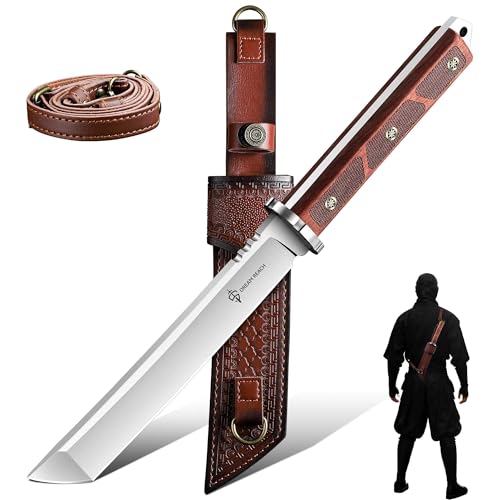
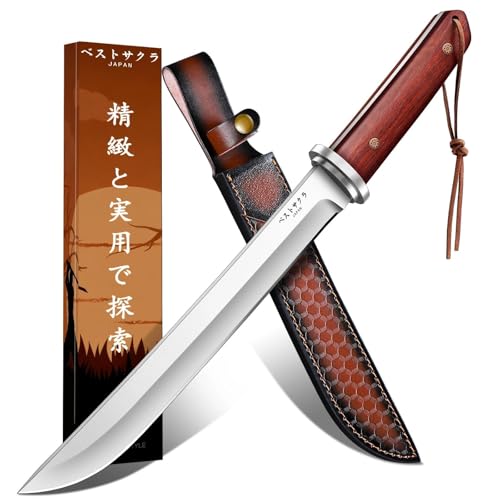
The Leopcito uses 3Cr13 stainless steel, a budget steel that resists rust reasonably well but ranks near the bottom for edge retention. The blade is 11.5 inches total length with a sharp pointed tip, and the handle is brass with seven strands of black nylon lifeline wrapped around it. That brass handle adds weight and a classic look, but brass is slick when your hand sweats, and the nylon cord wrapping won’t fix that. The listing calls it a ‘fixed blade knife’ but says nothing about the tang. For a knife this size, a hidden or rat-tail tang would be a serious structural weak point if you ever had to pry or chop with it. Given the budget steel, I’d bet on a partial tang at best.
Where this design wins is pure affordability and rust resistance. 3Cr13 will shrug off rain and humidity far better than high-carbon steel, and the brass handle won’t crack if you drop it on concrete. What you give up is any real cutting performance. The edge will roll or dull after a handful of hard cuts, and resharpening 3Cr13 is a chore because the steel is soft and gummy on stones. This is a knife for occasional carry or display, not for anyone who needs it to perform under stress. Compare that to the Purple Dragon’s D2 steel, which holds an edge many times longer.
Pros:
- 3Cr13 stainless — won’t rust if you forget to oil it after a rainy day.
- Brass handle with nylon cord — adds heft and a classic tanto look, and the cord gives a bit of extra grip texture.
- 11.5″ overall length — compact enough for a belt sheath but long enough to feel like a real knife.
Cons:
- 3Cr13 steel — edge retention is poor; this will need sharpening far more often than D2 or high-carbon steel.
- No stated tang type — a hidden or rat-tail tang could snap at the handle under any prying force, which is a safety issue for a ‘fighting’ knife.
- Brass handle gets slick — in wet or sweaty conditions, your grip will slip, which is exactly when you need control.
The Real Deal
Great match for: Someone on a tight budget who wants a tanto-shaped blade for a costume, display shelf, or very light utility work. Think twice if: You plan to actually rely on this for self-defense or survival — the steel and tang simply don’t support that role.
Dream Reach Japanese Tanto Knife (Traditional Carbon Tanto)
In a nutshell: This is the classic high-carbon tanto for people who want traditional feel without paying for a handmade piece.
Forged from high-carbon steel with professional heat treatment, the Dream Reach delivers hardness that holds a real edge. The blade handles pruning, splitting, and general outdoor tasks — the listing mentions those uses specifically. The handle is rosewood with a textured grid pattern, which provides a secure grip in wet or dry hands. It also has a cloud guard, a traditional Japanese tsuba-like feature that adds a bit of hand protection and visual flair. The listing doesn’t name the exact steel grade, which is a gap. High-carbon can mean 1095, 1060, or any number of alloys, and without that spec, I can’t tell you how tough or brittle this particular blade might be.
Compared to the Leopcito’s 3Cr13, the Dream Reach will hold an edge dramatically longer. High-carbon steel is the traditional choice for Japanese blades precisely because it takes a keen edge and keeps it. But that comes with a real downside: rust. If you don’t oil this knife after every use, you’ll see orange spots within days, especially in humid climates. The rosewood handle is a nice touch — it’s dense, fairly grippy, and the grid pattern helps prevent twisting in your hand. However, no sheath material is specified. A knife with no sheath, or a poor-fitting one, is an accident waiting to happen in a bag or on a belt. Budget for an aftermarket kydex sheath if you buy this.
Pros:
- High-carbon steel with heat treatment — takes and holds a sharper edge than budget stainless, and the heat treatment suggests proper hardness.
- Rosewood handle with grid pattern — natural grip texture that stays secure even with damp hands.
- Cloud guard — traditional styling that also gives a small barrier against your hand sliding onto the blade.
Cons:
- No specific steel grade listed — without 1095, 1060, or similar, I can’t verify toughness or hardness claims.
- Rust-prone high-carbon steel — requires oiling after every use; one forgotten day in a sweaty pack and you’ll have rust spots.
- No sheath mentioned — you’ll need to buy a separate sheath, or risk cutting yourself when carrying this knife.
Our Take
Ideal for: Traditionalists who want a carbon steel tanto for bushcraft or collection and already know how to maintain carbon blades. Pass on this if: You want a knife you can toss in a drawer and forget about — the rust will punish laziness.
FUSIONKEI Japanese Tanto Knife (Clay-Tempered Collectible)
Why it earns a spot: The FUSIONKEI brings actual traditional forging methods — clay tempering and multi-layer steel folding — into a production tanto.
This knife is advertised as forged using traditional Japanese methods, with multi-layer steel folding and clay tempering. That clay tempering process creates a visible hamon line, the wavy transition between hard edge and softer spine that’s a hallmark of differentially hardened Japanese blades. The handle is ergonomic rosewood, and the sheath is form-fitted full-grain leather. The multi-layer construction means the blade is not a single homogeneous steel; it’s folded to create a pattern and often a tougher overall structure. But multi-layer doesn’t automatically mean better edge retention than D2 — it trades some raw hardness for shock absorption and aesthetics.
Compared to a mono-steel D2 blade like the Freelander or Purple Dragon, the FUSIONKEI will likely be less brittle but also less wear-resistant. The clay tempering adds real toughness: a differentially hardened blade bends before it breaks, which is why this method survived centuries of combat. The rosewood handle is a strong point — it’s shaped for control rather than just looks. The full-grain leather sheath is premium and will mold to the blade over time, but leather requires maintenance. Left in a damp basement, leather sheaths mildew and retain moisture against the steel. If you live in a humid climate, you’ll need to store the knife and sheath separately or condition the leather monthly.
Pros:
- Clay tempering with visible hamon — differential hardening gives a hard edge and a flexible spine, reducing break risk.
- Full-grain leather sheath — form-fitted, durable, and traditional; it protects the blade when properly maintained.
- Ergonomic rosewood handle — contours fit the hand better than a straight cylinder, improving grip during hard cuts.
Cons:
- Leather sheath upkeep — requires regular conditioning and dry storage; mildew and trapped moisture become problems in humid areas.
- Multi-layer steel is softer than D2 — you’ll sharpen more often than with a D2 blade, though it’s tougher against chipping.
- Premium price for a collectible — this is more a display and practice knife than a beater survival tool.
Final Thoughts
Perfect for: Collectors and traditionalists who want a differentially hardened tanto with a hamon and a high-quality leather sheath. Not great if: You need maximum edge retention for repeated hard use — D2 in the Freelander or Purple Dragon will outlast this blade.
Freelander Japanese Fixed Blade Knife with Sheath (Heavy-Duty D2 Survival)
Quick take: If you want a knife that can double as a small machete and shrug off abuse, the Freelander’s 6mm D2 spine is hard to beat on paper.
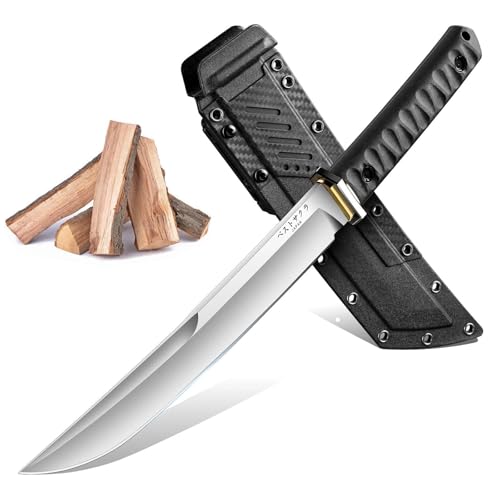
Built from D2 steel with a 6mm thick spine, the Freelander is unusually thick for a tanto. The handle is synthetic rubber, which provides a non-slip grip even in wet or cold conditions. D2 steel offers outstanding hardness and wear resistance — it holds an edge far longer than 3Cr13 or even many high-carbon steels, though it’s harder to sharpen when it does dull. The 6mm spine means this knife will not flex or snap under prying or batoning. You could hammer it through a log without worrying about the blade bending. That thickness comes with a trade-off: a 6mm blade is a wedge, not a slicer. It’s fantastic for chopping and splitting, but it will wedge in deep cuts rather than slice cleanly.
Compared to the Dream Reach’s high-carbon steel, the Freelander’s D2 is more rust-resistant but not stainless — it will still spot if left wet. The synthetic rubber handle is a practical choice. It insulates against cold, grips well with gloves, and won’t crack like wood. But it lacks the traditional aesthetic of rosewood. The listing doesn’t mention the tang type either, but a 6mm spine suggests a full tang by necessity — a rat-tail tang on a blade this thick would be absurd. Still, check before buying. The sheath is mentioned but material unspecified; for a knife this heavy, a kydex or hard plastic sheath is necessary to prevent the blade from cutting through a soft sheath during carry.
Pros:
- D2 steel — excellent edge retention; stays sharp through extended chopping and cutting.
- 6mm thick spine — virtually unbreakable under prying or heavy impact; this is a survival tool first.
- Synthetic rubber handle — non-slip in wet or muddy conditions and comfortable with gloves.
Cons:
- 6mm thickness kills slicing ability — the blade wedges rather than slices; poor for fine work or food prep.
- D2 is not fully stainless — prolonged moisture will cause spotting; regular oiling required.
- Heavy — the thick spine and rubber handle add weight, making this a poor choice for everyday carry on a belt.
Who Should Buy This
Great match for: Campers, survivalists, or anyone who wants a nearly indestructible chopper for batoning and heavy brush clearing. Skip if: You need a nimble fighting knife for quick draw and precision cuts — the Freelander is a tank, not a scalpel.
Purple Dragon Tanto Knife with Sheath (Full-Tang D2 Fighter — OUR PICK)

Here’s the deal: The Purple Dragon is the only knife on this list that combines a full-billet D2 blade, a G10 handle, and a double guard — the three features that separate a real fighting knife from a decoration.
The blade is forged from a single billet of D2 tool steel — no welds, no weak points. That phrase implies a full tang, which is the single most important structural feature in a fighting knife. A full tang runs the entire length and width of the handle, so the blade can’t snap off at the grip under stress. The blade also has ocean wave carvings, which the manufacturer says reduce drag on deep cuts. Whether or not that’s measurable, the carvings add visual character without compromising thickness. The handle is black G10, triple-riveted, with aggressive texturing. G10 is a fiberglass laminate — extremely tough, moisture-proof, and grippy even when wet. The double guard is a critical safety feature: it prevents your hand from sliding forward onto the blade during a thrust, which is exactly when accidents happen in a defensive scenario.
Compared to the Freelander’s 6mm thick spine, the Purple Dragon is likely thinner and more balanced for a fighting knife. D2 steel holds an edge for a very long time, though it’s slower to sharpen than high-carbon steel. The G10 handle is superior to rubber or wood for wet conditions — it won’t absorb water, crack, or get tacky. The double guard is something you rarely see at this price point, and it’s worth paying for. The listing doesn’t specify the sheath material, which is a minor gap. D2 will rust if left in a damp leather sheath, so you’ll want to confirm the sheath is kydex or at least lined. If it’s bare leather, store the knife outside it. No product is perfect, and the Purple Dragon’s weakness is likely sharpening difficulty: D2 is notoriously hard to put a fresh edge on with simple stones.
Pros:
- Single-billet D2 steel — full tang construction with no welds means the knife won’t break at the handle under heavy impact.
- G10 handle with aggressive texturing — vice-like grip in rain, sweat, or blood; won’t degrade like wood or rubber.
- Double guard — prevents your hand from slipping onto the blade during a thrust, a real safety advantage in a defensive tool.
Cons:
- Sheath material not specified — if it’s leather, you need to store the knife separately in humid climates to prevent rust.
- D2 sharpening difficulty — this steel is hard; you’ll need diamond stones or a professional sharpener for a fresh edge.
- Aggressive G10 texture — rough on bare hands during extended use; you may want light gloves for long chopping sessions.
Our Final Verdict on This One
Best for: Anyone who wants a genuine fighting knife with full tang, D2 steel, and a safety guard without custom-knife prices. Pass on this if: You only need a display piece or are afraid of sharpening high-hardness steel — this blade will punish neglect.
What to Look For in a Japanese Fighting Knife
Buying a fighting knife isn’t like buying a chef knife. The stakes are higher, and the wrong steel or handle can fail exactly when you need it. Here’s what separates a tool from a toy.
Steel Type: Carbon vs. Stainless for a Japanese Fighting Knife
AUS-8 steel is common in many japanese tactical knives, and for good reason: it resists corrosion and rust better than high-carbon steel, and cryogenic treatments enhance its durability and strength. The trade-off is edge retention — AUS-8 will need sharpening more often than D2, though it’s far easier to sharpen. Our list covers both ends: Leopcito’s 3Cr13 is a step below AUS-8 in edge retention, while Dream Reach and FUSIONKEI use high-carbon steels that take a keener edge but demand oiling after every use. D2, used in the Freelander and Purple Dragon, offers the best edge retention of the group but sharpens slowly. For a fighting knife, I’d avoid 3Cr13 entirely; it’s too soft for a defensive edge.
Tang Construction: Full Tang Isn’t Optional for Heavy Impact
A full tang is a piece of steel that runs the entire length and width of the handle, sandwiched between handle scales. A rat-tail tang is a thin rod welded onto the blade and hidden inside the handle — it can snap at the weld under even moderate prying or chopping. The Purple Dragon’s single-billet construction is the gold standard here; the Freelander’s 6mm spine also implies a full tang, though the listing doesn’t state it outright. The Leopcito’s missing tang info is a red flag. Before you buy any fighting knife, ask the seller directly: ‘Is this full tang?’ If the answer is vague, walk away. A hidden tang is a hidden failure point.
Sheath Retention and Safe Carry
A knife that falls out of its sheath is a knife that cuts you when you bend over or run. Positive retention — a click-lock, a strap, or a tightly contoured kydex form — is non-negotiable for a fixed-blade carry knife. Leather sheaths like the FUSIONKEI’s full-grain version are beautiful but require maintenance and can retain moisture against the blade. Kydex or hard plastic sheaths are better for humid climates. The U.S. Consumer Product Safety Commission tracks blade-related injuries, and many occur when a poorly retained knife slips free during everyday movement. Check the retention mechanism on any sheath before you trust it on a belt.
Blade Geometry and Sharpening a Tanto
A tanto has two distinct edge angles: the long primary edge and the angled tip edge. Sharpening both correctly requires maintaining each bevel separately — do not try to sharpen the entire edge as one continuous curve. High-carbon steels like the Dream Reach sharpen easily with water stones, while D2 demands diamond stones and patience. Regardless of steel, keep the edge angle between 20 and 25 degrees per side for a fighting knife; too acute and the edge chips on hard contact, too obtuse and it won’t cut cleanly. The ocean wave carvings on the Purple Dragon may look stylish, but they don’t change the sharpening process — you still work the edge bevels.
Our Final Recommendation
For most buyers, the Purple Dragon Tanto Knife is the clear winner: full-billet D2, G10 grip, and a double guard for a price that doesn’t require a second mortgage. On a tight budget, the Leopcito gets you a tanto shape, but accept its soft steel as a toy, not a tool. If you’re a traditionalist who wants a hamon, the FUSIONKEI delivers clay-tempered charm with a leather sheath. The book isn’t a knife at all — it’s a reference for collectors. Decide what you’ll actually do with the blade, then buy the steel that matches the job.
Frequently Asked Questions
What’s the difference between Japanese combat knives and tactical knives?
Japanese combat knives are historically designed for military use, emphasizing thrusting ability and quick deployment. Tactical knives are a broader modern category that includes utility and survival functions — many so-called tactical knives would be poor combat weapons. A true combat knife prioritizes a full tang and a guard, like the Purple Dragon’s double guard; a tactical knife might just be a rugged outdoor blade with a black coating. Read the tang and steel specs before trusting the label.
Is a tanto knife legal to carry for self-defense?
Legality varies wildly by jurisdiction. In many U.S. states, fixed-blade knives over a certain length (often 3 to 4 inches) are illegal to carry concealed without a permit, and some cities ban fixed blades outright. A tanto is generally treated as a dagger because of its thrusting design, which can carry additional restrictions. Always check your local laws and the Consumer Product Safety Commission guidelines for knife safety, not legality — that’s determined by state and municipal code. Ignorance of the law is not a defense, and a ‘fighting knife’ label can work against you in court.
How do I prevent rust on a carbon steel tanto?
Carbon steel rusts quickly, so after every use, wipe the blade dry and apply a thin coat of mineral oil or a dedicated knife oil. Avoid storing a carbon tanto in a leather sheath for long periods — leather holds moisture against the steel. In humid climates, consider a kydex sheath instead. The Dream Reach’s high-carbon steel demands this routine daily; skip it once and you’ll see orange spots. D2 is more forgiving but still not stainless, so oil it weekly if carried regularly.
What is the ideal blade length for a fighting knife?
Most experienced instructors agree that a fighting blade between 5 and 7 inches offers the best balance of reach and control. Longer blades add momentum but slow your draw and make close-quarters retention harder. The Leopcito’s 11.5-inch overall length puts its blade around 6 inches, which is within that range. The Freelander’s 6mm thick spine makes it overbuilt for combat — it’s better as a survival chopper. Shorter than 5 inches sacrifices reach; longer than 7 inches becomes unwieldy indoors.