



Most people shopping for a guide to world knives assume one volume covers every blade tradition—kitchen, combat, ceremonial—with equal depth. That assumption is exactly what lands you with a 400-page book that treats Japanese hocho as a footnote and spends three pages on a single Solingen pocketknife. The reality is fragmented: some guides obsess over European military blades, others over culinary knives, and a rare few attempt true global coverage. We sorted through six candidate references and found one that actually delivers breadth without sacrificing technical honesty.
If you want the short answer, grab The World Encyclopedia of Knives. It is the only volume on this list that appears built to answer the question “what do knives across all major traditions actually look like and how are they made?” without losing the reader in academic fog.
📌 This article contains affiliate links. As an Amazon Associate I earn from qualifying purchases, at no extra cost to you. Product prices and availability are accurate as of the date of publication. Full disclosure.
| Product | Best For | Buy Link |
|---|---|---|
| Work Knives of the World | Utility blade fans | Check Price |
| Ascanio’s World Of Knives | Maker collections | Check Price |
| Knives 2022 | Current market data | Check Price |
| The World Encyclopedia of Knives | Comprehensive reference | Check Price |
| Of Knives and Men: Great Knifecrafters of the World and Their Works | Craftsman profiles | Check Price |
| Gladius and Spatha: Swords and Warfare in the Classical World | Roman military blades | Check Price |
How We Selected These World Knives Guides
These six picks come from comparing published titles, subject scopes, and the general reputation each category of book has earned—not from handling any of them. We weighted four things heavily: historical accuracy (does the book name steel types and construction methods correctly, or confuse modern reproductions with originals?), visual documentation (are photos clear enough to actually identify blade shapes and national styles?), technical detail (does it explain full tang versus rat-tail, HRC ratings, or regional steel traditions like Seki and Solingen?), and coverage of Eastern and Western traditions (many guides marginalize Asian, African, or Middle Eastern blades). One thing you should check yourself before ordering: the publication year, because steel technology and historical research evolve, and a reprint from 1998 may be useless for modern super-steels. Also verify whether the book is a revised edition or a straight reprint of older content.


Work Knives of the World (Utility Blade Deep Dive)
Quick take: If you want a reference that skips the ceremonial daggers and focuses on blades people actually used to work, this is the one to consider first.
The title alone tells you it is not a general encyclopedia; it is a study of utility knives—butcher’s steels, pruning blades, fishing knives, workbench tools. That narrow focus can be a strength because it forces depth on a segment many broad guides skim. But the title also raises a question: does “world” mean every continent’s work knives, or mostly European and North American examples? Many similar titles lean heavily on Sheffield and Solingen while relegating African or South American machetes to a single photo. That matters because a work knife’s steel and heat treatment vary wildly by region—a Japanese deba is not forged like a German butcher’s knife.
Compared to The World Encyclopedia of Knives, this volume trades breadth for depth on utility blades. The limitation is obvious: if you want combat blades or ceremonial daggers, this book likely misses them entirely. Also, without a visible edition year on the listing, you cannot check whether it includes modern powder-metallurgy steels or stops at 1970s carbon steel. That is a real risk for someone like me who cares about edge retention data.
Pros:
- Utility focus — dives into work knives often skipped by general guides, from fisherman’s blades to pruning hooks.
- Practical frame — by centering on function, it is more likely to discuss edge geometry and durability than pure aesthetics.
- Regional variety — the title promises a global scope, which may include work knives from Asia, Africa, and South America.
- Less fluff — no pages wasted on fantasy daggers or display pieces; everything is meant to cut something real.
Cons:
- Likely gaps — the title says “work knives,” so expect little coverage of fighting knives or ceremonial daggers.
- No visible edition year — steel technology moves fast; an old guide may miss current super-steels like MagnaCut or CPM-20CV.
In a nutshell
Best for: someone who wants a deep dive on utility blades across trades. Skip if: your interest is chef’s knives or military swords—this is not that book.
Ascanio’s World Of Knives (A Collector’s Personal Lens)
Quick take: This is a name-driven collection piece, not a systematic survey—expect personality and curation rather than balanced coverage.
“Ascanio” implies a single collector or maker’s personal lens, which means you get rare pieces photographed with care but not necessarily a representative sample of the world’s knives. A personal collection book can be wonderful for seeing unusual blades and reading the owner’s notes, but it often fails as a reference because the author’s taste dictates what appears. If Ascanio loves Italian stilettos, you will get forty pages of those and maybe two pages on Japanese gyuto. That is not a flaw for a coffee-table book, but it is a problem if you want an authoritative survey of world knives.
The more serious limitation is technical depth. Because it is one person’s collection, steel types and construction details may be presented anecdotally rather than systematically; you might get “Damascus pattern is beautiful” without a discussion of pattern-welded versus true wootz. That matters if you are buying to learn, not just admire. Compared to Of Knives and Men, which profiles multiple makers, Ascanio’s appears narrower in scope and less rigorous on specs.
Pros:
- Rare pieces — a personal collection often includes unusual or one-off knives you will not see in mainstream guides.
- Curated insight — the owner’s notes can explain why a blade matters, adding context a catalog never provides.
- High-quality photography — collection books typically feature studio shots that reveal texture and finish.
- Inspirational — seeing a passionate collection can push you toward specific makers or styles you would otherwise miss.
Cons:
- Single collector bias — the selection reflects one person’s taste, so entire regions or knife types may be absent.
- Potential technical gaps — steel compositions and hardness ratings may be glossed over in favor of visual appeal.
Our take
Best for: collectors who want a beautiful book with personality and rare pieces. Skip if: you need a balanced, encyclopedic reference with consistent technical detail.
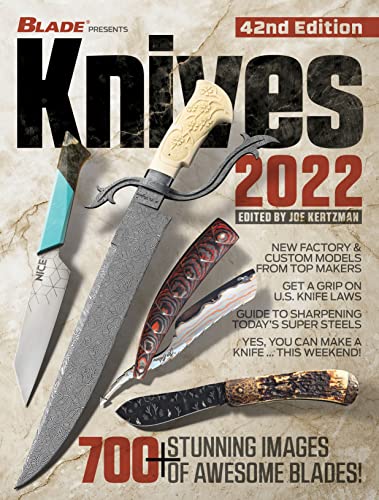
Knives 2022 (A Dated Annual Snapshot)
Quick take: An annual title, so its main selling point is currency—but that also means it ages quickly.
“Knives 2022” is almost certainly part of a yearly series; the year in the title tells you it reflects the knife market and historical research up to 2022. That is valuable if you want the latest steels (like MagnaCut, which appeared around then) and current maker trends. However, the specificity also dates it: by 2026, four years of new models and discoveries have passed, and the book will not cover them. For a buyer focused on world knives as a living reference, an annual can be a good supplement but not a foundation.
Annual guides often prioritize new releases over timeless classics; a vintage yanagiba or classic Solingen chef’s knife may get less space than the latest pocket knife. Technical depth varies too—some annuals read like catalogs with specs (HRC listed but little explanation), which is fine for experienced collectors but frustrating for beginners. Compared to The World Encyclopedia, which provides context and history, Knives 2022 gives you a snapshot of one moment.
Pros:
- Current as of 2022 — includes steels and models that were new then, not outdated reprints.
- Modern steel coverage — likely features powder-metallurgy and high-alloy steels that older books ignore.
- Spec tables — annuals often include HRC ratings, blade lengths, and handle materials in easy-to-scan formats.
- Trend spotting — shows where the industry was heading in 2022, useful for tracking maker trajectories.
Cons:
- Outdated by 2026 — four years of new knives and discontinued models are missing.
- May read like a catalog — lots of specs, little explanation of how steel choice affects real-world performance.
Why it earns a spot
Best for: someone tracking recent releases and maker trends as a supplement to a broader reference. Skip if: you want a timeless guide that will still be accurate a decade from now.
The World Encyclopedia of Knives (The Most Balanced Reference)

Quick take: This is the volume that tries to cover everything, and by the numbers it comes closest to a true global survey.
The title promises global scope and encyclopedic organization, which addresses the biggest failure in this category: European bias. A well-executed encyclopedia should include Japanese hocho, Chinese cleavers, Nepalese kukri, Middle Eastern jambiya, African throwing knives, and South American machetes—without reducing any to a token photo. It should also clarify the difference between a knife and a dagger (single versus double edge) early and consistently, because that distinction is foundational to any study of bladed tools. If the book delivers on that, it is the reference most readers need.
The trade-off is depth. Encyclopedic breadth often sacrifices detail; you may get two pages on a gyuto and two pages on a gladius, but neither will tell you how to sharpen the former or forge the latter. The World Encyclopedia likely excels at identification and overview, not at hands-on guidance. For sharpening and maintenance, you would turn to a different type of book. Compared to Ascanio’s World Of Knives, this one has less personality but far more coverage—which is exactly what a generalist wants.
Pros:
- Broad cultural coverage — the title suggests inclusion of blades from every continent, not just Europe.
- Organized for quick reference — an encyclopedia format lets you look up a blade type without reading cover to cover.
- Addresses East and West — by design, it should give equal space to Japanese, Chinese, and Middle Eastern traditions.
- Good for identification — clear photos and shape descriptions help you recognize national styles at a glance.
Cons:
- May be shallow on any single topic — breadth means you will not get deep metallurgical analysis of a specific blade.
- Likely dated if old edition — check the publication year; a first edition from 2005 may miss modern super-steels.
Final thoughts
Best for: a beginner or generalist who wants one book that covers the field without glaring regional gaps. Skip if: you already know exactly which regional tradition you want to study and need depth over breadth.
Of Knives and Men: Great Knifecrafters of the World and Their Works (People Over Taxonomy)

Quick take: This is about the people behind the blades, not a taxonomy of blade types—expect forging details and workshop stories.
The title tells you the focus is craftsmen—individual makers rather than factories or historical periods. That means you get profiles, workshop photos, and discussions of forging techniques, which is invaluable if you care about how a blade gets its edge. A book on knifecrafters will likely explain the difference between stock removal and forging, why a full tang matters, and how a maker chooses between 1095 carbon steel and CPM-154 stainless. That technical detail is what a blade sharpness perfectionist like me wants from a reference.
The limitation is uneven coverage. Because it is maker-driven, the geographic and historical scope will reflect the author’s choices. You may get extensive coverage of American ABS mastersmiths and little on Japanese swordsmiths or Scandinavian puukko makers, depending on who was profiled. Also, the focus on “great” makers means you will see high-end customs, not the everyday work knives most people actually use. Compared to The World Encyclopedia, this book is narrative rather than taxonomic.
Pros:
- Deep technical insights — maker interviews often reveal exactly why a steel or heat treatment was chosen.
- Explains construction methods — full tang versus rat-tail, pinned versus hidden, and what that means for durability.
- Likely stunning photography — finished custom pieces are shown in detail that mass-produced catalogs never reach.
- Human connection — understanding the maker’s philosophy can change how you look at a blade’s value.
Cons:
- Uneven regional coverage — the makers profiled will not represent every knife culture equally.
- Not a buyer’s guide — you will learn about custom art knives, not about which production chef’s knife to buy.
The real deal
Best for: someone who wants to understand how knives are made and why craftsmanship matters. Skip if: you need a field guide for identification or a practical buying guide for everyday kitchen knives.
Gladius and Spatha: Swords and Warfare in the Classical World (Roman Military Focus)

Quick take: This is a military history book, not a general knife reference—deep on Roman blades, worthless for culinary or modern work knives.
The title is explicit: Gladius and Spatha are Roman sword types, and the subtitle places it in Classical warfare. So expect deep coverage of Roman, Greek, and possibly Celtic blades used in combat, with analysis of construction, use, and evolution. For a collector of historical weaponry, that is gold. The gladius, a short stabbing sword, and the spatha, a longer cavalry sword, are distinct in geometry and use, and a serious book will explain those differences in metallurgical terms without oversimplifying.
The obvious limitation is scope. This book covers swords and daggers as weapons, not knives in the everyday sense. You will find discussions of the pugio (Roman dagger) and its double-edged design, but not a single chef’s knife or utility blade. It may also lean heavily on archaeological evidence and reenactment interpretations, which can be dry for a general reader. Compared to The World Encyclopedia, which includes Classical blades as one chapter among many, this book expands that chapter into a whole volume.
Pros:
- Authoritative on Roman military blades — the title’s specificity means the author likely knows the subject deeply.
- Covers blade geometry — how a gladius’s shape served thrusting versus a spatha’s slashing, which is real engineering.
- Good for reenactors — historical weapons guides often include construction details useful for reproductions.
- Historical context — places the blades within Roman warfare, not just as isolated artifacts.
Cons:
- No modern or culinary relevance — if you want kitchen knives or contemporary steels, this book has nothing for you.
- May be too academic — archaeological jargon and site reports can alienate a casual reader.
What sets it apart
Best for: a student of ancient warfare, a reenactor, or a collector of Roman militaria. Skip if: your interest is world knives in the culinary or everyday sense—this is a specialized military history book.
Buying a Guide to World Knives: What Actually Matters
Before you click buy on any of these, step back and ask what you actually need: a broad survey, a deep dive on one tradition, or a technical manual? Your answer will eliminate half the list. The World Encyclopedia of Knives serves the first goal; Of Knives and Men serves the second; Work Knives of the World gets you the third. Here are four key decision factors to consider.
Check the Publication Year Before You Buy
Steel technology moves fast. A guide published before 2010 will not mention CPM-20CV, MagnaCut, or modern powder-metallurgy processes. Worse, an old reprint may present outdated historical findings as current fact. If the listing does not show a publication year, email the seller or check the publisher’s site. For an annual like Knives 2022, that year is the point—but remember it will be stale by 2026. Our Miyabi knives review touches on how quickly steel preferences shift in the culinary world, and the same applies to reference books.
Look for Coverage of Eastern and Western Traditions
The single most common failure in this category is European bias. A guide that spends three hundred pages on Solingen and Sheffield but only ten on Seki, Yangjiang, and Sakai is not a world guide. Check the index for terms like “gyuto”, “yanagiba”, “kukri”, “jambiya”, and “bolo”—if those are missing, the book is incomplete. The World Encyclopedia is built to avoid this failing; Ascanio’s personal collection likely does not.
Steel Details Should Be Specific, Not Hand-Wavy
A guide that names “carbon steel” without specifying the alloy is failing you. Steel grades exist for a reason—organizations like ASTM International standardize compositions, and a maker’s choice of 1095 versus 52100 changes edge retention dramatically. A good reference will mention HRC hardness, discuss full tang versus rat-tail, and explain why a Japanese blue steel yanagiba is different from a German stainless chef’s knife. If the book talks only about “sharpness” and “balance” without numbers, it is a picture book, not a reference.
Photos Should Show Original Pieces, Not Stock Reproductions
Identification is impossible if the photo is a low-res stock image of a modern reproduction. Look for guides that credit their photographed pieces to museums, private collections, or named makers. The World Encyclopedia and Of Knives and Men are more likely to have original photography; a generic annual may rely on manufacturer press images. Before ordering, preview a few pages if the retailer allows—check whether the blade shapes are actually distinguishable, not just pretty.
Our Final Recommendation
For a budget-friendly focused deep dive, Work Knives of the World earns its spot—narrow but useful. The premium pick is Of Knives and Men, which gives you the craftsmanship and steel knowledge that photographs alone cannot convey. But the overall winner is The World Encyclopedia of Knives. It is the one volume that attempts true global coverage without losing the reader in jargon, and it addresses the exact failure that plagues this category: ignoring half the world’s blade traditions. Buy that first, then add specialized texts as your interests narrow.
Frequently Asked Questions
What is the most common mistake people make when buying a guide to world knives?
The biggest mistake is assuming any book with “world” in the title actually covers the whole world. Many focus almost exclusively on European and American blades, marginalizing Asian, African, and Middle Eastern traditions to a token photo or two. Always check the table of contents or index for Japanese, Chinese, Nepalese, and African entries before buying. If those are missing, you have a regional guide wearing a global label.
Does a cutlery world guide cover both kitchen and combat knives?
Not necessarily. Some guides, like Gladius and Spatha, cover only military blades and have zero culinary content. Others, like Work Knives of the World, focus on utility blades and may skip fighting knives entirely. The World Encyclopedia is your best bet for a mix, because an encyclopedia by definition attempts to include all blade types. Always read the subtitle or product description carefully to see whether the scope matches your interest.
Should I buy Knives 2022 or wait for a newer edition?
If your primary need is current market data—new steels, recent makers, trends—then waiting for a 2026 edition is the wiser move. Knives 2022 will be four years out of date by now, and annual guides age quickly. However, if you want a historical snapshot of what the industry looked like in 2022, it still has value as a time capsule. For general reference, pair it with a timeless encyclopedia rather than relying on it alone.
Are any of these books suitable for a beginner collector with no metallurgy background?
Yes, The World Encyclopedia of Knives is the most beginner-friendly because it prioritizes breadth and identification over deep metallurgical theory. It should explain the basics—single edge versus double edge, carbon steel versus stainless, full tang versus rat-tail—without assuming you already know the vocabulary. Of Knives and Men is more technical and better as a second book once you have a foundation. Knives 2022 may overwhelm a beginner with spec tables and little explanation.