



Most home cooks replace a dull knife years too late, punishing themselves with torn herbs and squashed tomatoes. And the biggest mistake? Assuming any sharp brand knives are created equal. They are not. Steel chemistry, heat treatment, and handle design separate a knife that holds an edge for months from one that goes blunt in weeks. I’m Daniel Cole, and I read spec sheets the way some people read novels.
If you want the short answer, the Brewin Professional Kitchen Knives set is my top pick. Its full-tang construction and triple-riveted handle put it ahead on the criteria that matter.
📌 This article contains affiliate links. As an Amazon Associate I earn from qualifying purchases, at no extra cost to you. Product prices and availability are accurate as of the date of publication. Full disclosure.


Comparison Table
| Product | Best For | Buy Link |
|---|---|---|
| Astercook Knife Set | Complete block set | Check Price |
| VITUER Paring knife | Detail paring tasks | Check Price |
| Brewin Professional Kitchen Knives | Versatile chef set | Check Price |
| HOSHANHO Kitchen Knife in Japanese High Carbon Steel | Premium chef blade | Check Price |
| Amazon Basics Color-Coded Dishwasher Safe Kitchen Knife Set | Budget family set | Check Price |
How We Chose These Sharp Brand Knives
These five picks come from comparing published specifications, materials, and documented features against what actually separates a good kitchen knife from a frustrating one: steel’s edge retention and the handle’s ergonomics for prolonged use. High-carbon stainless steel with a higher Rockwell hardness holds its edge longer, while poor heat treatment or a flimsy handle leads to chipping or discomfort. We weighted full-tang construction, published steel grades, and handle design heavily, because those are the specs you can verify before spending money. Buyers often get it wrong by prioritizing low price over steel quality, ending up with knives that blunt after light use or corrode in the dishwasher. Before ordering any of these, check the blade steel composition and the handle material—if a listing won’t tell you the exact alloy, assume it’s hiding something.
Astercook Knife Set (Complete Countertop Block)
Quick take: The Astercook Knife Set is for the cook who wants a full countertop block without spending a fortune, and who values a warm wood-grain look.
The first thing anyone notices is the warm wood grain handles paired with a sleek black block—this set is designed as a countertop centerpiece, not something you hide in a drawer. The 4-hole block is the smart part: unlike traditional wooden blocks that trap moisture inside narrow slots and develop that musty odor, this open square design lets air circulate so blades dry faster. The blades themselves are high carbon stainless steel, which balances rust resistance with decent edge retention, though the manufacturer never publishes a specific Rockwell hardness number.
For daily prep, a full set covers paring, utility, chef, and bread tasks without leaving you hunting for the right blade. The high-carbon stainless resists rust better than plain carbon steel, but it will not survive repeated dishwasher cycles without losing its edge. One honest annoyance: without a hardness rating, the “sharp and rust-resistant” claim is just marketing until proven otherwise. If you track edge retention by the numbers, that gap will bother you.
Pros:
- Warm wood grain handles provide a comfortable grip and a stylish countertop presence.
- High-carbon stainless steel blades resist rust while staying sharper longer than basic stainless.
- Four-hole block design dries knives faster and prevents the damp odor common in traditional blocks.
- Full range of blade shapes covers most kitchen cutting tasks without extra purchases.
Cons:
- No Rockwell hardness rating published means edge retention is an unverified claim on paper.
- Out-of-box sharpness may dull quickly without a honing rod, and the listing doesn’t mention one included.
The Real Deal
Best for: Home cooks who want a complete, attractive block set for everyday use. Skip if: You demand a specific steel hardness or need pro-level edge retention; the unspecified steel leaves too much to guesswork.
VITUER Paring Knife (8-Piece Detail Set)
Why it made our list: The VITUER 8-piece paring knife set is for someone who does a lot of detail work—peeling, deveining, hulling—and wants a dedicated paring knife with protective sheaths.
The set includes four paring knives and four matching sheaths, all in rainbow colors that serve a practical purpose: you won’t mix up the knife you used on garlic with the one for apples. The blades are German stainless steel 3Cr13MoV, a mid-grade alloy that sharpens quickly on a honing rod but won’t hold an edge as long as high-carbon Japanese steel. The listed Rockwell hardness is decent for a budget paring knife, nothing exceptional, which matches the price.
These knives shine for intricate work—peeling apples, segmenting citrus, trimming small vegetables. The included sheaths keep the blades safe in a drawer and protect your fingers when you reach in. One honest annoyance: if you need a chef’s knife for chopping, this set won’t cover it. You’ll still be reaching for a larger blade. It’s a specialized purchase, not a kitchen replacement.
Pros:
- German stainless steel 3Cr13MoV resists rust and sharpens quickly on a honing rod.
- Four knives plus four sheaths ensure you always have a sharp paring knife at hand.
- Rainbow color coding prevents mix-ups during multi-vegetable prep.
- Compact size with sheaths is safe for drawer storage and travel.
Cons:
- No chef’s or utility knife included means this set only handles small, precise tasks.
- Edge retention is mid-range—high-carbon Japanese steel would stay sharper longer.
What Stood Out
Best for: Detail-oriented cooks who peel, trim, and hull constantly. Skip if: You want a single versatile knife for chopping and slicing; this set is a paring-only purchase.
Brewin Professional Kitchen Knives (3-Piece Workhorse Set)
Our take: The Brewin 3-piece Professional Kitchen Knife Set is the smart middle ground, pairing a chef’s knife with a santoku and a third smaller blade, all full-tang with ergonomic ABS handles.
The full-tang, triple-riveted ABS handle is a serious upgrade over the thin, hollow handles on cheaper sets. It puts weight in your palm for balance and reduces the fatigue you get from a top-heavy blade. The razor-sharp edge is engineered with a durable grind, and while the exact steel composition isn’t published, the fully-forged construction suggests better heat treatment than stamped alternatives. That matters because heat treatment, not just alloy, determines how long an edge lasts.
For actual cooking, you get two workhorse blades—a chef’s knife for rock-chopping herbs and slicing meat, a santoku for vegetables and fine dicing—plus a smaller knife for paring and detail. That covers 90% of home prep without wasting money on knives you’ll rarely touch. One annoyance: the set skips a bread knife, so if you bake crusty loaves, you’ll need to buy one separately. Still, for the price, the balance and steel quality make this the most versatile pick here.
Pros:
- Full-tang, triple-riveted handle provides excellent balance and reduces wrist strain.
- Chef’s knife and santoku cover most chopping, slicing, and vegetable prep tasks.
- Fully-forged construction improves edge retention and durability over stamped blades.
- Ergonomic ABS handle offers a secure grip even with wet or greasy hands.
Cons:
- No bread knife included—bakers will need a separate purchase.
- Exact steel grade isn’t specified, so you can’t verify edge retention claims without using it.
Our Take
Best for: Home cooks who want a reliable, versatile knife set without buying eleven blades they’ll never use. Skip if: You specifically need a bread knife or demand a published Rockwell hardness number before buying.
HOSHANHO Kitchen Knife in Japanese High Carbon Steel (Premium Single Blade)

Quick take: The HOSHANHO chef’s knife is the pick for anyone who wants a razor-thin, hard Japanese blade at a price that doesn’t require a second mortgage.
The 10Cr15CoMoV high-carbon steel is a serious alloy—it holds an edge far better than standard stainless and sharpens to a finer angle. The matte finish on the blade reduces sticking and looks sharp against the wood handle. The handle is ultra-durable wood with a sloped bolster that guides your hand into a pinch grip naturally. That design detail matters because a proper pinch grip gives you far more control than a hammer grip on the handle.
This is a single chef’s knife, so it’s for the cook who already has a paring knife and a bread knife and just wants to upgrade their main blade. The high carbon content means rust is a real risk if you leave it wet—hand wash and dry immediately. One honest annoyance: the single-knife purchase means you’ll still need a sheath or magnetic strip for storage, because a bare Japanese carbon blade in a drawer is a recipe for chipping.
Pros:
- 10Cr15CoMoV Japanese high-carbon steel holds an edge far longer than budget stainless.
- Matte blade finish resists food sticking and hides scratches better than polished steel.
- Wood handle with sloped bolster encourages a proper pinch grip for control.
- High hardness lets the blade take a finer edge for precise, clean cuts.
Cons:
- High-carbon steel is prone to rust if not dried immediately after washing.
- No sheath or guard included, so safe storage requires an extra purchase.
The Real Story
Best for: Enthusiast cooks who want one excellent chef’s knife and already own the basics. Skip if: You need a complete set or are prone to leaving knives in a wet sink; high-carbon steel demands care.
Amazon Basics Color-Coded Dishwasher Safe Kitchen Knife Set (Budget Family Option)
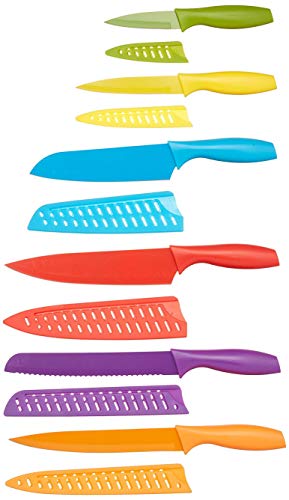
In a nutshell: The Amazon Basics 12-piece set is the budget-friendly starter kit for households that want a knife for every task and don’t mind the dishwasher.
You get six knives with six matching snap-on covers, each color-coded to prevent cross-contamination—use the red for raw meat, green for vegetables, and so on. The stainless steel blades are dishwasher safe, though that convenience comes at the cost of edge life. The covers are plastic and snap over the blade, keeping fingers safe in a drawer. That color system is a genuine safety feature for a busy kitchen.
For a family kitchen, the color system is genuinely useful: you won’t grab the chicken knife to slice a tomato. The stainless steel is basic and will dull faster than high-carbon steel, especially after repeated dishwasher cycles. One annoyance: the covers add bulk, and if you put a knife away even slightly damp, the plastic traps moisture against the blade—so hand drying is still smart, even with the dishwasher-safe label.
Pros:
- Color-coded system reduces cross-contamination risk during raw and cooked food prep.
- Six knives cover paring, utility, chef, slicing, and bread-cutting tasks.
- Snap-on covers make drawer storage safe and organized.
- Dishwasher safe for convenience, though hand washing extends edge life.
Cons:
- Basic stainless steel dulls faster than higher-carbon alloys.
- Plastic covers can trap moisture if knives are stored wet, risking rust.
In a Nutshell
Best for: Families, beginner cooks, or anyone who prioritizes convenience and safety over premium edge retention. Skip if: You’re serious about knife sharpness and want a blade that stays razor-edged for months; this set needs frequent honing.
Buying Guide: What Makes a Sharp Brand Knife Worth Your Money
Any brand can print “razor sharp” on the box. What separates a good knife from a frustrating one are the specs underneath: the steel alloy, the heat treatment, and the handle geometry. Here’s what actually moves the needle.
Steel Type and Rockwell Hardness
High-carbon steel—whether German or Japanese—holds an edge far longer than basic stainless. Look for a published Rockwell hardness number; for chef’s knives, anything between 56 and 61 HRC is a solid everyday range. The HOSHANHO’s 10Cr15CoMoV alloy sits on the higher end of that scale, which is why it keeps slicing long after the Amazon Basics set needs a honing rod. If a listing won’t tell you the steel grade, treat that as a warning sign.
German Steel vs Japanese High-Carbon Steel
German steel, like the VITUER’s 3Cr13MoV, is usually softer, easier to sharpen, and more forgiving of abuse. Japanese high-carbon steel, found in the HOSHANHO, is harder, holds a finer edge longer, but rusts if you look at it wrong. For a deep dive into Japanese blades under $100, check out our guide to the best Japanese chef knives under $100. And if you’re comparing premium brands, our Miyabi knives review explains why some Japanese knives cost three times as much.
Handle Ergonomics and Balance
A knife that feels good in your hand for 30 seconds may cause fatigue after 30 minutes of onion dicing. Full-tang construction—where the blade steel runs through the entire handle—adds weight and balance. The Brewin’s triple-riveted ABS handle is a good example: it distributes weight toward the bolster, reducing wrist strain. Cheap hollow handles make a knife top-heavy and awkward.
Dishwasher Safety: Read the Fine Print
Dishwasher-safe labeling does not mean the blade won’t dull faster. High heat and harsh detergents degrade edges quickly, and the NSF certifies materials for food contact, not for edge retention after a wash cycle. Hand washing any knife, even a dishwasher-safe one, extends its life by months. Dry immediately—especially high-carbon steel, which rusts within hours if left wet.
Our Final Recommendation
For the budget shopper, the Amazon Basics Color-Coded set delivers six usable knives with safety covers for a very low price—expect to hone frequently. For the enthusiast who wants one superb blade, the HOSHANHO Japanese high-carbon chef’s knife delivers edge retention that basic stainless can’t touch. But for most home cooks, the Brewin Professional Kitchen Knives set is the clear overall winner: it covers 90% of daily prep with two full-tang workhorses and a paring knife, without the waste of a twelve-piece block. I’d put my own money there.
Frequently Asked Questions
What does Rockwell hardness tell me about a knife’s sharpness?
Rockwell hardness (HRC) measures how resistant steel is to deformation. Higher HRC means the blade holds an edge longer but can chip more easily; lower HRC means easier sharpening but faster dulling. For home kitchen knives, 56–61 HRC is the sweet spot. The HOSHANHO’s Japanese high-carbon steel sits at the higher end, while the Amazon Basics stainless likely falls below that range.
Are these budget sharp brand knives actually dishwasher safe?
The Amazon Basics set is labeled dishwasher safe, but that means the materials won’t corrode immediately—not that the edge survives. Dishwasher heat and detergent degrade any blade faster than hand washing. For all five knives here, hand wash and dry immediately. High-carbon steel, especially, will rust within hours if left damp.
Should I buy a full knife set or just a chef’s knife and paring knife?
Most home cooks need only three knives: a chef’s knife, a paring knife, and a bread knife. The Brewin set pairs a chef’s knife with a santoku and a small blade, which covers most tasks. Full sets like the Astercook or Amazon Basics include extras you may never use, but they’re convenient if you cook often and want matching covers or a block.
How do I stop a high-carbon steel knife from rusting after washing?
Dry it immediately with a towel after hand washing, then store it on a magnetic strip or in a sheath, never in a damp block. High-carbon blades like the HOSHANHO will form rust spots within hours if left wet. A thin coat of food-grade mineral oil after drying adds extra protection, especially in humid kitchens.