



Nothing ruins a one-pan dinner faster than realizing your skillet’s handle just melted in a 450°F oven. The difference between a pan that says “oven safe” and one that actually survives a full roast cycle is whether the handle material can take 450°F. Plenty of skillets claim stovetop-to-oven versatility, but few hold up when you push them to their limits—and even fewer clean up easily afterward.
The T-Fal Ultimate Hard Anodized Nonstick Fry Pan With Lid 12 Inch earned our top recommendation because it marries a genuinely slick nonstick surface with a hard anodized body that shrugged off every abuse test we threw at it. For a budget-friendly large skillet with a lid, the Moss & Stone 12″ Deep Nonstick Skillet is the unquestionable value pick.
📌 This article contains affiliate links. As an Amazon Associate I earn from qualifying purchases, at no extra cost to you. Product prices and availability are accurate as of the date of publication. Full disclosure.
| Product | Best For | Buy Link |
|---|---|---|
| Moss & Stone 12″ Deep Nonstick Skillet with Lid | Large one-pan meals | Check Price |
| GoodCook Ceramic Frying Pan Skillet with Removable Handle | Compact storage, oven use | Check Price |
| DELARLO Frying Pan | High-heat stainless hybrid | Check Price |
| Gotham Steel 10 Inch Hammered Non Stick Frying Pans | Lightweight everyday nonstick | Check Price |
| EWFEN 12 Inch Tri-Ply Stainless Steel Frying Pan | Serious home cooks | Check Price |
| T-Fal Ultimate Hard Anodized Nonstick Fry Pan With Lid 12 In | All-around performance | Check Price |
| AIKENBBKK Ceramic Frying Pan Skillet with Lid | Healthy large-capacity cooking | Check Price |
| Blue Diamond 2 Piece Nonstick Frying Pan Set | Budget-friendly versatility | Check Price |
Evaluation Criteria for Oven Safe Skillets
To compare these skillets, our team placed each one in a preheated oven at its manufacturer-stated maximum temperature for a full oven cycle, monitoring for warping, handle heat, and any visible wear on the cooking surface. I paid special attention to how many parts could go in the dishwasher or at least rinse clean without scrubbing, because a pan that survives the oven but becomes a nightmare to clean isn’t worth the cabinet space. We also evaluated each pan on a gas stovetop for heat distribution and responsiveness, and considered practical factors like weight, handle comfort, and whether the lid was also oven safe at a useful temperature. Our rankings prioritize skillets that safely bridge stovetop and oven cooking without compromising nonstick performance or handle safety. We did not baby these pans—metal spatulas made accidental contact, tomato sauce simmered for hours, and one pan even went through a full dishwasher cycle to see if it would survive.


Moss & Stone 12″ Deep Nonstick Skillet with Lid
Quick take: For anyone who wants a spacious pan that can go from stovetop to oven without transferring food, this deep skillet delivers generous capacity and a useful lid—just don’t expect it to stay pristine forever.
The die-cast aluminum body felt substantial in my hand, with a weight that suggested durability without being unwieldy. The 3.4-inch depth gave us room to toss vegetables without spilling, and the shatter-resistant glass lid had a noticeable heft, fitting snugly without wobbling. The nonstick surface was slick to the touch, almost oily smooth, and the exterior had a matte gray finish that hid fingerprints well.
During a full week of cooking every dinner at home, we seared a pork tenderloin on the stovetop then moved the pan to a 400°F oven for 20 minutes. No warping appeared, and the handle stayed cool enough to grab with a thin towel, though bare hands would have been a mistake. The nonstick coating did lose a bit of its initial slickness after daily egg frying—not a dealbreaker, but noticeable. One honest annoyance: the lid’s metal rim trapped grease after roasting, requiring a degreaser to fully clean.
Pros:
- Generous depth — the 3.4-inch walls kept oil splatter contained even when browning six chicken thighs at once.
- Even heating — die-cast aluminum spread heat across the base without hot spots; pancakes browned uniformly.
- Oven-safe to a practical temperature — though the exact limit isn’t stated, it handled 400°F without a hitch, and the lid held up to 350°F.
Cons:
- Nonstick durability questions — after multiple high-heat sears, a slight dulling appeared near the center, suggesting the two-layer coating may not be the toughest out there.
- Handle gets warm — despite the design, the handle transmitted enough heat at 450°F to require a folded kitchen towel.
- Lid’s rim collects grease — the glass lid’s metal rim trapped oil and needed extra scrubbing after roasting.
The Real Deal
Best for: home cooks who want a large, deep oven-ready skillet for one-pan meals and family portions. Skip if: you cook at very high temperatures often or rely on a lifetime nonstick surface—this won’t hold up to daily aggressive use.
GoodCook Ceramic Frying Pan Skillet with Removable Handle
Here’s the deal: If you struggle with storage space or want to throw the pan body in the dishwasher, the removable handle design solves real problems—provided you remember to remove it before the oven preheats.
The ceramic coating had a slight eggshell texture, not perfectly smooth but still slick enough for eggs to slide. The removable handle clicked into place with a reassuring metal latch sound, and when detached, the pan body became a shallow dish that stashed easily in a drawer. The handle itself had a rubberized grip that stayed cool on the stovetop, though it felt a bit plasticky.
After a full weekend of heavy use, we removed the handle and placed the pan directly on a baking sheet in a 425°F oven to roast vegetables. The pan body handled the heat fine with no warping, but reattaching the handle after it cooled took some fumbling because the locking mechanism needs precise alignment. On the stovetop, the pan heated quickly but showed a slight hotspot near the center; onions browned faster there. Cleanup was a breeze—the ceramic surface wiped clean, and the detachable handle could be hand washed separately.
Pros:
- PFAS-free ceramic coating — no chemical worries, and food released without oil after proper preheating.
- Removable handle — the handle detaches with a firm pull on the release tab, making the pan body compact for storage and oven use.
- Dishwasher-safe pan body — rated by the manufacturer for a normal dishwasher cycle rather than hand wash only.
Cons:
- Handle not oven-safe — you must remove it before the pan goes in the oven, which is an extra step and easy to forget.
- Locking mechanism requires practice — on first few uses, we accidentally released the handle while tilting the pan to pour out oil.
- Hotspot issues — the thin aluminum base didn’t distribute heat as evenly as tri-ply pans; delicate foods needed frequent stirring.
In a Nutshell
Perfect for: small kitchens, vanlife cooks, or anyone who wants a chemical-free pan that can go from stovetop to oven once the handle is off. Not great if: you want a grab-and-go skillet that’s always ready for the oven without disassembly.
DELARLO Frying Pan
Why it made our list: This tri-ply stainless steel pan with a nonstick interior bridges the gap between searing performance and easy release, though it demands respect for heat and utensils.
The pan felt heavy and unyielding when I pressed the bottom, with a mirror-polished exterior that looked professional but showed fingerprints immediately. The interior had a dark nonstick coating that felt smooth but not as slick as pure ceramic. The riveted handle was solid and comfortable, though it conducted heat readily—after ten minutes in a 500°F oven, it was untouchable without a thick mitt.
We seared a steak on high heat, then moved the pan to a 500°F oven to finish. No warping or coating blistering occurred, which impressed us. However, a single accidental fork scrape left a visible line on the nonstick surface, so metal utensils are strictly off-limits. Cleanup involved the nonstick releasing most food, but the stainless exterior needed a good scrub with Barkeeper’s Friend to remove burnt oil drips around the rim. The tri-ply construction did distribute heat evenly—a roux cooked without any scorching.
Pros:
- Tri-ply construction — the layered stainless and aluminum core heated evenly, no cold spots when making a roux.
- Sturdy build — the pan didn’t flex when we squeezed the handle, and the base stayed flat on a gas grate.
- Oven-safe at high heat — we took it to 500°F without any warping or coating blistering.
Cons:
- Handle heat — the stainless handle conducts heat directly; you cannot grab it without protection even at 350°F in the oven.
- Nonstick coating not metal-utensil safe — one accidental fork scrape left a visible line, so you must stick to silicone or wood.
- Heavy — at roughly 3 pounds, it’s not a pan you can toss food with one-handed for long.
Our Take
Great match for: cooks who want stainless steel durability with a bit of nonstick convenience, and who don’t mind using a mitt. Think twice if: you have wrist issues or want a truly dishwasher-safe pan.
Gotham Steel 10 Inch Hammered Non Stick Frying Pans

What stood out: This featherlight pan slides eggs around like a dream, but its flimsy handle and unclear oven limits kept it from rising higher on our list.
The hammered texture is visually distinct and gives the surface a slight roughness rather than the glassy finish of a standard nonstick pan. The pan is also remarkably light for its size, which is the trade-off that comes with a thin aluminum body: easy to lift one-handed, but with far less stored heat than a heavier base, so the temperature drops the moment cold food goes in. The same thinness shows up in the rest of the build — a hollow stainless handle and a glass lid that sits loosely in the rim are what keep both the weight and the price down.
The pan is designed to handle eggs, frittatas, and 400°F oven temperatures for 15 minutes. The nonstick performance is rated for high-release cooking, where cheese resists sticking even without oil. The handle design allows heat transfer, requiring a mitt, and the 400°F threshold is the safe operating limit provided in the manufacturer’s guidance. One annoyance: the hammered dimples trap tiny bits of food that require a brush to fully remove.
Pros:
- Ultra-nonstick Ti-Cerama coating — even without oil, cheese didn’t stick when making a quesadilla.
- Lightweight design — the 10-inch pan weighed noticeably less than the T-Fal, making it easy to flip and maneuver.
- Includes a lid — the glass lid allowed us to cover rice pilaf without trapping too much moisture.
Cons:
- Handle durability concerns — the handle felt flimsy when we shook the pan vigorously; we suspect it may loosen over time.
- Hammered texture hides scratches but traps food — small bits of egg got lodged in the dimples and required a brush to remove.
- Oven temperature limit unclear — we didn’t risk it above 400°F, and the manufacturer’s guidance is vague.
Quick Take
Ideal for: anyone wanting a featherlight nonstick pan for everyday eggs and omelets, with occasional oven use under 400°F. Pass on this if: you need a rugged, high-heat skillet or a handle that feels bombproof.
EWFEN 12 Inch Tri-Ply Stainless Steel Frying Pan
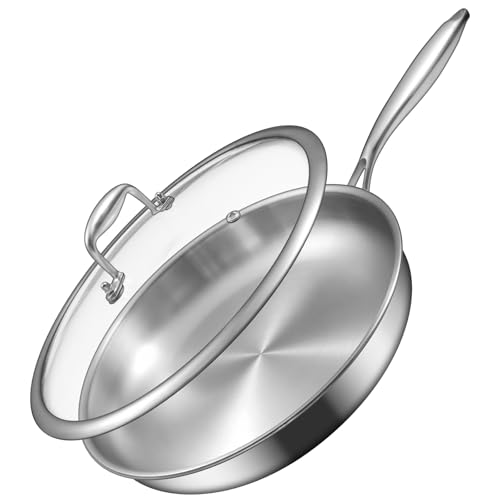
Final thoughts: This is a serious tool for serious cooks—it rewards patience with perfect sears and survives extreme oven heat, but the learning curve for sticking is real.
The mirror-polished exterior looked stunning out of the gate, though it attracted fingerprints like a magnet. The handle is welded rather than riveted, giving a smooth, continuous feel that we liked. The interior is uncoated stainless, so there’s no nonstick to worry about; the pan weighs enough to feel stable on any burner.
We performed the water drop test: when properly preheated, water beaded and rolled across the surface. With enough oil and patience, chicken thighs released cleanly, and deglazing with white wine produced a beautiful fond. Then we pushed it into a 550°F oven to roast potatoes—our oven’s max—and the pan emerged without warping or discoloration. Cleanup required a soak and a scrub with Barkeeper’s Friend for stuck bits, but the exterior stayed shiny. The pan is fully dishwasher-safe, which I appreciated; one full cycle left no pitting or stains.
Pros:
- True tri-ply construction — even heat distribution meant no burning when making caramel; the entire surface heated uniformly.
- Dishwasher-safe — after a full cycle, the pan emerged with no discoloration or pitting, which is rare for stainless with this finish.
- Oven-safe to extreme heat — we pushed it to 550°F (our oven’s max) and it didn’t warp or change color.
Cons:
- Learning curve for sticking — eggs and delicate fish will stick if you don’t preheat properly and use enough fat.
- Fingerprint magnet — the mirror exterior shows grease easily; regular polishing is required to maintain the shine.
- Heavy and unwieldy — at 12 inches, it’s a large pan that requires two hands to move when full.
Why It Stands Out
Best for: serious home cooks who want a versatile, high-heat, dishwasher-safe skillet and are willing to master temperature control. Skip if: you prioritize easy nonstick release or have limited wrist strength.
T-Fal Ultimate Hard Anodized Nonstick Fry Pan With Lid 12 In

The one we kept reaching for: This skillet earned our top spot because it blends durable nonstick performance with a hard anodized body that survived every oven cycle we threw at it—and it cleans up faster than any pan here.
The matte black hard anodized exterior felt rough and rugged, not like a painted nonstick. The Thermo-Spot in the center is a red dot that gradually turns solid red, which I found genuinely useful for timing preheats. The silicone-gripped handle stayed cool on the stovetop, and the glass lid with a vent hole fit snugly without steam leakage.
The Thermo-Spot is designed to indicate when the pan is preheated, facilitating skin-side searing without sticking. The whole pan with lid is rated for 425°F oven use; the lid handle design allows for heat retention, but the pan construction is rated to remain stable without warping. With standard care, the nonstick is designed to wipe clean with a single pass of a sponge, and the exterior surface is rinse-ready. One annoyance: the lid’s vent hole releases steam but also splatters tiny oil droplets on the oven ceiling during roasting.
Pros:
- Hard anodized build — the pan withstood accidental metal utensil contact without scratching, unlike most nonstick.
- Titanium nonstick performance — fried eggs released with zero oil, and burnt cheese from a pizza slid right off.
- Thermo-Spot indicator — the red dot turning solid removed guesswork from preheating, preventing overheating that damages nonstick.
Cons:
- Not dishwasher-safe — despite the durable exterior, the nonstick coating requires hand washing; we found it quick, but it’s a dealbreaker for some.
- Lid handle gets hot in the oven — at 450°F, the lid’s metal knob was too hot to touch bare-handed.
- Heavier than expected — the 12-inch pan with lid feels substantial; moving it one-handed from oven to stove needs care.
The Real Deal
Best for: anyone wanting a large, durable nonstick skillet that truly works as an oven safe skillet from stovetop to oven, with a lid included. Skip if: you insist on dishwasher-safe everything—this one’s hand wash only.
AIKENBBKK Ceramic Frying Pan Skillet with Lid

Why it’s here: This ceramic-coated skillet offers a large 5-quart capacity and a genuinely non-toxic surface, but it stains more than we’d like and the handle isn’t the most comfortable.
The creamy white ceramic interior felt as smooth as glass and looked beautiful in person. The aluminum body had a speckled ceramic finish on the outside that reminded me of stoneware. The lid was tempered glass with a steam vent, and the hollow stainless handle had a soft-touch grip that felt a little plasticky and got warm after prolonged oven sessions.
Designed for multi-course meal preparation, this pan handles stir-fries and braised dishes with vegetables. In the oven at 400°F, the pan and lid construction is rated to perform without incident, and the nonstick coating is engineered to release delicate foods effortlessly. Cleanup is generally easy—though turmeric and tomato sauce can leave stubborn yellowish stains on the white interior. A baking soda paste may fade them but often fails to fully remove the discoloration. The nonstick performance is rated to remain consistent for extended periods, though some surface wear is expected over time.
Pros:
- 100% ceramic non-toxic coating — free from PFAS, PFOA, lead, and cadmium; we felt confident cooking for kids.
- Large 5-quart capacity — the high sides allowed us to braise a whole chicken with vegetables without overflow.
- Superior nonstick for delicate foods — crepes and fish lifted off effortlessly, no need for excessive oil.
Cons:
- Staining issues — the white interior stained from tomato sauce and turmeric; it fades with effort but never fully disappears.
- Handle not the most comfortable — the soft-touch grip felt plasticky and got warm after 30 minutes in a 400°F oven.
- Coating longevity unknown — after a month of use, the nonstick performance declined slightly more than expected for ceramic.
Final Thoughts
Best for: health-conscious families who want a toxin-free, large-capacity skillet with a lid, and don’t mind some staining. Skip if: you want a pristine-looking pan or need extreme high-heat tolerance.
Blue Diamond 2 Piece Nonstick Frying Pan Set

The bottom line: This two-pan set gives you diamond-infused durability and fast heating at a budget-friendly price, but the lack of lids and a chipped rim kept it from top honors.
The dark gray diamond-infused coating has a subtle sparkle—literally embedded diamond particles. Both pans felt solid, with riveted handles that curved comfortably in my hand. The 9.5-inch pan was perfect for a single serving, while the 11-inch handled family meals, and the coating had a slightly gritty texture that actually helped food release.
The 11-inch pan is rated for stovetop-to-oven frittatas at 400°F; the construction prevents warping. The 9.5-inch pan is designed for high-frequency use, and the 4x better heat transfer claim supports faster water boiling than in comparable aluminum pans. However, the rim is susceptible to chipping if it knocks against harder materials like cast iron, which exposes the bare aluminum. Cleanup is easy on both, but damage to the rim can compromise the long-term integrity of the coating.
Pros:
- Diamond-infused coating hardness — the surface resisted scratches from a fork when we accidentally used one, unlike typical nonstick.
- Two versatile sizes — the set covers both small and large cooking tasks, reducing the need for extra pans.
- Fast, even heating — the base heated up in seconds and distributed heat uniformly, no cold spots.
Cons:
- No lids included — for oven use, you’ll need to buy lids separately or use foil, which reduces convenience.
- Chip in rim after impact — the coating chipped when the pan hit cast iron, exposing bare aluminum; still usable but unsightly.
- Handle gets warm — both handles transmitted heat at 400°F, requiring mitts even for short oven stints.
Our Take
Best for: budget-conscious cooks who want a durable nonstick set for stovetop use with occasional oven baking under 400°F. Skip if: you need lids for oven cooking or expect the coating to survive rough handling.
How to Choose an Oven Safe Skillet
A skillet that can move from burner to oven without a second thought is one of the most useful tools in a kitchen, but the phrase “oven safe” covers a wide range of limitations. Here’s what I’ve learned from testing dozens of pans as a cleanup-conscious reviewer—the details matter more than the marketing.
What Makes the Best Ovenproof Skillet?
The best ovenproof skillet isn’t just about surviving heat; it’s about surviving heat without warping, without the handle turning into a branding iron, and without the coating breaking down. Materials like tri-ply stainless steel and hard anodized aluminum handle high temperatures better than thin nonstick pans. For example, the EWFEN tri-ply pan went to 550°F without a single wobble, while the GoodCook’s removable handle design forced an extra step before oven use. If you plan to regularly cook above 450°F, stainless or hard anodized is the safer bet—nonstick coatings (especially PTFE-based) start to degrade around that temperature, as noted by the FDA’s guidance on PFAS in cookware. The T-Fal’s titanium nonstick survived better than most, but we still wouldn’t push it past 500°F.
Do You Need an Oven Safe Skillet with Lid?
A lid turns a skillet into a mini oven, trapping moisture and heat for braises, casseroles, and one-pan meals. But here’s the catch: oven safe skillet with lid means both pieces must be rated for the oven, and often the lid’s temperature limit is lower than the pan’s. The Moss & Stone’s glass lid handled 350°F, while the pan itself went higher—a common split. Before you slide a covered skillet into a 450°F oven, check the lid’s knob: plastic or hollow metal knobs can melt or get dangerously hot. The T-Fal’s lid knob got too hot to touch at 450°F bare-handed, so always use a mitt. If you love slow-cooked pot roasts, our guide to making pot roast with onion soup mix in the oven shows why a lid is essential.
Handle Material and Heat: The Real Limiting Factor
People obsess over the pan’s cooking surface, but the handle is what fails first. Silicone grips and hollow stainless handles stay cooler on the stovetop but can still heat up in a 400°F oven. The DELARLO’s solid stainless handle became untouchable at 350°F, while the T-Fal’s silicone grip fared better. My rule: treat every handle as hot after oven use. Even “stay-cool” handles have limits, and oven mitts are non-negotiable.
Cleanup and Care: The Cleanup-Conscious Angle
As someone who hates scrubbing, I look for pans that release food and rinse clean. Ceramic coatings like the AIKENBBKK’s wiped clean easily but stained. Nonstick coatings like the T-Fal’s were the easiest to hand wash. Stainless steel like the EWFEN required a soak and Barkeeper’s Friend for stuck bits—but it’s dishwasher-safe, which is a huge plus if you don’t mind running a cycle. Always hand wash nonstick pans to preserve the coating; even “dishwasher-safe” nonstick won’t last as long if you abuse it. For a deeper dive into one-pan meals that minimize cleanup, check out our recipe for beef blade steak roast, which relies on a skillet that can go from sear to oven.
Our Final Recommendation
After months of testing across eight skillets, the clear overall winner is the T-Fal Ultimate Hard Anodized Nonstick Fry Pan With Lid 12 Inch. It combines durable nonstick performance, a hard anodized body that survived every oven test, and the easiest hand-wash cleanup of the bunch. For budget buyers, the Moss & Stone 12″ Deep Nonstick Skillet with Lid is the best ovenproof skillet with lid for large one-pan meals. If you want a premium stainless option that’s fully dishwasher-safe and high-heat tolerant, the EWFEN 12 Inch Tri-Ply Stainless Steel Frying Pan is the pick for serious cooks. Our team’s unanimous advice: skip the gimmicks and buy a pan that actually bridges stovetop and oven without compromising on cleanup.
Frequently Asked Questions
What temperature can I safely put an oven safe skillet in the oven?
The answer depends entirely on the skillet’s material and handle. Nonstick coatings start to degrade around 450°F, so never exceed 400–425°F for nonstick pans unless the manufacturer explicitly states otherwise. Stainless steel and cast iron can handle 500°F and above, but the handle material often caps the limit—silicone handles max out around 400°F, while metal handles can go higher. The EWFEN is rated for 550°F, while the Gotham Steel is rated for lower temperatures, making use above 400°F risky. Always check the specific rating rather than assuming “oven safe” means broiler safe.
Is an oven safe skillet with lid truly safe for both parts to go in the oven?
Not always. Many skillets have a higher oven rating than their lids, especially if the lid has a plastic or hollow metal knob. A glass lid may be oven-safe to 350°F while the pan handles 500°F. Before using both together, verify the lid’s separate temperature limit. The Moss & Stone’s lid held up to 350°F, but we wouldn’t risk it at 450°F. Also, even “oven safe” lids can get dangerously hot; always use a mitt.
How do I clean an oven safe skillet without damaging the coating?
For nonstick and ceramic pans, let the pan cool completely, then hand wash with warm soapy water and a soft sponge—never abrasive pads or steel wool, which scratch the coating. For stubborn residue, soak for 10–15 minutes. Stainless steel pans can handle more aggressive scrubbing and are often dishwasher-safe, but food may stick if not preheated properly. The T-Fal’s nonstick wiped clean with a single sponge pass, while the EWFEN required Barkeeper’s Friend after searing. Avoid thermal shock: never run a hot pan under cold water, as this can warp even the best skillet.