Abrasive choice matters more than the number of stages printed on a knife sharpener. The best way to sharpen a knife depends on its steel, bevel, edge thickness, and how much metal the abrasive removes.
Here’s the short answer: the HFS(R) Sharpening Stone is my overall pick because its four diamond-grit surfaces offer more control than a fixed carbide slot, provided you follow the product directions for lubrication and angle. For beginners who want the least technique, Zwilling’s four-stage design is the safer recommendation on paper.
easycookingways.com is funded by affiliate commission. Our picks come from comparing published specifications and documented features against what matters in the category — no brand pays for a place on this page. If you buy through a link here we may earn a commission at no extra cost to you, and it pays for the research behind the next guide. Full disclosure.
As an Amazon Associate we earn from qualifying purchases. This does not affect the price you pay.
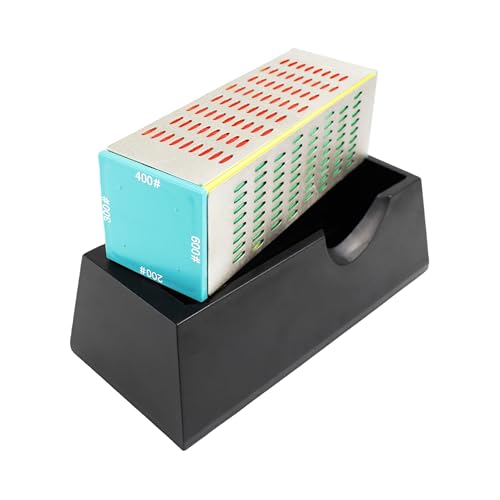
HFS(R) Sharpening Stone Diamond Knife Sharpener 4-Way Industrial Grade 200 to 600 Grit (Most Control)
In this guide
- The short answer
- HFS(R) Sharpening Stone Diamond Knife Sharpener 4-Way Industrial Grade 200 to 600 Grit (Most Control)
- AnySharp GLOBAL Easy to Use (Best Hands-Free Design)
- Longzon 6-in-1 Knife Sharpener 5 Stage (Best Accessory Bundle)
- ADDYNO 3-Stage Knife Sharpener for Kitchen Knives (Best Value)
- PAUDIN Kitchen Knife Sharpener (Best-Looking Countertop Option)
- Zwilling 4-Stage Ultra-Sharp Knife Sharpener (Best Premium Pick)
- How to Choose the Best Way to Sharpen a Knife at Home
- Our Final Recommendation
- Frequently Asked Questions
The short answer
- Best overall: HFS(R) Sharpening Stone – Four diamond grits give the most progression control
- Best hands-free option: AnySharp GLOBAL – Suction base and a simple guided slot
- Best accessory bundle: Longzon 6-in-1 Sharpener – Five stages plus a cut-resistant glove
- Best value: ADDYNO 3-Stage Sharpener – Three abrasive stages and a non-slip base
- Best for neat counters: PAUDIN Kitchen Sharpener – Guided slots in a walnut-colour body
- Best premium pick: Zwilling 4-Stage Sharpener – Coarse and fine stages for two blade styles
How We Chose These Kitchen Knife Sharpeners
These picks come from comparing published specifications, materials and documented features against what actually matters in kitchen knife sharpening. Abrasive type and progression received the most weight: diamond, ceramic, tungsten steel and carbide-style abrasives do not remove metal in the same way, and coarse stages should not be used casually on a thin or finely finished edge. Edge-angle control came next, because a sharp abrasive cannot rescue a bevel that is repeatedly held at the wrong angle. Base stability also matters; a sharpener that moves can encourage uneven pressure or force a blade through a slot. The main failure modes are removing too much metal, raising an uneven burr, flattening serrations, and damaging a thin edge. Buyers should check their knife’s steel, bevel style and manufacturer guidance before ordering. The HFS listing does not state whether water or oil is required, so that detail must be confirmed from its instructions rather than guessed.
| Product | Best for | Abrasive or stage detail | Stability or control detail |
|---|---|---|---|
| HFS(R) Sharpening Stone | Manual progression | Diamond, 200 to 600 grit | ABS holder, non-slip base |
| AnySharp GLOBAL | Beginner setup | Abrasive not listed | PowerGrip suction base |
| Longzon 6-in-1 Sharpener | Accessory bundle | Five stages, abrasives not listed | Non-slip base and glove |
| ADDYNO 3-Stage Sharpener | Named materials | Ceramic, tungsten steel, diamond | Wide non-slip base |
| PAUDIN Kitchen Sharpener | Guided dry use | Abrasive not listed | Precision guides, non-slip base |
| Zwilling 4-Stage Sharpener | Knife-style guidance | Coarse and fine stages | Non-slip bottom, 0.77 pounds |
HFS(R) Sharpening Stone Diamond Knife Sharpener 4-Way Industrial Grade 200 to 600 Grit (Most Control)
- BrandHFS
- ModelSPN-STONE-10
- Dimensions6.0 inches x 3.0 inches x 3.0 inches
- Weight1.21 Pounds
Why it earns a spot: This is the strongest choice for a sharpness perfectionist who wants abrasive progression rather than a one-slot shortcut.
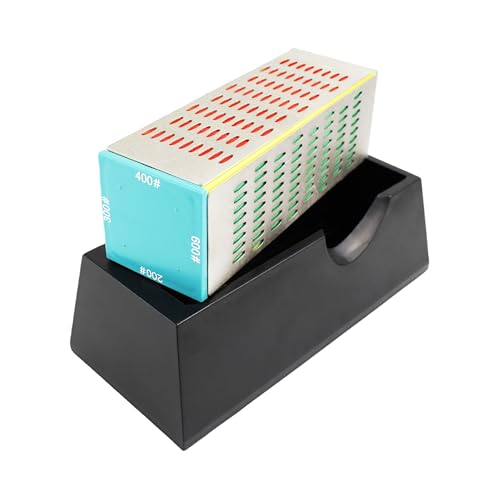
The HFS model SPN-STONE-10 measures 6.0 by 3.0 by 3.0 inches and weighs 1.21 pounds. The listing describes a diamond-coated surface in an ABS holder with a non-slip base, plus four sides marked 600 fine, 400 medium, 300 coarse and 200 extra coarse. That range gives a buyer more opportunity to match the abrasive to the edge instead of attacking every knife with one aggressive wheel.
The progression is the reason I place it first. A genuinely dull knife may need a coarse stage before refinement, while a knife that has merely lost bite should stay on the finer side. The trade-off is technique: a stone does not automatically set the angle, and the listing does not state a required water, oil or dry-sharpening method. Compared with the fixed-slot models here, the HFS can offer more control but gives beginners more chances to create an inconsistent bevel.
Pros:
- Four diamond grits – 200, 300, 400 and 600 provide a documented coarse-to-fine progression.
- Non-slip ABS holder – The holder is designed to keep the abrasive platform steadier than a loose stone.
- 1.21-pound body – The listed weight is substantial within this group and supports a more planted countertop setup.
Cons:
- Angle is manual – There is no documented angle guide, so bevel control depends on the user’s technique.
- Lubricant is not listed – The product information does not say whether water, oil or no lubricant is appropriate.
- Coarse surfaces can be excessive – The 200 and 300 sides should not be the default for thin, hard or finely finished Japanese edges.
Final Thoughts
Ideal for: cooks who want the best way to sharpen kitchen knives with visible abrasive progression and are willing to learn angle control. Pass on this if: you want a foolproof slot, need documented serrated-knife compatibility, or do not want to confirm the correct lubricant.
AnySharp GLOBAL Easy to Use (Best Hands-Free Design)

- BrandAnySharp
- ModelANYSHARPRED
- Dimensions4.33 inches x 6.1 inches x 2.76 Inches
- Weight0.18 pounds
- Size / capacityOne Size
- ColourDark Red
Quick take: AnySharp is aimed at beginners who value a suction base and guided simplicity more than fine control over the bevel.
The AnySharp model ANYSHARPRED measures 4.33 by 6.1 by 2.76 inches, weighs 0.18 pounds and is listed in Dark Red. Its documented PowerGrip suction base is intended to hold the sharpener in place while the knife is pulled through a guided path. That arrangement removes much of the angle-guessing that makes sharpening a knife at home intimidating for a new user.
The limitation is equally clear. The listing does not identify the abrasive material, stage progression or angle, so the buyer cannot judge how aggressively the sharpener removes steel from the published information alone. A fixed slot can be convenient, but forcing a blade through an unsuitable slot may leave an uneven or overly thick edge. This is a more approachable design than the manual HFS stone, yet it offers less information for a buyer choosing between Western and Japanese bevels.
Pros:
- PowerGrip suction base – The documented hands-free feature is intended to reduce movement during a pull-through stroke.
- 0.18-pound listed weight – Its light body is easy to store and suited to buyers who want a compact kitchen tool.
- Guided sharpening path – The design avoids asking beginners to estimate an angle from scratch.
Cons:
- Abrasive type not listed – The product information does not identify whether the working abrasive is diamond, ceramic or carbide.
- Progression not listed – There is no documented coarse and fine sequence to match different levels of dullness.
- Limited compatibility information – Serrated edges, thin Japanese blades and unusual bevels should not be assumed compatible.
Who Should Buy This
Great match for: beginners seeking the easiest way to sharpen a knife with a fixed position and minimal setup. Think twice if: your priority is a carefully controlled bevel, a known abrasive, or a sharpener for serrated knives.
Longzon 6-in-1 Knife Sharpener 5 Stage (Best Accessory Bundle)
- Brandlongzon
- Modelks-040
- Dimensions10.23 inches x 3.74 inches x 2.16 inches
- ColourNavy+Orange
In a nutshell: Longzon offers the broadest documented feature package here, but its five-stage claim needs to be understood as a convenience feature rather than proof of superior edge work.
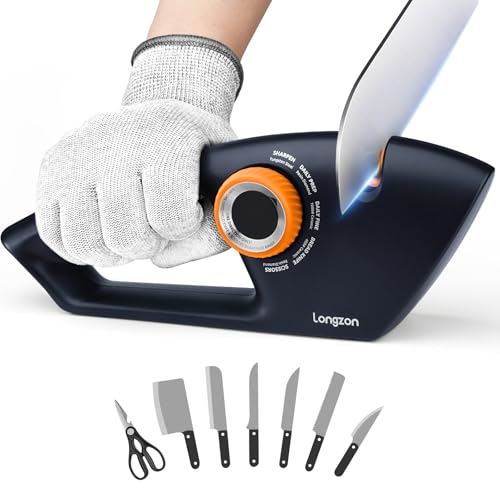
The Longzon model ks-040 measures 10.23 by 3.74 by 2.16 inches and comes in Navy+Orange. The listing describes a five-stage sharpener with a non-slip base, a cut-resistant glove and support for kitchen knives, scissors and other blades. The glove adds a documented safety accessory, while the long body may suit a buyer who wants the sharpener to occupy a defined section of the counter.
Five stages can be useful only if each stage has a clear job and the user applies the right one. The supplied information does not identify every abrasive, the angle, the stage order or the material of the body, so I would not choose Longzon solely because its stage count is higher than the HFS or ADDYNO. Our preference is to treat the coarse stage as occasional repair work, use finer stages for maintenance, and avoid all fixed pull-through stages on serrated edges unless the manufacturer explicitly supports them.
Pros:
- Five-stage format – More documented stages than the three-stage ADDYNO and the single guided path of AnySharp.
- Cut-resistant glove included – The listing provides a dedicated accessory for hand protection during sharpening.
- Non-slip base – A stable base is important when pressure is applied through multiple guided slots.
Cons:
- Stage abrasives are not identified – The listing does not explain which abrasive handles repair, refinement or honing.
- Angle information is missing – More stages cannot compensate for an angle that does not match the knife’s bevel.
- No serrated-edge approval is documented – Its broad blade compatibility claim should not be extended automatically to scalloped edges.
Why It Stands Out
Perfect for: households that want a broad kitchen accessory package, a non-slip base and a supplied glove. Not great if: you need transparent abrasive specifications or are buying for a thin Japanese knife whose edge deserves gentle, controlled work.
ADDYNO 3-Stage Knife Sharpener for Kitchen Knives (Best Value)

- BrandAddyno
- ModelAKS301
- Dimensions7.87 inches x 2.95 inches x 1.77 inches
- Size / capacity7.87
- ColourBlack
Here’s the deal: ADDYNO makes the stage sequence easy to understand, but its tungsten steel stage deserves more caution than the simple slot layout suggests.
The Addyno model AKS301 measures 7.87 by 2.95 by 1.77 inches, is listed in Black, and has a documented ceramic stage on the left, tungsten steel in the centre and diamond on the right. Its wide non-slip base is intended to keep the unit stable on a countertop. The three materials at least give the buyer a clearer idea of the progression than products whose abrasive type is not listed.
That clarity does not make every stage suitable for every knife. Ceramic is harder than metal, so its presence makes sense as a refining stage, while tungsten steel and diamond can be unnecessarily aggressive for a thin, hard or finely finished edge. Compared with PAUDIN, ADDYNO offers more explicit abrasive information; compared with HFS, it offers less manual progression and less information about exact grit sizes. For the best way to sharpen a knife at home, the important choice is still the stage and pressure, not simply pulling through all three slots.
Pros:
- Named ceramic stage – Ceramic is identified as one of the three working materials and can serve a fine-edge role.
- Documented diamond stage – Diamond is listed for the sharpener’s more abrasive side.
- Wide non-slip base – The base addresses countertop movement, a key concern for a guided sharpener.
Cons:
- Tungsten steel can be aggressive – The central stage should not be used casually on thin or delicate edges.
- Exact grit is not listed – Buyers cannot match a numerical grit to a particular repair or refinement task.
- Not for assumed serrated use – The listing does not explicitly approve the slots for serrated blades.
Our Take
Best for: budget-minded cooks who want the abrasive categories named and prefer a stable three-stage layout. Skip if: your knives are thin, finely finished or serrated and the manufacturer cannot confirm slot compatibility.
PAUDIN Kitchen Knife Sharpener (Best-Looking Countertop Option)

- BrandPAUDIN
- ModelKS8C
- Dimensions7.75 inches x 1.96 inches x 1.85 inches
- ColourWalnut
Why it earns a spot: PAUDIN is a sensible choice for someone who wants guided sharpening and a more considered countertop presentation without handling a loose stone.
The PAUDIN model KS8C measures 7.75 by 1.96 by 1.85 inches and is listed in Walnut. Its documented features include precision angle guides, a non-slip base and a no-water, no-oil pull-through design. The angle guides are the key specification because keeping the blade aligned with its existing bevel is more important than adding extra stages.
PAUDIN’s simplicity also exposes its weakness. The listing does not state the abrasive type, stage progression or exact angle, so a buyer cannot assess how the sharpener will interact with a particular steel or bevel. The one-pull design may suit routine kitchen maintenance, but a genuinely dull edge may need a more controlled abrasive progression such as the four diamond surfaces on HFS. For readers researching the best way to sharpen a blade, PAUDIN is a convenience option, not a universal answer.
Pros:
- Precision angle guides – The documented guides reduce the need to estimate the bevel by eye.
- No water or oil required by the listing – The stated dry design avoids the setup associated with a waterstone or oilstone.
- Walnut colour and non-slip base – The appearance is more deliberate than an entirely utilitarian body, while the base addresses movement.
Cons:
- Abrasive material is not listed – The buyer cannot confirm whether the working surface is diamond, ceramic or carbide.
- One-pull design limits progression – The listing does not explain separate coarse and fine stages for different edge conditions.
- Angle value is not listed – Precision guides are less useful if their angle does not suit the knife’s existing bevel.
The Real Deal
Ideal for: cooks who want guided, dry sharpening in a compact body and are prepared to confirm compatibility first. Pass on this if: you need a named abrasive, numerical grit progression or a repair-focused sharpener for very dull knives.
Zwilling 4-Stage Ultra-Sharp Knife Sharpener (Best Premium Pick)

- BrandZWILLING
- Model32602-001
- Dimensions7.63 inches x 1.81 inches x 10.5 inches
- Weight0.77 Pounds
- Size / capacity1 unit
- ColourStainless Steel
Final verdict on this model: Zwilling is the most convincing beginner-friendly premium option because the listing documents four stages and support for Western and Asian-style blades.
The Zwilling model 32602-001 measures 7.63 by 1.81 by 10.5 inches, weighs 0.77 pounds, and is listed in Stainless Steel. Its four-stage design includes coarse and fine functions for both Western and Asian-style blades, along with a comfortable handle and non-slip bottom. Those distinctions matter more than a generic four-stage label because blade geometry differs between knife styles.
Zwilling still does not list the abrasive material, exact angles or warranty, so it cannot match HFS for technical transparency. The four-stage structure should also not be read as permission to sharpen every knife in the drawer, especially serrated edges or unusually thin blades. Compared with AnySharp, Zwilling offers more documented progression; compared with ADDYNO, it gives clearer blade-style guidance but less abrasive detail.
Pros:
- Four documented stages – Coarse and fine functions are listed for both Western and Asian-style blades.
- Non-slip bottom – The base is designed to support stable countertop sharpening.
- 0.77-pound listed weight – The body is heavier than AnySharp’s listed 0.18 pounds and lighter than HFS’s 1.21 pounds.
Cons:
- Abrasive material is not listed – Buyers cannot compare its working surfaces directly with HFS, ADDYNO or other named abrasives.
- Exact angle is not listed – Western and Asian-style labels help, but the actual guide geometry remains unspecified.
- Serrated compatibility is not stated – The four stages should not be used on scalloped edges without explicit manufacturer approval.
Who Should Buy This
Great match for: buyers who want a premium-priced, guided sharpener with documented coarse and fine options for two broad knife styles. Think twice if: you demand a named abrasive and exact angle, or your collection includes serrated and unusually thin blades.
How to Choose the Best Way to Sharpen a Knife at Home
Best way to sharpen a knife at home: match the abrasive to the edge
Sharpening removes metal and changes the edge; honing mainly realigns an existing edge. A honing steel can help maintain an edge that has rolled slightly, but it is not a substitute for sharpening a genuinely dull knife. Whetstones are blocks made from natural or man-made stone containing abrasive particles of consistent size, while waterstones are whetstones designed for use with water.
HFS is the clearest stone-style choice here because its diamond surfaces are labelled 200, 300, 400 and 600 grit. Pull-through models are easier to position, but their abrasive progression is less transparent unless the listing names the stages.
Angle control matters more than stage count
The correct angle and bevel compatibility matter more than having three, four or five stages. A guided slot can help a beginner, while the HFS requires the blade to be held consistently by hand. AnySharp, PAUDIN and Zwilling all focus on guided use, but only PAUDIN explicitly describes precision angle guides, and Zwilling explicitly distinguishes Western and Asian-style blades.
Carbide sharpening wheels and coarse diamond surfaces can remove too much metal if used as routine maintenance. ADDYNO identifies tungsten steel, ceramic and diamond, but it does not publish grit sizes; the coarse or more aggressive stage should therefore be reserved for an edge that truly needs it.
Protect thin and serrated edges
Multi-stage pull-through sharpeners generally should not be used on serrated edges unless the manufacturer explicitly supports them, because a slot can flatten or damage the scallops. None of the six listings provides a clear serrated-edge approval, so a serrated knife should not be treated as compatible by default.
Japanese, high-carbon and thin-bladed knives deserve the same caution. A sharpener may be marketed as universal, yet the knife’s steel, bevel and edge geometry still determine whether the abrasive is suitable. Buyers comparing chef knives can also use our guide to the differences between santoku and chef knives before choosing a sharpening method.
Consider maintenance and long-term cost
A stone and a pull-through sharpener have different maintenance needs. A stone may require the specified lubricant, drying and storage, while fixed abrasive slots need cleaning and should not be treated as interchangeable with a whetstone. The HFS listing does not state replacement abrasive availability or warranty, and the other listings also leave warranty information unlisted, so long-term replacement cost cannot be confirmed from the published data.
For safety, keep the blade moving away from your fingers and use a stable base; general consumer-product safety guidance is available from the U.S. Consumer Product Safety Commission. A stable base is not a substitute for careful hand placement, and a supplied glove does not make an unsuitable abrasive or angle safe for every knife.
Our Final Recommendation
HFS is my overall winner because the four diamond surfaces give the buyer the clearest progression and the most room to control metal removal. ADDYNO is the budget pick for shoppers who want ceramic, tungsten steel and diamond identified in one body. Zwilling is the premium pick for beginners who want four guided stages and documented support for Western and Asian-style blades. If you want to learn how to properly sharpen a knife, choose HFS and accept the technique. If you want fewer decisions, choose Zwilling. None should be treated as automatically suitable for serrated, thin or unusual edges.
Frequently Asked Questions
What is the best way to sharpen a knife at home for a beginner?
A guided sharpener is usually easier to position than a loose stone because the slot or guide helps control the blade path. Zwilling documents four stages for Western and Asian-style blades, while PAUDIN lists precision angle guides and a non-slip base. Beginners should still confirm compatibility, use the least aggressive suitable stage and avoid assuming that a guided sharpener works on serrated edges.
How does kitchen knife sharpening differ from honing?
Sharpening removes metal and creates a new edge profile, while honing mainly realigns an existing edge. A honing steel can help maintain a knife that has started to lose alignment, but a genuinely dull knife needs an abrasive. HFS offers four diamond surfaces from 200 to 600 grit, while the fixed-slot products use documented stages without always listing their abrasive materials.
Is a whetstone better than a pull-through sharpener for most kitchen knives?
A whetstone offers more control over angle, bevel and progression, but it requires more technique. A pull-through sharpener is simpler and may be preferable for a beginner who values repeatable positioning. HFS provides the clearest stone-style progression in this group, while Zwilling, AnySharp and PAUDIN reduce angle guesswork. Neither format should be used on a serrated edge without explicit approval.
Can carbide or coarse diamond damage a thin Japanese knife?
Yes, an aggressive abrasive can remove more metal than necessary from a thin or finely finished edge, especially when the angle does not match the bevel. ADDYNO lists tungsten steel and diamond, and HFS lists 200 and 300 diamond grits, so both require restraint on delicate knives. Check the knife maker’s guidance and use a finer, compatible method when the edge geometry calls for it.
Why does a knife still feel dull after sharpening?
A knife may still feel dull if the abrasive never reached the full bevel, the angle changed during each pass, or a rough burr remains on one side. Using every stage in a multi-stage sharpener can also remove unnecessary metal without fixing alignment. Work from the least aggressive suitable stage, keep pressure consistent, refine the burr, and test sharpness safely without running a finger along the edge.