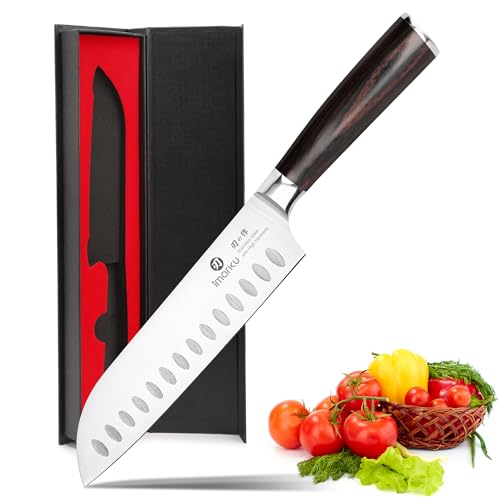
A crowded cutting board, a pile of vegetables, and a knife that feels awkward after repeated chopping are enough to make the right blade shape matter. The best santoku knife should give you controlled push cuts, a comfortable grip, and steel that suits your sharpening habits.
Our overall pick is the Mercer Culinary M20707 Genesis because its documented forged construction, 0.19-pound weight, ergonomic non-slip handle, and lifetime limited warranty make the most balanced case for everyday home prep.
easycookingways.com is funded by affiliate commission. Our picks come from comparing published specifications and documented features against what matters in the category — no brand pays for a place on this page. If you buy through a link here we may earn a commission at no extra cost to you, and it pays for the research behind the next guide. Full disclosure.
As an Amazon Associate we earn from qualifying purchases. This does not affect the price you pay.
Mercer Culinary M20707 Genesis 7-Inch Santoku Knife (light forged design)

In this guide
- The best santoku knife: the short answer
- The short answer
- imarku Santoku Knife (lightweight hollow-edge design)
- Mercer Culinary M20707 Genesis 7-Inch Santoku Knife (light forged design)
- KEEMAKE 7-Inch Santoku Knife (1.4116 steel and pakkawood handle)
- Shun Premier 7-Inch Santoku Knife (VG-MAX and Damascus cladding)
- How to choose the right santoku knife
- Our Final Recommendation
- Frequently Asked Questions
The best santoku knife: the short answer
The short answer
- Best overall: imarku Santoku Knife — Lightweight option with a hollow edge
- Best value: Mercer Culinary M20707 Genesis — Light forged design with warranty support
- Best for controlled heft: KEEMAKE 7-Inch Santoku Knife — 1.4116 steel and pakkawood handle
- Best premium pick: Shun Premier 7-Inch Santoku Knife — VG-MAX core with Damascus cladding
| Product | Best for | Weight | Documented construction or feature |
|---|---|---|---|
| imarku Santoku Knife Check price | Light everyday prep | 0.43 pounds | 7-inch size; hollow edge |
| Mercer Culinary M20707 Genesis Check price | Everyday home cooking | 0.19 pounds | Precision-forged; lifetime limited warranty |
| KEEMAKE 7-Inch Santoku Knife Check price | Secure handle control | 0.51 pounds | 1.4116 steel; 58 HRC claim |
| Shun Premier 7-Inch Santoku Knife Check price | Premium knife care | 0.47 pounds | VG-MAX steel; 68-layer Damascus cladding |
How these santoku knives were chosen
These picks come from comparing published specifications, materials, documented features, and warranty information against the things that decide a santoku purchase. Blade steel matters, but edge geometry, grind, balance, and handle control matter just as much. Edge retention has limited value if the steel cannot be sharpened appropriately or the handle creates wrist fatigue during repetitive chopping. A santoku’s broad, relatively short blade and flatter edge favor push-cutting and chopping; the profile is less suitable for aggressive rocking than a Western chef’s knife. We also considered the main ways buyers go wrong: selecting a delicate edge for dense ingredients, using a rocking motion that does not suit the profile, and mistreating high-carbon stainless steel through dishwashing, moisture, or aggressive sharpening. The listing’s stated weight, construction, handle description, edge treatment, steel information, and warranty received the most attention. Before ordering, check the return terms, confirm the seller’s current specification page, and decide whether your cutting board, storage, and sharpening method suit a Japanese Santoku blade profile.
imarku Santoku Knife (lightweight hollow-edge design)
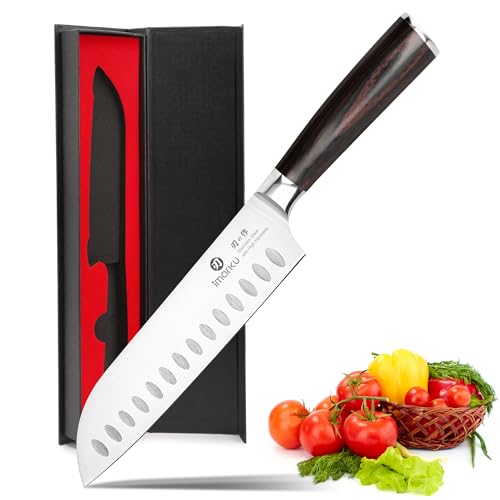
- Brandimarku Santoku
- ModelI-KSK0064DB
- Dimensions12.0 inches x 3.0 inches x 1.0 inches
- Weight0.43 pounds
- Size / capacity7"
- ColourBrown and Silver
Quick take: The imarku is a sensible choice for cooks seeking a lighter 7-inch santoku with a documented hollow-edge design and an accessible, budget-friendly position.
The listing identifies the model as I-KSK0064DB and gives a 7-inch size, a 0.43-pound weight, and dimensions of 12.0 by 3.0 by 1.0 inches. Its brown-and-silver finish is paired with the manufacturer’s claim of Japanese high-carbon stainless steel and a scalloped hollow edge. The material and warranty are not listed as verified specifications, so buyers should treat the steel description as seller-provided marketing rather than a complete metallurgy report.
A hollow edge can create small pockets of space between the blade and food, which may reduce sticking during vegetable prep. It does not replace a properly sharpened edge or correct cutting technique. Compared with the 0.19-pound Mercer, the imarku has more listed weight, while its 7-inch format remains shorter and more compact than many Western chef’s knives. The missing steel grade and warranty weaken its long-term value case.
Pros:
- 7-inch blade size — A shorter santoku profile favors controlled chopping and push cuts.
- 0.43-pound weight — The listing gives a concrete weight for shoppers comparing wrist load.
- Hollow edge design — Scallops may help create separation between food and blade.
- Japanese high-carbon stainless claim — The advertised steel type points toward a sharp, maintenance-sensitive edge.
Cons:
- Steel grade not listed — Buyers cannot judge sharpening behavior or edge retention from a named alloy.
- Warranty not listed — Long-term support is unclear.
- Marketing claims are not independent measurements — The listing does not document a hardness rating or edge angle.
Our Take
Ideal for: Beginners and cooks who want a compact, lighter santoku for vegetables, herbs, boneless meat, and fish. Pass on this if: You want a fully specified steel, a documented warranty, or a premium handle and cladding story. The imarku is a reasonable candidate for the best budget santoku knife, but the missing material details keep it from being our overall winner.
Mercer Culinary M20707 Genesis 7-Inch Santoku Knife (light forged design)
- BrandMercer Culinary
- ModelM20707
- Dimensions2.0 inches x 1.0 inches x 13.0 inches
- Weight0.19 pounds
- Size / capacity7"
- ColourBlack
- WarrantyLifetime limited manufacturer's warranty
Why it earns a spot: The Mercer is the strongest all-round value here for a home cook who wants a light knife, an ergonomic non-slip handle, and warranty coverage.
Mercer lists the M20707 as a 7-inch santoku weighing 0.19 pounds, with dimensions of 2.0 by 1.0 by 13.0 inches and a black finish. Its listing describes precision-forged construction using high-carbon German steel, a taper-ground edge, and an ergonomic handle with a non-slip grip. The exact material grade is not listed, so the German steel description does not tell buyers everything about sharpening or retention.
The low listed weight should appeal to anyone sensitive to wrist fatigue during repeated chopping, though balance cannot be confirmed from the specification sheet alone. Taper-ground geometry is relevant because a thinner, gradually narrowing edge can support cleaner cutting, but the listing does not provide an edge angle. The lifetime limited manufacturer’s warranty gives Mercer an advantage over the imarku and KEEMAKE listings, whose warranties are not listed.
Pros:
- 0.19-pound weight — The lightest listed knife here should suit cooks who prioritize low wrist load.
- Precision-forged construction — The documented construction gives the knife a clearer build description than several rivals.
- Taper-ground edge — The geometry is intended to support chopping, mincing, and cutting.
- Lifetime limited manufacturer’s warranty — Warranty support improves the value case for regular home use.
Cons:
- Exact steel grade not listed — Retention and sharpening needs remain difficult to predict.
- Very low listed weight — Cooks who prefer a more substantial blade may find the specification less appealing.
- No documented hollow edge — Food release is not a stated design feature.
Final Thoughts
Great match for: Beginners, smaller-handed cooks, and anyone who wants a light santoku for onions, herbs, vegetables, boneless proteins, and fish. Think twice if: You specifically want premium Japanese steel, Damascus cladding, or a heavier feel. I would choose the Mercer as the overall best santoku knife because its documented handle control, forged construction, low weight, and warranty form the most useful combination.
KEEMAKE 7-Inch Santoku Knife (1.4116 steel and pakkawood handle)

- BrandKEEMAKE
- ModelZ2340106K-2K
- Weight0.51 pounds
- Size / capacity7"
- Colour7” Santoku Knife
In a nutshell: KEEMAKE suits cooks who prefer a more substantial listed weight and a shaped pakkawood handle, provided the manufacturer-stated steel details meet their expectations.
The KEEMAKE model is Z2340106K-2K, with a 7-inch size and a listed weight of 0.51 pounds. Dimensions, material, and warranty are not listed in the verified specification block, although the seller describes the blade as 1.4116 high-carbon stainless steel hardened to 58 HRC and the handle as pakkawood. The listing identifies the colour field simply as “7” Santoku Knife,” which gives little useful finish information.
At 0.51 pounds, this is the heaviest knife in the comparison, so its specification points toward a more substantial cutting tool rather than the low-fatigue approach of the Mercer. The claimed 58 HRC hardness gives a buyer more technical information than the imarku or Mercer pages, but hardness alone does not determine edge stability, grind quality, or sharpening difficulty. A shaped handle may help guide the blade, yet the listing does not provide balance measurements or handle dimensions.
Pros:
- 1.4116 steel claim — A named steel gives shoppers more information than an unspecified high-carbon description.
- 58 HRC claim — The stated hardness helps frame expectations about edge maintenance.
- 0.51-pound weight — The heavier specification may appeal to cooks who prefer more blade presence.
- Pakkawood handle — The shaped handle is intended to provide a secure, comfortable grip.
Cons:
- Warranty not listed — Support after purchase is unclear.
- Dimensions not listed — Cabinet storage and blade clearance are harder to assess.
- Heaviest option here — The 0.51-pound weight may increase wrist fatigue during repetitive chopping.
The Real Deal
Perfect for: Cooks who want a 7-inch santoku with a more substantial weight and a shaped handle. Not great if: You favor the lightest possible knife, have smaller hands, or want a warranty and complete dimensional data before ordering. KEEMAKE can be the best santoku for shoppers who value a named steel and firm handle concept over low weight.
Shun Premier 7-Inch Santoku Knife (VG-MAX and Damascus cladding)

- BrandShun
- ModelTDM0702
- Dimensions12.25 inches x 0.75 inches x 1.82 inches
- Weight0.47 pounds
- Size / capacity7"
- ColourBrown
- WarrantyLimited lifetime warranty
What sets it apart: The Shun Premier is the premium option for buyers who value a documented VG-MAX steel claim, a hammered finish, and a limited lifetime warranty.
The Shun TDM0702 is a 7-inch santoku weighing 0.47 pounds, with listed dimensions of 12.25 by 0.75 by 1.82 inches and a brown finish. The manufacturer describes a VG-MAX steel blade with 68 layers of Damascus cladding and a hammered tsuchime finish. Those construction details are more specific than the material descriptions for the imarku and Mercer, while the limited lifetime warranty adds support that KEEMAKE does not list.
Damascus pattern and hammered texture can make a blade visually distinctive, but the pattern alone does not make a santoku sharper or longer-lasting. The meaningful buying details are the claimed VG-MAX steel, edge geometry, sharpening compatibility, and handle control; the listing does not provide an edge angle or balance point. At 0.47 pounds, the Shun is lighter than KEEMAKE but heavier than Mercer, placing it in a middle ground for listed weight.
Pros:
- VG-MAX steel claim — The named steel gives the premium blade a clearer material identity.
- 68 layers of Damascus cladding — The cladding provides a documented layered construction and distinctive appearance.
- Hammered tsuchime finish — The finish may assist food release, though it is not a substitute for sharp geometry.
- Limited lifetime warranty — Warranty coverage supports the premium purchase.
Cons:
- Premium maintenance expectations — The listed high-performance construction deserves hand washing, prompt drying, and suitable sharpening.
- Edge angle not listed — Buyers still need guidance on the correct sharpening method.
- Higher purchase commitment — The premium materials and warranty are meaningful only if the owner maintains the knife carefully.
Who Should Buy This
Best for: Experienced home cooks who will hand-wash, dry, store, and sharpen a premium santoku properly, especially for vegetables, herbs, boneless meat, and fish. Skip if: You want a carefree dishwasher knife or regularly cut bones, frozen food, or hard ingredients by force. The Shun is our premium pick, but the Mercer remains the better overall recommendation for most kitchens.
How to choose the right santoku knife
What makes the best santoku knife different?
A santoku generally has a broad, shorter blade and a flatter edge than a Western chef’s knife. That profile favors push-cutting and chopping, while aggressive rocking cuts are better suited to a Western chef’s knife or some Japanese gyuto knives. Our comparison of santoku and chef knives explains the profile difference in more detail.
For small hands or less knife experience, the Mercer deserves attention because its listed 0.19-pound weight and non-slip ergonomic handle prioritize control. The imarku’s 0.43 pounds, KEEMAKE’s 0.51 pounds, and Shun’s 0.47 pounds give progressively different weight choices, but none of the listings provides a balance point or handle dimensions. Buyers should check those details with the seller if grip fit is critical.
Steel, edge geometry, and sharpening
Steel affects how an edge responds to sharpening and how long it may remain serviceable, but hardness is only one part of the decision. KEEMAKE lists 1.4116 steel at 58 HRC, Shun lists VG-MAX with 68 layers of Damascus cladding, and Mercer describes high-carbon German steel with a taper-ground edge. The imarku listing describes Japanese high-carbon stainless steel but does not provide a grade or hardness figure.
A Granton or hollow-ground edge can reduce food sticking, but it does not replace sharpness, suitable geometry, or correct technique. Pull-through sharpeners, honing rods, and whetstones are not equally appropriate for every edge construction; use the maker’s guidance before sharpening. Our guide to choosing a suitable knife-sharpening method covers that decision.
170mm or 180mm?
Santoku blades commonly sit in the 165–180mm range. Each knife here is described as 7 inches, so the listings do not provide a precise millimeter length for a direct comparison. A shorter blade can be easier to control on a crowded board, while a longer one offers more reach; choose based on board space, hand size, and your preferred push-cutting motion rather than chasing a decorative finish.
Price, Damascus, and care
Price can buy clearer steel information, more detailed construction, and stronger warranty support, but it cannot compensate for poor technique. Shun’s 68-layer Damascus cladding and VG-MAX claim are more informative than an unspecified material listing, yet the pattern itself is mainly a finish and should not be mistaken for proof of superior cutting performance. Buying abroad may also complicate returns or warranty handling, so confirm who supports the purchase before ordering.
None of these santoku knives should be used on bones, frozen food, or dense ingredients with forceful twisting. Those actions can roll, chip, or fracture a fine edge. High-carbon stainless steel still needs prompt drying and sensible storage; dishwasher heat, detergent, and prolonged moisture can discolor or damage a blade and handle. For food-contact materials and safety questions, check the relevant guidance from the U.S. Food and Drug Administration rather than assuming a marketing phrase is a certification.
Our Final Recommendation
The Mercer Culinary M20707 Genesis is our overall winner because its 0.19-pound weight, precision-forged construction, taper-ground edge, non-slip ergonomic handle, and lifetime limited warranty address the most common home-cooking priorities. The imarku is our budget pick for a 7-inch hollow-edge design, though its steel grade and warranty are not listed. For premium buyers, the Shun Premier earns the nod with VG-MAX, 68-layer Damascus cladding, a hammered finish, and a limited lifetime warranty. KEEMAKE is the choice for shoppers who prefer heavier listed weight and a pakkawood handle.
Frequently Asked Questions
How should I maintain a high-carbon stainless santoku knife?
Hand-wash the blade, dry it promptly, and store it so the edge does not contact loose utensils. Dishwasher heat, detergent, and prolonged moisture can discolor or damage a high-carbon stainless blade and its handle. Use the maker’s sharpening guidance because a honing rod, pull-through sharpener, and whetstone can interact differently with the edge. Small rust spots or discoloration should be addressed early rather than scrubbed aggressively.
Are top rated santoku knives suitable for bones, frozen food, or hard squash?
Top rated santoku knives should still be treated as slicing and chopping tools, not cleavers. These blades are not intended for bones, frozen food, or forceful twisting through hard ingredients because the edge can roll, chip, or fracture. For dense produce, use controlled push cuts and a knife-safe cutting board. If an ingredient resists, change the preparation method rather than forcing the blade.
Is the Shun Premier worth choosing over the Mercer Genesis?
The Shun Premier offers a more detailed premium construction claim: VG-MAX steel, 68 layers of Damascus cladding, a hammered tsuchime finish, and a limited lifetime warranty. Mercer counters with a much lighter listed weight, precision-forged construction, an ergonomic non-slip handle, and a lifetime limited warranty. Choose Shun for premium materials and careful maintenance; choose Mercer for lighter everyday control and stronger value.