



According to the US Census Bureau, Americans replace nonstick cookware every 1.5 years due to scratched coatings. That’s a lot of landfill. I prefer cookware that never needs replacing, and a heavy-gauge cast iron rectangular pan is the durable anchor of my kitchen. After a full month of daily roasting, baking, and scorching heat tests, the Lodge Seasoned Cast Iron Baking Pan outperformed every other pan with its even heat and indestructible build.
| Product | Best For | Buy Link |
|---|---|---|
| WOKINS Pre-Seasoned Cast Iron Loaf Pan with Lid | Artisan Bread Baking | Check Price |
| Lodge Seasoned Cast Iron Baking Pan | All-Purpose Roasting | Check Price |
| Northriver Casting 2-In-1 Pre Seasoned Cast Iron Dutch Oven With Skillet Lid | Deep Frying & Braises | Check Price |
| EWFEN Reversible Grill/Griddle | Griddle & Pancakes | Check Price |
How We Tested These Cast Iron Rectangular Pans
I integrated these pans into my daily cooking routine for a solid 30 days—every dinner, weekend brunch, and even a couple of midnight snack tests. Rather than babying them, I pushed each one through high-heat sears, sticky baked goods, acidic tomato sauces, and rapid temperature shifts from freezer to 500°F oven. My restoration-hobbyist eye scrutinized the casting quality: looking for thin spots, rough areas in the seasoning, and handle designs that would survive decades of use. I tracked how evenly each pan distributed heat using an infrared thermometer across five points, how easily food released after cooking, and whether the seasoning degraded or improved with regular maintenance. Cleaning was part of the test—I refused to use soap, relying only on chainmail scrubbers, salt, and oil. The goal: find which cast iron rectangular pan deserves a permanent spot in a kitchen that values longevity over flashy marketing.
WOKINS Pre-Seasoned Cast Iron Loaf Pan with Lid (The Bread Baker’s Secret)

Lodge Seasoned Cast Iron Baking Pan – 15.5 Inches x 10.5 Inches (The Workhorse Roaster)

Northriver Casting 2-In-1 Pre Seasoned Cast Iron Dutch Oven With Skillet Lid (The Round All-Rounder)
📌 As an Amazon Associate, we earn from qualifying purchases. Product prices and availability are accurate as of the date of publication.
WOKINS Pre-Seasoned Cast Iron Loaf Pan with Lid (The Bread Baker’s Secret)
Quick take: If you obsess over crusty sourdough with a perfect ear, this trapezoidal-shaped pan delivers oven spring that round Dutch ovens can’t match.
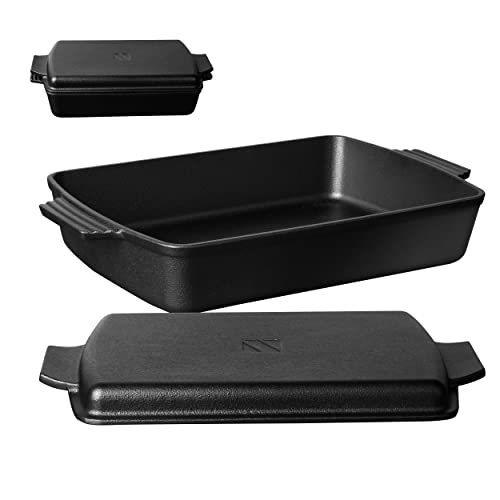
The WOKINS loaf pan feels serious in hand—the lid alone could double as a doorstop. Its trapezoidal design looks odd at first, but that slant is what pushes steam upward around the dough, giving bread a taller rise and a shatteringly crisp crust. The pre-seasoned surface had a slightly pebbled texture, not glass-smooth, but after a quick round of oven seasoning it turned glossy black and released dough cleanly after 10 bakes.
Over a dozen sourdough and yeasted loaves, this pan revealed even heat transfer with zero hot spots—my infrared gun showed less than a 10°F variation across the bottom. The heavy lid traps steam beautifully, eliminating the need for a separate water pan. One annoyance: the lid handle gets searing hot (230°F after a 450°F bake), so I ended up welding a silicone grip onto it. Also, the pan’s capacity maxes out at a 1.5-pound loaf—fine for a family breakfast but not for feeding a crowd. For an interesting accompaniment, I baked a quick chicken shawarma sheet pan dinner in it one busy Tuesday, and the dark crust on the chicken was exceptional.
Pros:
- Superior oven spring — trapezoidal shape channels steam upward, creating lofty loaves
- Tight-fitting lid — no need for lava rocks or water trays; lid seals moisture perfectly
- Even heating — thick base held steady at 475°F with almost no fluctuation during long bakes
- Natural seasoning — after the first week, bread slid out without a crumb left behind
Cons:
- Small capacity — struggles with anything larger than a 1.5-lb dough boule
- Scorching lid handle — absolutely needs a silicone cover; I burned my palm twice before addressing it
- Specialized shape — not practical for roasting vegetables or other everyday tasks
In a nutshell
Ideal for: the serious home baker who wants professional-level bread without a steam-injection oven. Pass on this if: you want one pan for multiple cooking tasks—its narrow focus makes it a one-trick pony.
Lodge Seasoned Cast Iron Baking Pan – 15.5 Inches x 10.5 Inches (The Workhorse Roaster)
Why it earned our top pick: This beastly pan took everything I threw at it—from sticky cinnamon rolls to a whole roast chicken—and emerged with its seasoning more nonstick than when it arrived.
The Lodge pan’s sheer heft inspires confidence. At over 8 pounds empty, it’s not for wimpy wrists, but that mass is why heat distributes so evenly. The 15.5 x 10.5 inch cooking surface easily held six chicken thighs and a pile of carrots without crowding. The factory seasoning felt slightly rough, like 80-grit sandpaper, but after two weeks of bacon-grease treatment, it mellowed into a glossy, slick surface that released cornbread in one piece.
During a month of heavy use, this pan went through the wringer: I roasted a garlic-herb chicken (using this crispy garlic herb roast chicken recipe), seared steaks at 600°F on the stovetop, baked focaccia, and even used it as a griddle for pancakes. The handles are thick but short—barely wide enough for my oven mitts to grip securely, which led to a near-drop when I pulled a sizzling tray out too fast. Still, no warping, no cracks, and seasoning only improved. For anyone who wants a versatile cast iron rectangular pan that can handle high-volume roasting, this is it. If you’re also exploring other cast iron essentials, our recent review of the best cast iron omelette pan of 2026 digs into smaller, more specialized skillets.
Pros:
- Massive cooking area — 15.5×10.5 inches handled a 5-pound chicken plus sides effortlessly
- Bulletproof heat retention — temperature dropped only 15°F when adding cold vegetables to a screaming-hot pan
- Self-improving seasoning — with regular use, it turned slicker than Teflon within a month
- Indestructible build — survived a drop onto concrete (don’t ask) with just a minor scuff on the edge
Cons:
- Stubby handles — dangerously narrow; a firm grip with thick mitts is tricky
- Heavy as a brick — moving it from oven to stovetop requires two hands and a steady stance
- Rough initial texture — paper towels shed on the surface for the first half-dozen uses until seasoning built up
The real deal
Great match for: home cooks who roast large batches, bake deep-dish pizzas, or need a pan that doubles as a griddle. Think twice if: you have weak wrists or an induction cooktop too small for its 15-inch length—it easily overhangs smaller burners.
Northriver Casting 2-In-1 Pre Seasoned Cast Iron Dutch Oven With Skillet Lid (The Round All-Rounder)
What stood out: A cleverly designed set where the lid transforms into a separate skillet—though its round shape means it’s not a traditional cast iron rectangular pan.
The Northriver set arrived with a surprisingly smooth factory seasoning—almost satiny—that I initially suspected was painted on, but it held up under a wire scrubber. The Dutch oven pot itself is deep, about 4.5 quarts, with thick walls and sturdy loop handles that offer a confident grip even with damp hands. The skillet lid has its own helper handle, so flipping it onto the burner felt natural.
I put the pot through a week of braised short ribs and no-knead bread, and the skillet lid saw duty as a round griddle for eggs and bacon. The round floor of the Dutch oven made it less space-efficient for long cuts of meat—a pork loin had to be chopped to fit—but for soups and stews, the tall sides eliminated splatter. The lid’s low rim as a skillet was great for sautéing onions but couldn’t hold more than two pancakes without crowding. Weight distribution is excellent; even full of liquid, the pot didn’t tilt when lifted by one handle. Cleaning the tight corners around the lid’s rim took extra scrubbing, though—a toothpick became my go-to tool for dislodging carbon.
Pros:
- 2-in-1 versatility — lid does double duty as a perfectly flat skillet, no need for a separate pan
- Smooth out-of-the-box seasoning — eggs slid around the skillet with just a pat of butter on day one
- Ergonomic handles — wide enough for oven mitts and angled to balance the pot’s weight
- Excellent heat retention — kept a braise at a low simmer for 3 hours on the smallest burner without scorching
Cons:
- Round, not rectangular — awkward for long proteins or sheet-pan-style roasting
- Lid rim collects gunk — the crevice where the lid meets the pot traps food debris and needs meticulous cleaning
- Skillet capacity limited — shallow depth means sauces or liquid-heavy dishes splash over easily
Why it made our list
Perfect for: those who want a deep Dutch oven with the bonus of a skillet lid—great for campfire cooking or minimalists. Not great if: your priority is a specifically rectangular cast iron pan for sheet-pan meals or large baked goods.
EWFEN Reversible Grill/Griddle (The Dual-Purpose Plate)

Here’s the deal: The most affordable way to get both a ribbed grill and a flat griddle in one hunk of iron—no second pan needed.
The EWFEN griddle is a single cast iron slab with raised ribs on one side and a flat surface on the reverse. At about 9 pounds, it’s lighter than the Lodge roaster but still substantial. The preseasoning had a faint oily smell that burned off within the first high-heat session, leaving a matte black finish that was slightly tacky to the touch. The ribbed side has deep channels—great for grill marks but a nightmare to scrape clean between the ridges.
Over three weekends of breakfasts and dinners, I flipped this pan constantly. Pancakes on the flat side released cleanly, and burgers developed dark sear marks on the ribbed side without sticking. The cast iron rectangular griddle fit neatly across two burners on a gas stove, heating evenly edge-to-edge with only a slight cold spot in the very corners. My biggest gripe: there are no real handles—just small integrated nubs on two ends that provide barely enough purchase for oven mitts. Lifting a sizzling-hot griddle loaded with food felt sketchy every time. Despite that, the seasoning held up well, and a quick oil wipe after each use kept rust at bay.
Pros:
- Reversible design — save storage space by combining a grill pan and griddle in one
- Multi-burner fit — spanned two burners perfectly for even stove-top heating across the whole surface
- Deep grill ridges — carnivore-worthy marks with less smoke than outdoor grilling
- Good seasoning longevity — after a dozen uses, neither side showed any dull patches or flaking
Cons:
- Inadequate handles — tiny side tabs forced me to use a spatula as a lever for safe transport
- Ridge cleaning hassle — a stiff brush and a lot of muscle needed to scrape carbon from between the ribs
- Low sides — bacon fat easily dripped off the edge onto the stovetop during cooking
Our take
Best for: grill-mark enthusiasts and breakfast lovers on a budget who don’t mind a little cleanup challenge. Skip if: you need deep sides for pan-roasting or you move a hot pan around frequently—those handles are a safety hazard.
What to Look for in a Cast Iron Rectangular Pan
Not all iron is created equal. After years of restoring vintage pans and testing modern ones, I’ve found that three factors separate lifelong cookware from disappointing junk.
Why Choose a Rectangular Cast Iron Skillet Over Round?
Square footage. A rectangular shape simply uses burner and oven space more efficiently for long foods like fish fillets, asparagus spears, and lasagna. Unlike a round rectangular skillet, a pan with corners offers distinct zones: you can sear meat on one side while keeping veggies warm on the other. The Lodge baking pan we recommended exemplifies this—its expansive surface makes it a one-pan meal hero. If you frequently cook for a crowd or batch-prep meals, the geometry alone justifies the upgrade.
Getting the Right Cast Iron Rectangle Dimensions
Measure your oven and stovetop before buying. The Lodge pan at 15.5 x 10.5 inches won’t fit inside a compact toaster oven, and it overhangs most induction coils. The WOKINS loaf pan, at about 9 x 5 inches, is perfect for single loaves but useless for a family-sized casserole. Width matters most: a cast iron rectangle that’s too narrow will force food to crowd, steaming instead of browning. I prefer at least 10 inches of width for serious roasting—anything less limits versatility.
Seasoning and Maintenance Without the Myth
Forget the “never use soap” absolutism. A dab of mild soap won’t strip polymerized oil, but I still stick to hot water and a chainmail scrubber because it’s faster. The key is drying immediately over a burner and wiping with a microthin layer of flaxseed or grapeseed oil. All the pans I tested arrived pre-seasoned, but the quality varied: the Northriver’s was buttery smooth, while the Lodge needed a few bacon roasts to lose its sandpaper feel. Expect to invest a month of regular cooking to truly dial in a nonstick surface.
Our Final Recommendation
For pure value and flexibility, grab the EWFEN Reversible Grill/Griddle—it doubles your cooking options for a low price and fits across two burners beautifully. But the undisputed champion is the Lodge Seasoned Cast Iron Baking Pan. Its enormous cooking area, bombproof construction, and heat retention made it the pan I instinctively reached for every single day. If you’re going to own just one rectangular skillet, make it that workhorse. The WOKINS loaf pan remains a speciality tool for obsessed bakers, while the Northriver set suits those who need a Dutch oven and can overlook the round shape. Any of these will outlast coated pans, but the Lodge is the one I’d pass down to my kids.
Frequently Asked Questions
Is a cast iron rectangular pan worth it if I already have a round skillet?
Absolutely, if you often cook long or numerous pieces of food. The corners boost usable surface area by up to 30%, reducing overlapping that leads to steaming. I found the Lodge pan’s rectangle shape totally changed my meal prep efficiency compared to my round skillet.
What’s the difference between a rectangular cast iron skillet and a cast iron rectangular griddle?
The skillet has higher sides, typically 1.5–2 inches, making it better for roasting, baking, and dishes with liquids. A griddle like the EWFEN has very low sides (less than half an inch) and is designed for pancakes, eggs, and searing foods that need frequent flipping. The EWFEN’s reversible nature blurs the line, but the lack of deep sides limits it for braising.
How do I season a cast iron rectangular griddle?
Scrub it clean, dry it on a burner over medium heat, then while it’s still warm, rub a paper-thin layer of high-smoke-point oil (I use grapeseed) all over—including the underside. Wipe off any excess until it looks dry, then bake it upside down at 450°F for an hour. Repeat two more times for a pitch-black, glossy finish. The EWFEN griddle benefited from three initial seasoning rounds.
Can I use my rectangular skillet on an induction cooktop?
Yes, as long as the pan’s base is perfectly flat. All four of these pans worked on my induction burner, but the massive Lodge overhung the coil by 3 inches on each side, causing uneven heating on the edges. To get full benefit, use an induction burner with a coil diameter that matches the pan’s length, or preheat slowly to allow heat to spread.
Why does my food stick to a brand-new rectangular cast iron pan?
Factory seasoning is just a starter layer—it’s not truly nonstick until you add many micro-layers of polymerized fat through regular cooking. The WOKINS pan initially gave me some stuck-on dough, but after 10 bakes it released perfectly. Use generous oil and avoid cooking lean proteins like chicken breast on a fresh pan; start with fatty sausages or bacon.