



The right dicing knife turns a pile of onions into uniform cubes without making your wrist beg for mercy. But blade profiles, steel types, and handle shapes vary wildly, so picking one off a shelf is a gamble. We narrowed the field to eight standouts, and the Cutluxe Nakiri Knife leads the pack because its flat edge and forged German steel are built for exactly the kind of push cuts that make dicing fast and safe.
If you want the best dicing knife for everyday vegetable work, grab the Cutluxe Nakiri Knife—it nails the edge geometry and grip that keep knuckles safe and fatigue low. For budget-minded cooks, the imarku Santoku Knife is the value pick with its Japanese high-carbon steel at a hard-to-argue price.
📌 This article contains affiliate links. As an Amazon Associate I earn from qualifying purchases, at no extra cost to you. Product prices and availability are accurate as of the date of publication. Full disclosure.
| Product | Best For | Buy Link |
|---|---|---|
| Cutluxe Nakiri Knife | Vegetable prep | Check Price |
| Santoku Knife | General dicing | Check Price |
| Babish 6.5 Inch Santoku Knife | Small hands | Check Price |
| TUO Santoku Knife | Non-stick slicing | Check Price |
| OXO Good Grips 8 in Chef’s Knife | Locking sheath | Check Price |
| Bloomhouse Chef’s Knive | Olive wood handle | Check Price |
| imarku Santoku Knife 7 Inch | Budget pick | Check Price |
| Chef Knife 7 Inch | Left-handed use | Check Price |
What We Looked For in a Dicing Knife
We narrowed this list by comparing published specifications—steel composition, blade profile, handle material, and documented features—against the factors that actually separate a great dicing knife from a mediocre one. Edge geometry comes first: a flat Nakiri edge powers straight push cuts for even dice, while a slightly curved Santoku belly allows rocking. Steel matters just as much; high-carbon 1.4116 German steel holds an edge longer but can chip on bone or frozen food, while softer stainless dulls faster but is easier to sharpen. We weighted handle ergonomics and balance heavily because wrist fatigue leads to sloppy cuts and accidents. Maintenance requirements, including dishwasher safety, also factored in. One thing to check before ordering: if you struggle with food sticking to the blade, look for a knife with granton dimples or a hollow edge—they create air gaps that release onions and potatoes cleanly.


Babish 6.5 Inch Santoku Knife High Carbon 1.4116 German Steel Kitchen Knife Razo (High-Carbon German Steel)

Cutluxe Nakiri Knife (Flat Edge for Push Cuts)
Quick take: This is the knife I’d hand to someone who dices onions, carrots, and celery every single day.
The listing describes an all-purpose Nakiri vegetable knife built on a blend of Japanese sensibility and forged German stainless steel, with a smooth pakkawood handle that’s ergonomically shaped. The flat blade profile is the defining feature: a Nakiri has no belly or curve, so the entire edge contacts the cutting board at once. That means every push cut produces a clean, full-length slice through vegetables without the rocking motion a curved chef’s knife demands. The pakkawood handle is resin-impregnated hardwood, which resists moisture better than raw wood and provides a secure grip when your hands are wet from rinsing produce.
The flat edge is a trade-off. It excels at straight-down chopping and dicing, but you lose the ability to rock the blade for mincing garlic or herbs—you have to lift and chop instead. On paper, the forged German steel offers better edge retention than stamped stainless, but hardness always comes with brittleness; avoid hitting the blade against bones or frozen food. Compared to the TUO Santoku on this list, the Cutluxe lacks granton dimples, so starchy vegetables like potatoes may stick to the side of the blade during long prep sessions. However, for pure dicing volume, the flat profile reduces the need for a claw grip adjustment mid-cut, which is why I recommend it over curved knives for beginners.
Pros:
- Flat Nakiri edge—makes full-contact push cuts for uniform dice without rocking.
- Forged German stainless steel—holds an edge longer than stamped blades at this price range.
- Pakkawood handle—resists moisture and provides a textured grip that stays secure when wet.
- Ergonomic shape—reduces wrist strain during extended vegetable prep because your hand stays in a neutral position.
- Japanese blade profile—thin behind the edge, which lowers cutting resistance and makes slicing onions less effortful.
Cons:
- No granton edge—potatoes and zucchini can cling to the blade face since there are no air pockets.
- Flat profile limits versatility—cannot rock for mincing herbs or garlic; you must chop up and down.
- Forge-hardened steel can chip—not suitable for cutting through bones, frozen food, or hard squash rinds without care.
Our Take
Best for: Home cooks who dice a lot of vegetables and want a dedicated knife that reduces wrist fatigue. Skip if: You need one knife to mince, slice, and butcher—this Nakiri is a specialist, not a generalist.
Santoku Knife (Seamless Stainless Handle)
The short version: This is the one to grab if you want a zero-maintenance blade that won’t absorb odors or harbor bacteria in the handle.
The spec sheet calls this a 7-inch Japanese Santoku with a classic sheep’s foot tip—that blunt, almost straight spine that curves down gently to the tip. The entire knife, blade and handle, is stainless steel, which means no rivets, no seams, no wood grain to trap moisture. That seamless construction is a real advantage in a busy kitchen: after dicing raw chicken or fish, you can wash the whole knife under hot water without worrying about water seeping into a handle joint. The sheep’s foot tip provides more usable blade length before the curve, which helps with straight-down chopping near the heel.
A full-stainless handle shifts the balance point toward the blade, which some cooks prefer for controlled tip work but others find heavy during long sessions. The lack of a textured grip means the handle can feel slippery if your hands are oiled or wet. On the upside, this knife is fully dishwasher safe—though I’d still hand wash to protect the edge—because there’s no wood to crack or plastic to warp. Compare that to the Babish Santoku on this list, which has a full-tang handle but likely a resin or synthetic scale; neither is dishwasher friendly. For dicing onions, the slight curve of the Santoku belly lets you rock through a pile, but the straight-ish sheep’s foot design is closer to a Nakiri than a chef’s knife, so push cuts still work well.
Pros:
- Full stainless steel handle—seamless and hygienic; no crevices for bacteria to hide.
- 7-inch Santoku blade—sheep’s foot tip offers a long flat section for chopping vegetables.
- Dishwasher safe—no wood or synthetic components to degrade in heat or detergent.
- Balanced weight distribution—stainless handle adds heft near the bolster for controlled rocking.
- Japanese steel—thin edge geometry slices through ripe tomatoes without tearing.
Cons:
- Slippery polished finish—the all-metal handle lacks texture; wet or oily hands may lose grip.
- Heavier than wood-handled knives—the full stainless construction increases fatigue during marathon prep.
- No finger guard or bolster—your index finger rests directly on the blade spine, which can cause hot spots over time.
In a nutshell
Perfect for: Cooks who want a low-maintenance, dishwasher-safe knife that won’t absorb stains or odors. Think twice if: You prioritize grip texture or a lightweight feel—the polished metal handle is not for everyone.
Babish 6.5 Inch Santoku Knife High Carbon 1.4116 German Steel Kitchen Knife Razo (High-Carbon German Steel)
Here’s the deal: The Babish hits the sweet spot for smaller hands or cramped cutting boards—a 6.5-inch blade with the same steel many pricier knives use.
The listing is specific: forged from a single piece of high-carbon 1.4116 German steel, tempered, ground, and polished for maximum sharpness, with a full-tang handle for balance. 1.4116 is a chrome-molybdenum-vanadium steel that’s common in German kitchen knives; it resists corrosion well and takes a keen edge without being too hard to sharpen at home. The 6.5-inch length is shorter than most Santokus, which gives you more control near the tip for detail work like dicing shallots or trimming pepper ribs. The full tang means the metal extends through the handle, adding weight and durability, though the listing does not specify the handle material—likely a resin or composite scale.
Shorter blades are easier to maneuver but require more strokes per onion, so if you dice in volume, a 7-inch knife covers more ground. The 1.4116 steel sits in a good middle ground: harder than cheap stamped stainless but not as brittle as high-carbon Japanese steels like VG-10. The full-tang construction is a plus for balance—I’d expect this knife to pivot on the pinch grip without tipping forward or back. One real limitation: the listing does not mention a granton edge, hollow grind, or any non-stick treatment, so diced onions and potatoes will likely stick to the blade face. For the best knife to chop onions without constant scraping, I’d lean toward the TUO Santoku with its granton dimples—but the Babish is still a solid traditional choice.
Pros:
- 1.4116 high-carbon German steel—holds an edge longer than soft stainless and takes minimal effort to resharpen.
- Forged single-piece construction—no weak points along the tang; the knife is less likely to snap under lateral pressure.
- Full-tang handle—balanced feel during long dicing sessions because weight is distributed evenly.
- 6.5-inch blade—easier to control in tight spaces and for smaller hands than a 7 or 8-inch blade.
- Tempered and polished edge—arrives sharp out of the box, which means less work for the home sharpener.
Cons:
- No non-stick features—no granton dimples or hollow edge, so food can cling to the flat blade sides.
- Unspecified handle material—likely synthetic, but the listing doesn’t state whether it’s dishwasher safe or how it wears over time.
- Shorter blade length—requires more cutting strokes per onion, which can add up to more wrist movement during big prep sessions.
Why it earns a spot
Great match for: Cooks with smaller cutting boards or hands who want high-carbon steel without paying for a premium brand. Not great if: You dice large quantities daily—the 6.5-inch length will feel slower than a 7-inch Santoku or 8-inch chef’s knife.
TUO Santoku Knife (Granton Edge Non-Stick)
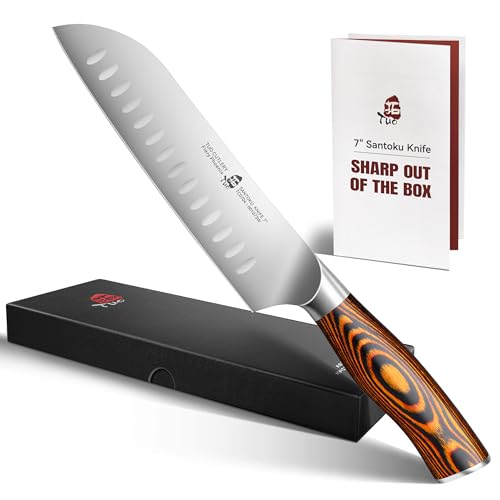
What sets it apart: The TUO’s hollow-ground dimples solve the single most annoying problem in dicing—food sticking to the blade face.
The listing emphasizes a hand-polished 15° V-shaped edge using the traditional HONBAZUKE method, a granton edge design with hollow-ground dimples to prevent sticking, and durable German steel. The granton edge is what I’d steer anyone toward if they hate scraping onions off a knife; those oval air pockets create tiny gaps between the blade and the food, so slices release cleanly. The 15° edge angle is more acute than typical Western knives (which run 20-22° per side), meaning it cuts with less resistance through dense vegetables like rutabaga. The steel is high-carbon German, but the exact grade isn’t specified—still, the heat treatment claim suggests decent edge retention.
A 15° edge is sharper but also more fragile than a 20° edge; if you twist the blade while it’s embedded in a hard root vegetable, you risk micro-chipping. The granton dimples help with wet, starchy foods but do little for dry, crumbly ones like hard cheese. Compared to the Cutluxe Nakiri, the TUO’s slight Santoku curve lets you rock through herbs or garlic, adding versatility. The handle is likely a resin or G10 composite—the listing doesn’t specify—so treat it as hand-wash only. For best knife to chop onions without sticking, this one earns the nod over the flat-faced Babish because those dimples genuinely work on the thin, wet layers of an onion.
Pros:
- Granton edge with hollow-ground dimples—reduces friction so onion slices fall away instead of clinging.
- 15° V-shaped edge—acute angle glides through vegetables with noticeably less pushing force.
- High-carbon German steel—good corrosion resistance and edge retention for everyday use.
- Hand-polished HONBAZUKE finish—indicates attention to edge refinement out of the box.
- Japanese-style Santoku profile—slight curve allows rocking for mincing while still chopping straight for dice.
Cons:
- Fragile acute edge—15° angle chips easier than a 20° edge if you hit bone or cut on a glass board.
- Handle material not specified—unknown dishwasher compatibility; hand washing is the safe assumption.
- Granton dimples collect residue—the pockets can trap garlic paste or citrus pith if not rinsed promptly.
Final thoughts
Ideal for: Anyone tired of food sticking to their knife during high-volume onion and potato dicing. Pass on this if: You frequently cut through hard squash or bone—the acute edge will not survive that kind of abuse.
OXO Good Grips 8 in Chef’s Knife with Locking Sheath (Locking Sheath Included)

Quick take: This is the safest choice for anyone who just throws knives in a drawer—the locking sheath alone is worth the price of admission.
The spec sheet describes an 8-inch chef’s knife designed for chopping, dicing, and mincing, with a straight edge, large blade surface, rounded tip, and a protective locking sheath. The blade is stainless steel, but the listing doesn’t specify the alloy, so it’s likely a softer, more forgiving steel that dulls faster but sharpens easily. The 8-inch length and large surface area make it a generalist: you can dice onions, slice meat, and smash garlic with the flat of the blade. The rounded tip is a safety feature—it reduces the chance of piercing through a bag or poking your other hand during rapid prep.
The straight edge means this knife leans toward push cuts and chopping rather than rocking, but the rounded tip and slight belly still allow a gentle rock for mincing. The locking sheath addresses a common oversight: many knives on this list ship without any blade cover, and storing them loose in a drawer will both dull the edge and risk finger cuts. The Good Grips handle is likely rubberized or textured for a secure grip, though the material isn’t specified. Compared to the Cutluxe Nakiri, the OXO is longer and heavier, which helps with large vegetables like cabbage but can tire the wrist during fine dicing. For a dedicated dicing knife, the 8-inch blade is overkill for most onions—a 6.5 or 7-inch is easier to control precisely.
Pros:
- Locking sheath included—protects the blade and your fingers when stored in a crowded drawer.
- 8-inch blade with large surface—handles large produce like squash or cabbage with fewer strokes.
- Rounded tip—reduces accidental punctures during fast chopping.
- Straight edge profile—suited to push cuts that produce uniform dice without rocking.
- Good Grips handle—textured surface provides traction even with wet hands.
Cons:
- Unspecified steel grade—likely softer stainless that will need frequent honing to stay sharp.
- 8-inch length—feels unwieldy for fine dicing; a 6.5 or 7-inch blade gives more tip control.
- Sheath adds bulk—the locking mechanism can be fiddly to release one-handed when your other hand is covered in chicken juice.
The Real Deal
Best for: Households that need a do-everything knife with safe storage, especially if you don’t own a knife block or magnetic strip. Skip if: Your primary task is delicate vegetable dicing with precision—the 8-inch chef’s design is too broad for that.
Bloomhouse Chef’s Knive – German Stainless Steel Knive -Two Time Oprah’s Favorit (Olive Wood Handle)

In a nutshell: This is the showpiece knife—beautiful Italian olive wood, but beauty comes with more maintenance than most cooks want to sign up for.
The listing states this is an 8-inch German steel chef’s knife with an Italian olive wood handle, and that Bloomhouse plants one tree per set sold in partnership with One Tree Planted. The blade material is German stainless steel, but no specific alloy is given, so edge retention is an unknown. The handle is the star: olive wood is dense, naturally antimicrobial, and gorgeous with its swirling grain—but it is not dishwasher safe and requires occasional oiling to prevent cracking. The 8-inch chef’s profile has a slight curve for rocking, making it a general prep knife rather than a specialized dicer.
Olive wood handles feel smooth and warm, but they are porous compared to pakkawood or synthetic materials; if left wet, the wood can swell and crack the tang joint. The lack of a specified steel grade is a concern: without knowing whether it’s high-carbon or softer stainless, you’re guessing at sharpening frequency and edge longevity. The tree-planting initiative is a genuine ethical plus, but it doesn’t affect performance. For dicing onions, the 8-inch length and curved belly mean you’ll likely rock rather than push-cut, which is less precise for uniform cubes. At its price, you’re paying for aesthetics and sustainability—fine if that’s your priority, but the Cutluxe Nakiri at a similar or lower cost will dice vegetables more efficiently.
Pros:
- Italian olive wood handle—naturally antimicrobial, visually distinctive, and comfortable in a pinch grip.
- One tree planted per set—supports reforestation; a real ethical consideration for some buyers.
- German stainless steel blade—corrosion-resistant and easy to resharpen, though grade is unspecified.
- 8-inch chef’s profile—versatile for slicing, dicing, and mincing in a single knife.
- Oprah’s Favorite pick—aesthetic appeal that doubles as a gift for design-conscious cooks.
Cons:
- No steel grade listed—you have no way to know whether edge retention will match the Babish 1.4116.
- Olive wood requires maintenance—hand wash only, dry immediately, and oil regularly or the handle will crack.
- Curved belly not optimized for dicing—rocking motion leads to less uniform cubes than a flat Nakiri.
Our Take
Perfect for: Gift-givers or home cooks who prioritize kitchen aesthetics and are willing to oil a handle. Think twice if: You want a low-maintenance workhorse—this knife needs more care than any other on this list.
imarku Santoku Knife 7 Inch with Sharp Japanese High Carbon Stainless Steel (Budget Japanese Steel)

The short version: This is the value pick—Japanese high-carbon stainless and a hollow edge at a price that makes it almost disposable if you ruin it.
The listing touts Japanese high-carbon stainless steel that resists rust, an ultra-sharp edge with professional blade polishing, and a hollow edge design with scalloped depressions to reduce friction. The 7-inch Santoku profile has a slight curve for rocking and a sheep’s foot-like tip for straight chopping. The steel is high-carbon but the exact grade isn’t specified; given the price point, it’s likely similar to AUS-8 or 440C, which holds an edge reasonably well but won’t match VG-10. The hollow edge functions like a granton edge, creating air pockets that release food.
The scalloped hollow edge is a genuine advantage for onions and potatoes, but the depressions are shallower than a true granton, so sticking is reduced but not eliminated. The budget price means you might get slightly softer steel than the Babish 1.4116, so expect to hone more often. The handle material isn’t specified—likely G10 or a molded composite—so treat it as hand-wash. For a first dicing knife, the imarku offers about 80% of the TUO’s performance at a fraction of the cost. The 7-inch length is ideal for most cutting boards, and the low price removes the fear of damaging an expensive blade on a stray avocado pit.
Pros:
- Japanese high-carbon stainless steel—better edge retention than cheap stamped stainless.
- Hollow edge scallops—reduce food sticking, especially on wet vegetables like zucchini.
- 7-inch Santoku blade—the sweet spot for dicing large onions without being unwieldy.
- Ultra-sharp polished edge—arrives ready to slice through ripe tomatoes without tearing the skin.
- Budget-friendly—affordable enough to replace if you accidentally chip the edge.
Cons:
- Unspecified steel grade—likely softer than the Babish 1.4116, so expect more frequent sharpening.
- Shallow scallops—not as effective at anti-stick as the TUO’s deep granton dimples.
- Unknown handle material—durability and grip texture are a gamble at this price point.
Why it earns a spot
Best for: Budget-minded cooks who want a real Japanese-style Santoku without spending more than a meal out. Skip if: You’re willing to pay a little more for known steel and a more substantial non-stick design—the TUO is the better long-term buy.
Chef Knife 7 Inch (Double-Edged for Lefties)

What sets it apart: The double-edged blade design means this knife works equally well for left-handed and right-handed cooks—a rarity in this price range.
The spec sheet describes premium Japanese stainless steel with a double-edged blade design suitable for both left and right-handed users, plus a well-balanced construction and an ergonomic handle. The double-edged (ambidextrous) design is particularly important because most Japanese knives have a single-bevel or asymmetrical grind that favors right-handers; lefties often struggle with steering or uneven cuts. This knife appears to have a symmetrical edge, but the listing uses “double-edged” loosely—it could mean a 50/50 bevel or simply that both sides are ground. The 7-inch length is practical for dicing, and the handle is ergonomic, though material unspecified.
The Japanese stainless steel is likely a mid-grade alloy, but the double-edge claim is the key selling point: if you’re left-handed, a knife with an asymmetrical grind will pull to one side as you cut, producing angled dice. A truly symmetric edge eliminates that problem. The handle is described as ergonomic and balanced, which suggests some thought went into fatigue reduction, but no specific texture or material details are given. Compared to the OXO 8-inch chef’s, this 7-inch blade is more maneuverable for dicing onions and peppers, though it lacks a locking sheath. The main risk is unknown steel hardness—if it’s too soft, you’ll be honing weekly.
Pros:
- Double-edged blade—ambidextrous design lets left-handed cooks dice without steering issues.
- 7-inch length—controllable for precise cuts on onions, carrots, and celery.
- Premium Japanese stainless steel—good corrosion resistance and acceptable edge retention.
- Well-balanced construction—reduces wrist fatigue during extended prep sessions.
- Ergonomic handle—shaped to fit a natural pinch grip, though material is unknown.
Cons:
- Steel grade not specified—you cannot confirm hardness or edge retention against the Babish 1.4116.
- No locking sheath or blade guard—storage requires a knife block, magnetic strip, or a third-party sheath.
- Double-edged claim unverified—without a detailed grind angle, left-handers should still test or read reviews before assuming perfect symmetry.
Final thoughts
Ideal for: Left-handed cooks who have struggled with right-biased Japanese knives, or anyone who wants a simple 7-inch chef’s knife for dicing. Pass on this if: You need a known steel grade and included storage—the OXO with its sheath or the Babish with its 1.4116 are safer bets.
How to Choose a Dicing Knife That Actually Works for You
A dicing knife is only as good as the edge geometry and steel behind it, but too many buyers focus on brand names instead of blade profile. Before you add one to your cart, understand how these four factors affect your daily prep.
Best Knife for Dicing Onions: Why Blade Profile Matters More Than Size
For onions specifically, a flat edge is the most efficient. A Nakiri, like the Cutluxe on our list, lets you push straight down through the layers without rocking, which keeps the dice even and reduces the chance of the blade slipping sideways. A Santoku with a slight curve works too, but you’ll need to adjust your grip for a clean push cut. The best knife for dicing onions is one that keeps your knuckles safe behind the claw—position four fingers behind the middle finger and keep knuckles closer to the blade than fingertips. If onion layers stick, the TUO’s granton dimples solve that immediately.
For slow-cooked dishes like pot roast with onion soup mix, uniform onion dice matters less than for raw salsas, so a curved Santoku is fine. But for precision work, flat wins.
Steel Composition: High-Carbon or Soft Stainless?
High-carbon steels like the 1.4116 German steel in the Babish hold an edge longer but chip if you hit bone or frozen food. Softer stainless dulls faster but is easy to restore with a honing rod. If you’re not comfortable sharpening, a softer steel might be more practical because a blunt knife is dangerous—it forces you to push harder and risk slips. The FDA regulates food-contact materials, so check that any knife handle or coating meets FDA requirements if the blade will touch food directly. Wood handles like the Bloomhouse’s olive wood are not dishwasher safe; hand washing prevents cracking.
Handle Ergonomics and Balance
Wrist fatigue is the enemy of safe dicing. A knife that’s too heavy at the blade or handle tip will tire your forearm after one onion. Full-tang constructions like the Babish or the generic Santoku spread weight evenly, while the OXO’s locking sheath adds a safety layer if you store knives loose. For prolonged sessions, choose a handle with enough texture to grip when wet—the Cutluxe’s pakkawood and OXO’s Good Grips handle both offer this. Avoid polished stainless handles if your hands sweat or get oily easily; that’s the #2 Santoku’s biggest flaw.
Maintenance: Sharpening and Storage
Every dicing knife needs regular honing, ideally before each use, and sharpening every few months depending on the steel. A granton or hollow edge adds a complication: the dimples can trap debris, so rinse immediately after use. For storage, a blade guard or sheath is non-negotiable if you keep knives in a drawer—the OXO’s included locking sheath is the best example on this list, and it’s a feature most competitors forget. If you don’t have a sheath, a magnetic strip or knife block is the safest alternative. For more on how to use a sharp knife properly, check out our guide to prepping a garlic herb roast chicken, which covers basic cuts and claw technique in action.
Our Final Recommendation
The Cutluxe Nakiri Knife is the overall winner for a dedicated dicing knife—flat edge, forged German steel, and a pakkawood handle that keeps your grip secure. For budget cooks, the imarku Santoku delivers Japanese high-carbon steel and hollow-edge release at a fraction of the cost. If you hate food sticking, spend up for the TUO Santoku with its granton dimples. Avoid the Bloomhouse unless you value looks over low maintenance. For most home kitchens, the Cutluxe is the knife I’d reach for every onion and carrot.
Frequently Asked Questions
What’s the difference between a Santoku and a Nakiri dicing knife?
A Nakiri has a flat edge with no belly, so every cut is a straight push—perfect for uniform dice. A Santoku has a slight curve that lets you rock for mincing but can make push cuts less precise. The Cutluxe Nakiri and the TUO Santoku on our list illustrate this trade-off: flat for speed and evenness, curved for versatility.
How often should I sharpen a dicing knife?
That depends on the steel. High-carbon 1.4116 steel like the Babish holds an edge for weeks of home use, while softer stainless may need honing before every session. I recommend honing with a ceramic rod each time you dice, and a full sharpening on a whetstone every 2-3 months for high-carbon blades, more often for softer steel.
Can I use a dicing knife to cut meat as well as vegetables?
Yes, but with caveats. A flat Nakiri is excellent for slicing boneless chicken breast or trimming fat, but it cannot rock through joints or bones—the thin edge will chip. For tougher cuts like beef blade steak, a curved chef’s knife is better, as described in our guide to roasting beef blade steak. Keep your dicing knife away from frozen meat entirely.
Why does my knife stick when dicing onions, and how do I stop it?
Onion layers are wet and full of sugar, so they cling to flat blade surfaces. A granton or hollow edge creates air pockets that release the slices. The TUO Santoku and imarku knife both feature this. If your current knife has no dimples, dip the blade in water periodically or wipe it with a paper towel between cuts.
Is an 8-inch chef’s knife better for dicing than a 7-inch Santoku?
Not necessarily. A shorter 6.5 or 7-inch blade gives you more tip control for fine, even dice, especially on smaller cutting boards. The OXO 8-inch knife is great for large produce but can feel unwieldy for onion dicing. I prefer a 7-inch Santoku or Nakiri as a dedicated dicing knife because the length matches most cutting board sizes.