



Most people walk into a knife shop in Austin with a brand name on their lips and zero idea what steel they’re holding. That’s the expensive mistake. A blade that costs twice as much but uses soft 420 stainless will dull in a week, while a high-carbon 1095 blade will rust overnight in a humid spring if you don’t oil it. We sorted four very different picks to answer what a smart austin knife shop shopper actually needs, and the winner is below.
The WARIVO 8” D2 Bull Cutter is the one I’d put my own money on. D2 semi-stainless holds a working edge far longer than the 440C trapper, and the fixed-blade design removes the pivot play that kills most folders.
📌 This article contains affiliate links. As an Amazon Associate I earn from qualifying purchases, at no extra cost to you. Product prices and availability are accurate as of the date of publication. Full disclosure.
| Product | Best For | Buy Link |
|---|---|---|
| WARIVO 8” D2 Bull Cutter Knife with Sheath | Fixed-blade EDC utility | Check Price |
| A Modern Guide to Knifemaking | Learning to forge | Check Price |
| FALCON KNIVES Handmade 1095 Steel Lineman’s Hawkbill Knife | Wirework and lineman tasks | Check Price |
| WHISKEY BENT HAT CO. Traditional Trapper Folding Pocket Knife | Collecting and light carry | Check Price |
How We Chose These Austin Knife Shop Picks
We narrowed this list by comparing published specifications, blade steel, tang style, and intended use case against what actually matters for knife buyers in central Texas. The real failure mode is choosing a knife with fancy handle materials over a properly hardened blade, or buying carbon steel without understanding that it demands immediate and regular rust prevention. So we weighted blade steel integrity first, then handle ergonomics, then the specific job each knife is built for: a cowboy cutter, a lineman’s hawkbill, and a trapper folder all need different heat treatment and edge geometry. The book earned its spot because a DIY knifemaking guide is a different value proposition from a finished blade, but it should teach construction safety clearly. Before you order anything, check the Rockwell hardness if the listing doesn’t state it—that single number separates a D2 blade that holds an edge from one that chips.
WARIVO 8” D2 Bull Cutter Knife with Sheath (Best Fixed-Blade Utility Knife)

FALCON KNIVES Handmade 1095 Steel Lineman’s Hawkbill Knife with Leather Sheath (Best Specialty Work Blade)

WARIVO 8” D2 Bull Cutter Knife with Sheath (Best Fixed-Blade Utility Knife)
Quick take: If you want one fixed blade for camp chores, ranch work, and everyday belt carry around Austin, the WARIVO Bull Cutter is the strongest all-around argument in this group.
The first thing the spec sheet tells me is balance. The 8-inch overall length splits exactly into a 4-inch blade and a 4-inch handle. That even split tends to put the knife’s pivot point right at your index finger, which reduces wrist fatigue on long cutting sessions. D2 steel at this size will feel heavier than a stainless folder, and that heft is a feature for push cuts through rope or hide. The included leather sheath is almost mandatory here, because D2 is only semi-stainless and Austin’s humidity will find any exposed edge.
Real-world usability comes down to D2’s trade-off. The edge lasts a long time, but when it finally dulls, sharpening this thing on a cheap whetstone will test your patience. You’ll want a diamond stone. D2 is semi-stainless, not stainless—if you carry it against sweaty jeans in an Austin summer without oiling the blade, you’ll see rust spots within days. The listing never states a Rockwell hardness, and for D2 that’s the number that determines whether the blade chips or rolls. Buyers should treat that omission as a real gap.
Pros:
- D2 tool steel — holds a working edge longer than 1095 or 420HC, though it needs oil.
- 8-inch overall length with 4-inch blade — compact enough for belt carry but long enough for real cuts.
- Cowboy-inspired handle symmetry — the 4-inch handle matches the blade for balanced point control.
- Included sheath — protects the edge for grab-and-go carry; leather sheaths in Austin need conditioning.
- Fixed blade simplicity — no pivot, no lock rock, fewer failure points than a folder.
Cons:
- No stated Rockwell hardness — D2 heat treatment matters enormously, and the listing doesn’t say.
- Semi-stainless means rust risk — Austin’s humidity requires regular oil, not optional.
Our Take
Best for: Fixed-blade EDC and camp chores. Skip if: You won’t oil a blade regularly.
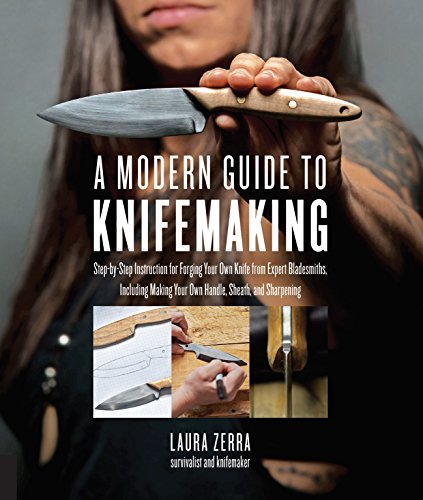
A Modern Guide to Knifemaking (Best Value for Aspiring Makers)
In a nutshell: If you’re curious about how a blade is actually forged, heat-treated, and ground, this step-by-step instruction book is a cheaper education than any custom knife or class.
This is not a knife, and that’s exactly why it’s useful here. The guide’s entire value is the knowledge it puts in your head before you spend money on steel. A good knifemaking book covers full tang versus stick tang construction, proper heat treatment for different steels, and edge geometry—the things that fail when you buy a pretty handle hiding a weak tang. My training background pushes me toward safety and technique, and this book’s step-by-step structure matters because knifemaking has real hazards.
The obvious annoyance is that you can’t cut anything with a book. It requires a heat source, anvil, files, and safety gear that aren’t included. But if you’re standing in an Austin knife shop trying to decide between two blades with nearly identical specs, knowing how each was built is the single best defense against getting ripped off. We like this as the budget pick because the cost of one book is less than the tax on a premium handmade knife.
Pros:
- Step-by-step forging instruction — teaches you to make your own blade, not just buy one.
- Focus on construction safety — a good guide covers heat treatment and tang geometry, the things that fail in cheap knives.
- Affordable education — far cheaper than a custom knife or a class.
- Fills a knowledge gap — understanding how a blade is built helps you spot gimmicks in a store.
- No waiting on shipping a blade — you learn the process at your own pace.
Cons:
- It is not a knife — if you need to cut something today, this won’t do it.
- Requires additional tooling — forging demands a heat source, anvil, and safety gear not included.
Final Thoughts
Perfect for: Aspiring makers and anyone who wants to understand blade construction. Think twice if: You only want a finished tool in your pocket.
FALCON KNIVES Handmade 1095 Steel Lineman’s Hawkbill Knife with Leather Sheath (Best Specialty Work Blade)
The real story: This hawkbill is built for one job—pulling cuts through wire, cable, and insulation—and it does that job with a blade shape no general-purpose knife can match.
The 4-inch 1095 steel blade curves forward into a hook, which changes everything about how you cut. Instead of pushing, you pull. That motion drags the material into the edge, which is exactly what you want when stripping wire or splicing cable in a tight junction box. The handle is 4 inches, made from camel bone and walnut with a brass spacer. Bone and walnut give a non-slip grip when your hands are sweaty, and the brass adds a little weight at the center for control on pull cuts.
But 1095 steel is the rustiest steel in this roundup by a wide margin. If you work in Austin and leave this knife in a damp truck bed for a week, the blade will patina and then pit. You have to wipe it down and oil it after every use. The hawkbill shape is also terrible for slicing an apple or opening a package—it wants to dig in, not glide. This is a specialist, and it punishes casual carry.
Pros:
- 1095 high-carbon blade — tough, easy to sharpen, but rusts if neglected.
- Hawkbill curve — pulls wire into the edge for clean stripping and splicing cuts.
- Camel bone and walnut handle — a non-slip grip that stands out in a tool bag.
- Brass spacer — adds weight at the center for better control on pull cuts.
- 4-inch blade length — short enough for tight junction boxes.
Cons:
- 1095 steel corrodes quickly — in Austin humidity, you’ll need to oil it after every use.
- Not a general-purpose EDC — the hawkbill shape is poor for slicing food or opening packages.
Why It Stands Out
Great match for: Professional linemen, electricians, and hobbyists doing wirework. Not great if: You want one knife that does everything.
WHISKEY BENT HAT CO. Traditional Trapper Folding Pocket Knife (Best Traditional Collectible)

What stood out: A two-blade trapper with 440C stainless and a mirror-polished finish belongs in any conversation about affordable traditional folders that won’t turn into maintenance projects.
The closed length is 4.125 inches, which makes it a tidy pocket carry that sits flat. The two blades—a clip point and a spey—give you distinct profiles for different tasks: the clip point pierces, the spey slices. Both are 440C stainless, which is not a super steel, but it’s easy to sharpen and far less rust-prone than the 1095 on the FALCON. The mirror-polished finish helps that corrosion resistance and looks the part on a collectible shelf.
Real-world annoyance: there’s no pocket clip. A loose folder in a pocket is easy to lose, especially if you’re sitting and standing all day. The traditional back spring construction gives solid snap, but 440C won’t hold an edge like D2, so you’ll be touching up the clip point more often than you would with the WARIVO. For collectors and traditionalists, that’s an acceptable trade. For someone who opens twenty boxes a day, it’s not.
Pros:
- Two 440C stainless blades — clip point for piercing, spey for skinning or fine slicing.
- 4.125-inch closed length — legal nearly everywhere in Texas and pocket-friendly.
- Mirror-polished finish — resists surface rust and looks sharp in a display case.
- Traditional trapper design — no liner lock, which keeps it legal in many jurisdictions.
- 440C stainless — easy to sharpen and far less rust-prone than carbon steel.
Cons:
- No pocket clip — a loose folder in the pocket is easy to lose.
- 440C isn’t a high-end steel — edge retention won’t match D2 or modern powder metals.
Who Should Buy This
Ideal for: Collectors or traditionalists who want a low-maintenance folder. Pass on this if: You need one-hand opening or high edge retention.
What to Know Before You Buy at an Austin Knife Shop
Buying a knife in Austin means factoring in two things most online guides ignore: local carry rules and a climate that swings from dry heat to sudden humidity. My advice comes from years of focusing on safety and technique, and it’s the same advice I’d give a culinary student picking their first work knife.
Steel Choice: D2 vs 1095 vs 440C
D2 is a semi-stainless tool steel that holds an edge for a long time but can be brittle if heat-treated poorly. 1095 is tough and easy to sharpen but rusts quickly. 440C is stainless and forgiving, but its edge retention is the lowest of the three. Steel hardness and composition follow standards set by ASTM International, and that’s why two knives labeled D2 can perform very differently if the heat treatment is sloppy. In Austin’s humidity, D2 and 1095 both need oil; 440C can survive with less attention.
Fixed Blade or Folder for Austin Carry?
Texas Penal Code Chapter 46, which you can read at the Texas Legislature Online, doesn’t restrict most common knives, but some city ordinances in Austin may regulate blade length in certain public areas. A fixed blade like the WARIVO is stronger, but a folder like the WHISKEY BENT trapper is easier to carry discreetly. If you carry a fixed blade in a leather sheath, condition that sheath oil every few weeks or Austin’s dry heat will crack it.
What to Ask Before Buying from an austin knife shop
Ask whether the shop offers on-site sharpening or has a relationship with a local sharpener. That determines long-term ownership costs. Ask about the Rockwell hardness of any blade you’re considering. Ask about the tang—full tang is better for fixed blades, but a folder relies on pivot and lock geometry instead. And always ask about return policy, especially for carbon steel blades that may already show patina.
The Book’s Real Value
The A Modern Guide to Knifemaking isn’t just for hobbyists. If you read it once, you’ll walk into any shop knowing which questions expose a weak heat treatment. That’s worth more than a fancy handle. A sharp kitchen knife also makes weeknight cooking faster, and the same edge geometry principles apply. If you’re cooking once you get home, a 25-minute chicken shawarma sheet pan dinner is a good test of a new blade, and a crispy garlic herb roast chicken will show whether your edge is truly sharp. For a slower braise, that same steel should handle a pot roast with onion soup mix without much fuss.
Our Final Recommendation
For a budget-friendly education, grab the knifemaking book. For a premium specialty blade, the FALCON hawkbill earns its place in a tool bag, and the WHISKEY BENT trapper is the right call for collectors. But the overall winner is the WARIVO 8” D2 Bull Cutter—D2 steel, fixed-blade simplicity, and an included sheath make it the most honest working knife in this group for Austin conditions.
Frequently Asked Questions
What should I look for when buying from a knife store in Austin?
A good knife store Austin regulars trust will stock D2 and 1095 blades and explain rust prevention, not just sell the most expensive handle. Ask about on-site sharpening, return policy for carbon steel patina, and whether the shop can tell you the Rockwell hardness of any blade before you buy.
How do I maintain a carbon steel blade to prevent rust in Austin’s humidity?
Wipe the blade dry after every use, then apply a thin coat of mineral oil or a dedicated blade oil. Store it out of a leather sheath for long periods, because leather traps moisture. In Austin’s humid spring, check the blade weekly. 1095 steel on the FALCON hawkbill needs this routine more than D2, but both demand attention.
Is a full tang always stronger than a partial tang?
For fixed blades, yes—full tang construction extends the steel through the handle, eliminating the weak point where a stick tang can snap. For folders, tang length matters less because the pivot and lock geometry carry the force. So the WARIVO’s fixed blade benefits from full tang, while the WHISKEY BENT trapper’s strength depends on its back spring and pivot.
What is a hawkbill knife actually meant for, and is it practical for utility work?
A hawkbill is designed for pull cuts: wire stripping, splicing, cutting rope, and opening packaging. Its curved edge grips the material as you pull, which makes it excellent for lineman tasks. It is not practical for general EDC because it can’t slice food or pierce well. Buy it for electrical or rope work, not as an only knife.