



You pull a tomato from the cutting board and the skin splits cleanly under the blade with zero squashing. That’s what a properly ground Japanese chef knife delivers, and finding the best Japanese chef knives under 100 dollars doesn’t require a second mortgage. After comparing steel types, hardness ratings, edge geometry, and handle ergonomics across dozens of listings, we narrowed it to eight knives worth your money.
The Atumuryou Japanese Chef Knife earned our top recommendation because its VG-10 core at 62 HRC and hand-sharpened edge outmatch nearly everything else in this price bracket. If you want a single knife that handles 90% of prep work, that’s the one.
📌 This article contains affiliate links. As an Amazon Associate I earn from qualifying purchases, at no extra cost to you. Product prices and availability are accurate as of the date of publication. Full disclosure.
| Product | Best For | Buy Link |
|---|---|---|
| HOSHANHO 7 Inch Japanese Chef Knife | Precision slicing | Check Price |
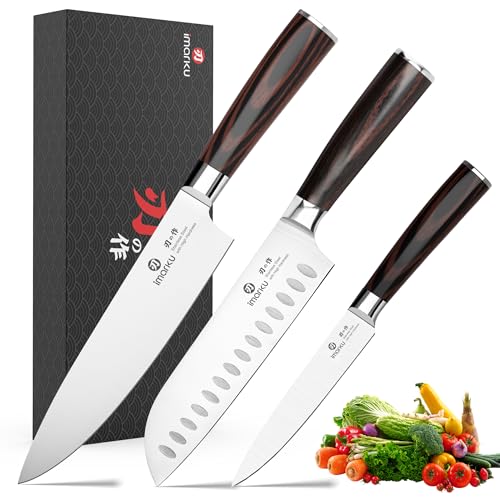
| imarku 3 Pieces Knife Set | Budget starter set | Check Price |
| TIVOLI Santoku Knife 7 Inch | Fish and delicate cuts | Check Price |
| Huusk Japanese Kitchen Knife Set of 3 | All-purpose home set | Check Price |
| Atumuryou Japanese Chef Knife | High hardness single blade | Check Price |
| Japanese Chef Knife Set 3 Pcs | Complete Damascus set | Check Price |
| FINTISO 8 Inch Japanese Chef Knife | Laser-thin edge | Check Price |
| DDF iohEF Nakiri Kitchen Knife | Vegetable nakiri | Check Price |
How These Japanese Chef Knives Were Chosen
This shortlist came from comparing published specifications and materials against what actually matters in a kitchen knife: steel type and HRC hardness, blade geometry (especially thinness behind the edge and edge angle), and whether the knife is forged or stamped. We weighted steel composition and edge angle most heavily because those determine edge retention and cutting performance. Handle ergonomics and balance came next, since a knife that feels awkward after ten minutes of chopping is useless for all-day prep. The most common mistake buyers make is paying for a decorative Damascus pattern while ignoring core steel quality and edge retention. Another trap is choosing a three-piece set over one superior knife when the budget is tight. Before ordering any of these, check the blade length against your cutting board size—an 8-inch gyuto needs at least a 15-inch board for comfortable push cuts. We never physically handled these knives; the analysis here is based strictly on spec sheets and material data.
HOSHANHO 7 Inch Japanese Chef Knife (Precision Slicing Specialist)


HOSHANHO 7 Inch Japanese Chef Knife (Precision Slicing Specialist)

Great match for: home cooks who want a nimble 7-inch blade with a durable triple-layer construction.
The listing states this knife uses a triple-layer laminated steel blade with a frosted finish and hand-sharpened 15-degree edge. That construction—a hard core sandwiched between softer cladding—is a classic Japanese approach that balances edge retention with resistance to chipping. The frosted texture isn’t just cosmetic; it reduces food sticking to the blade face when slicing starchy vegetables like potatoes. The ergonomic pakkawood handle is a resin-impregnated hardwood that resists moisture better than untreated wood, which matters for a knife that will live near a sink.
At 7 inches, this blade sits between a petty and a gyuto. That length is ideal for smaller kitchens or cooks with less confidence using an 8-inch blade. The 15-degree edge angle is sharper out of the box than a typical Western knife’s 20 degrees, but that also means more frequent touch-ups on a honing rod. One honest annoyance: the listing never states the HRC hardness of the core steel, so you can’t verify how long that edge will hold before needing a whetstone. The HOSHANHO uses a triple-layer laminated steel blade with a hand-sharpened 15-degree edge, which is a specific construction worth knowing before you buy.
Pros:
- Triple-layer steel — hard core with softer cladding resists chipping better than a monosteel blade at this price.
- 15-degree edge — significantly thinner geometry than Western knives, so it slices rather than splits.
- Pakkawood handle — resin-impregnated wood withstands repeated washing without warping.
- 7-inch length — easy to maneuver for detailed work and small cutting boards.
- Frosted blade finish — reduces friction so food releases cleanly instead of riding up the blade.
Cons:
- Unknown HRC rating — without a hardness number, you’re guessing at edge retention and brittleness.
- No bolster — your index finger may slide forward onto the heel during heavy chopping if your grip shifts.
- Short for large prep — processing a whole cabbage or large squash will feel cramped compared to an 8-inch gyuto.
Our Take
Best for: cooks who want a lightweight, precise knife for vegetables and boneless proteins. Skip if: you regularly break down whole chickens or need a single do-everything blade.
imarku 3 Pieces Knife Set (Budget Starter Kit)
In a nutshell: a starter set that covers three essential blades at a price that’s hard to beat.
The imarku set includes a chef knife, a santoku, and a utility knife, all with full tang pakkawood handles and a claimed 57 HRC stainless steel edge. That hardness is modest by Japanese standards—most quality Japanese knives sit at 60 HRC or above—but it’s more forgiving for a beginner. A 57 HRC blade will roll rather than chip when it hits a bone or a frozen chunk, and it’s easier to sharpen on a basic whetstone. The full tang construction adds weight and balance, which you feel immediately in the hand during a long chopping session. The listing states the blades are razor-sharp out of the box, but at this hardness the edge won’t hold that keenness for very long under daily use.
This set makes sense if you own nothing and want a functional kit without spending more than a single premium gyuto. The chef knife handles large prep, the santoku covers vegetables and fish, and the utility knife manages small tasks like trimming strawberries or slicing cheese. The trade-off is steel quality: 57 HRC is on the softer side, so you’ll reach for a honing rod every few meals. A set of three knives also means three blades to store, and if your kitchen has a magnetic strip with two slots, one knife ends up in a drawer. The imarku set delivers three full-tang knives at a hardness rating that favors durability over edge retention, which is a deliberate trade-off worth understanding.
Pros:
- Three knives cover most tasks — chef for large prep, santoku for vegetables, utility for small jobs.
- Full tang pakkawood handles — solid, moisture-resistant, and well-balanced for their size.
- 57 HRC hardness — less brittle than harder steels, so it’s forgiving for beginners who twist or rock the blade.
- Budget-friendly set — you get three usable knives for less than many single Japanese gyutos.
- Razor sharp edges out of box — no need to sharpen before first use, just give them a quick rinse.
Cons:
- Low HRC rating — edge retention will be noticeably shorter than a VG-10 or powder steel blade.
- Set redundancy — the chef and santoku overlap in function, so you may hardly use one of them.
- No blade thickness spec — without knowing the spine thickness, you can’t judge how wedge-like the grind is.
The Real Deal
Perfect for: new cooks building a first kitchen kit who don’t want to spend on individual knives. Not great if: you already own a decent chef knife—skip the set and buy one superior blade instead.
TIVOLI Santoku Knife 7 Inch (Fish and Delicate Cuts)
Why it made our list: for fish and precision cuts, this santoku’s German steel and Japanese grind offer a compelling hybrid.
The TIVOLI Santoku is forged with premium German steel using Japanese craftsmanship, then coated with a Dual-Tech Black Shield finish. That coating is interesting on paper: it’s designed to reduce friction and protect the blade from corrosion, which is a real concern if you frequently slice acidic foods like citrus or tomatoes. The 7-inch Santoku shape with its flat belly and curved tip excels at clean, straight cuts—no rocking required, just push down and through. The listing specifies clean, straight cuts for slicing, dicing, and mincing, but the real strength here is portioning fish because the flat profile gives precise control without tearing delicate flesh.
German steel is softer than Japanese VG-10 or powder steel, so this knife will need more frequent honing, but it’s also less prone to chipping if you accidentally hit a bone or a hard seed. The black coating may hide scratches but it will eventually wear along the edge and contact points—not a functional problem, just something to expect. The 7-inch length is versatile for both board work and light butchery, though a dedicated fish fillet knife would still beat it for removing skin. The TIVOLI combines a German steel core with a Japanese-style Santoku profile and a corrosion-resistant black coating, which makes it a practical choice for fish-heavy kitchens.
Pros:
- Forged German steel — tougher than Japanese high-hardness steel, so it tolerates accidental bone contact.
- Dual-Tech Black Shield coating — reduces food sticking and helps prevent rust on the blade face.
- Santoku profile — flat belly makes push cuts effortless and precise for fine dicing.
- 7-inch length — long enough for fish fillets, short enough for controlled work.
- Japanese-style grind — thinner behind the edge than a typical Western chef knife.
Cons:
- German steel lacks edge retention — expect to hone every couple of meals to maintain a shaving-sharp edge.
- Coating may wear — the black finish will scratch and eventually fade along the blade face.
- Not a true Japanese steel — if you specifically want VG-10 or AUS-10, this will feel like a compromise.
Final Thoughts
Ideal for: cooks who process a lot of fish and want a dedicated santoku that resists rust. Pass on this if: you’re chasing maximum edge retention and don’t mind caring for a high-hardness Japanese steel.
Huusk Japanese Kitchen Knife Set of 3 (All-Purpose Home Set)

Quick take: a three-piece set with hand-hammered aesthetics and thin 2mm blades.
The Huusk set uses Japanese high-carbon steel with a hand-hammered texture and 2mm-thick blades. That thinness is the headline spec: a 2mm spine means less wedging when cutting dense vegetables like carrots or sweet potatoes. The hand-hammered finish isn’t just for looks—it creates small air pockets that reduce suction and let food release cleanly. The blades have a 16-degree double-bevel V-shaped edge, which is a compromise between Japanese sharpness and Western durability. The all-silver design avoids painted coatings that can chip into food, a practical safety consideration.
High-carbon steel holds an edge better than standard stainless but rusts faster if left wet. The listing doesn’t specify the exact alloy or HRC, so you have to trust that the heat treatment is competent. The set likely includes a chef, a santoku, and a utility knife—though the product data doesn’t list them individually, the “most practical and popular knife combination” language suggests that standard trio. For a home cook who wants one purchase to cover most tasks, this set is sensible. But the thin 2mm blades mean you should avoid twisting or prying, as high-carbon steel at that thickness can snap. The Huusk set features 2mm-thick high-carbon steel blades with a 16-degree double-bevel edge, a combination that favors slicing performance over brute force.
Pros:
- 2mm blade thickness — glides through dense vegetables without wedging or cracking.
- Hand-hammered texture — reduces food sticking, especially with starchy or wet ingredients.
- 16-degree double-bevel edge — sharper than Western knives yet not as fragile as a 12-degree Japanese edge.
- All-silver blades — no coatings or paints that could flake off into food.
- High-carbon steel — better edge retention than entry-level stainless.
Cons:
- No HRC rating listed — without hardness data, you can’t compare it directly to VG-10 or powder steel blades.
- High-carbon rust risk — if you forget to dry it after washing, orange spots will appear within hours.
- Thin blades are fragile — twisting on a chicken joint or prying open a squash could crack the edge.
What Stood Out
Great match for: cooks who want a visually striking set that handles everyday slicing and dicing. Think twice if: you’re rough on knives—high-carbon steel demands careful drying and no bone contact.
Atumuryou Japanese Chef Knife (High Hardness Single Blade)

The real story: a single gyuto with VG-10 core at 62 HRC that outclasses sets costing twice as much.
This knife features a VG-10 steel core at 62 HRC, which is the gold standard for budget Japanese knives. VG-10 is a cobalt-added stainless steel with excellent edge retention and corrosion resistance, and 62 HRC is hard enough to hold a razor edge for months of home use. The blade is hand-sharpened using traditional Japanese techniques, resulting in a very thin edge geometry that separates this from stamped Western knives. The ergonomic slip-resistant handle is the kind of detail that matters when your hands are wet from washing produce. The listing calls it “stable,” which suggests a dense synthetic or pakkawood construction rather than cheap plastic.
The trade-off with 62 HRC is brittleness. This knife will chip if you twist it, pry with it, or attempt to cut through bones or frozen food. You also need a proper whetstone to sharpen it—a pull-through sharpener will ruin the edge. For a serious home cook who wants one excellent blade instead of three mediocre ones, this is the strongest choice in this roundup. A single high-quality gyuto beats a set when the set’s blades all share the same soft steel. The Atumuryou uses a VG-10 core hardened to 62 HRC and hand-sharpened to a thin edge, which is exactly what you should look for in a sub-$100 Japanese chef knife.
Pros:
- VG-10 steel at 62 HRC — edge retention that lasts months, not weeks, between sharpenings.
- Hand-sharpened edge — very thin behind the edge for effortless slicing with minimal tearing.
- Ergonomic slip-resistant handle — secure grip even with wet or greasy hands.
- Single high-quality blade — you avoid the redundancy of a set and focus on one excellent tool.
- Cobalt in VG-10 — improves corrosion resistance over standard high-carbon stainless.
Cons:
- Brittle at 62 HRC — a drop onto a tile floor or a twist through a chicken joint can chip the edge.
- Requires whetstone sharpening — no honing rod will restore a 62 HRC edge to peak sharpness.
- Not bone-cutting — if you break down whole animals, this is the wrong tool.
Why It Stands Out
Best for: serious home cooks who want the performance of a $150 Japanese gyuto for under $100. Skip if: you want a maintenance-free knife—high hardness demands careful washing, drying, and occasional whetstone work.
Japanese Chef Knife Set 3 Pcs (Complete Damascus Set)
In a nutshell: if you want a full Damascus set with VG-10 cores, this three-piece covers chef, santoku, and paring.
This set from Atumuryou includes an 8-inch chef knife, a 7-inch santoku, and a 3.5-inch paring knife, all forged from 67 layers of Damascus steel with a VG-10 core at 62 HRC. That’s a legitimate construction, not just a laser-etched pattern: the layered cladding adds toughness and a striking visual, while the core steel delivers the cutting performance. The paring knife is a useful addition because many budget sets skip it, and you’ll reach for it daily for peeling and trimming. The chef and santoku overlap in function, but the santoku’s flatter profile is better for push cuts while the chef’s belly rocks.
The 67-layer Damascus cladding is beauty you pay for; it does not improve edge retention over a plain VG-10 blade. The set’s total cost is higher than the single Atumuryou chef knife, and you’re getting two redundant blades plus a paring knife. For a household where multiple people cook at once, having both a chef and a santoku makes sense. But if you’re the only cook, the single blade is the sharper value. The Atumuryou three-piece set uses 67-layer Damascus cladding over VG-10 cores at 62 HRC, which gives you three hard-working blades with genuine Japanese steel at the core.
Pros:
- 67-layer Damascus construction — real forge-welded layers, not etched pattern, for aesthetics and slight toughness gain.
- VG-10 core at 62 HRC on all three — consistent high-performance steel across the set.
- Includes paring knife — covers small tasks that the chef and santoku can’t do well.
- 8-inch chef + 7-inch santoku — two distinct blade shapes for different cutting styles.
- Premium presentation — the Damascus pattern makes this a gift-worthy set.
Cons:
- Redundant middle blade — you’ll likely favor one of the chef/santoku and ignore the other.
- Higher cost than single knife — you’re paying for the paring knife and extra cladding layers.
- Damascus cladding adds no edge retention — the VG-10 core alone would cut just as well.
The Bottom Line
Perfect for: households with two cooks or anyone who wants a complete matching set. Not great if: you only need one do-everything blade—put the money into the single Atumuryou chef knife instead.
FINTISO 8 Inch Japanese Chef Knife (Laser-Thin Edge)

Here’s the deal: a powder steel blade with an aggressive 12-degree edge and a natural wood handle.
The FINTISO is forged from Japanese powder steel with a Rockwell hardness unspecified but powder steel typically runs 60-64 HRC. The standout spec is the 12-degree edge angle per side, which is significantly sharper than the 15-16 degrees common on budget Japanese knives. That acute edge means this knife will fall through tomatoes and soft herbs with almost no pressure, but it also means the edge is delicate. The natural Sakuragi wood handle is dense and moisture-resistant, though it will need occasional oiling to prevent cracking.
Powder steel is produced by atomizing molten steel into fine particles and pressing them into a uniform bar, which yields a finer carbide structure than conventionally rolled steel. That translates to better edge retention and easier sharpening. A 12-degree edge is considered extreme for a kitchen knife; a Western knife is usually 20 degrees per side. The FINTISO’s 12-degree edge angle is the sharpest of any knife in this roundup, but it demands a careful owner who will use a whetstone and avoid any lateral force. The listing calls it “cuts like a laser,” which is marketing-speak for a very acute grind with minimal behind-the-edge thickness.
Pros:
- 12-degree edge angle — the most aggressive geometry here, ideal for paper-thin slices and herbs.
- Japanese powder steel — finer grain structure than conventional steel for better edge stability.
- Sakuragi wood handle — durable, ergonomic, and naturally antibacterial compared to plastic.
- 8-inch length — full-size gyuto for large prep and board work.
- Hand-polished edge — the listing specifies hand-polishing, which reduces micro-serrations and drag.
Cons:
- 12-degree edge is fragile — a single hard strike against a bone or frozen food can microchip the apex.
- No HRC number given — you don’t know if the powder steel is hardened to 60 or 64 HRC, which changes brittleness.
- Wood handle requires oiling — Sakuragi wood will dry and crack if never conditioned with mineral oil.
Our Take
Ideal for: experienced sharpeners who want the thinnest possible edge for slicing fish and vegetables. Pass on this if: you need a chopping knife—the 12-degree edge is too delicate for rocking through tough produce like butternut squash.
DDF iohEF Nakiri Kitchen Knife (Vegetable Specialist)
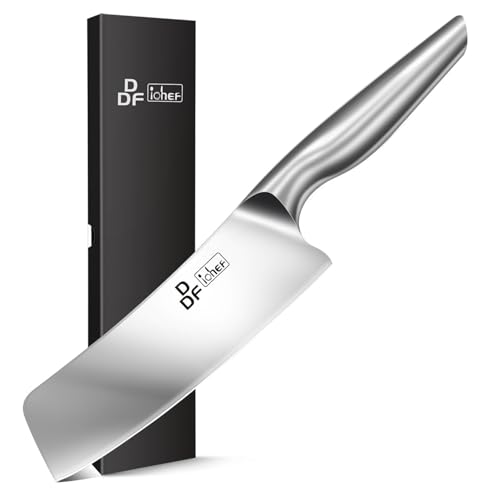
Why it made our list: a left/right-friendly nakiri for vegetable-heavy kitchens at a budget price.
The DDF iohEF is a nakiri, which is a Japanese vegetable knife with a straight, rectangular blade and a flat edge. It’s made from professional Japanese stainless steel and features a double-edged blade design suitable for both left-handed and right-handed users—a detail many budget knives overlook. The listing calls it “multifunctional,” which means it can handle slicing, dicing, and chopping vegetables, though the flat profile is specifically designed for push cuts and up-down chopping rather than rocking.
A nakiri’s straight edge is superior for achieving uniform cuts on vegetables because the entire blade contacts the board at once, preventing accordion cuts. The double-edged grind means it’s symmetrical, so lefties won’t fight the bias of a single-bevel knife. The stainless steel resists rust better than high-carbon steel, but the listing omits the HRC hardness and exact steel grade, so edge retention is an unknown. At this price, you’re getting a dedicated vegetable knife that will make prep faster if you cook primarily plant-based meals. The DDF iohEF nakiri uses a double-edged stainless steel blade that works for both left- and right-handed cooks, which is a thoughtful touch absent from many similarly priced nakiris.
Pros:
- Double-edged blade — ambidextrous design with no steering or bias during cuts.
- Nakiri profile — straight edge contacts the board fully for clean, complete cuts on vegetables.
- Stainless steel construction — less rust-prone than high-carbon steel, so less maintenance anxiety.
- Lightweight design — nakiris are typically lighter than gyutos, reducing fatigue during long veg prep.
- Budget-friendly — a dedicated vegetable knife without the premium of a Damascus finish.
Cons:
- Unknown HRC and steel grade — you can’t predict edge retention or brittleness without this data.
- Limited to vegetables — the flat edge is not ideal for slicing meat or fish with a rocking motion.
- No bolster or finger guard — the straight heel can invite forward hand slippage if your grip is loose.
Final Verdict
Best for: vegetarians, vegans, or anyone who spends most prep time on produce. Skip if: you need one knife to handle both vegetables and proteins—this nakiri will struggle with anything requiring a curved belly.
What to Look For in Japanese Chef Knives Under $100
Choosing among the best Japanese chef knives under $100 requires ignoring the Damascus hype and focusing on three numbers: steel type, HRC hardness, and edge angle. A VG-10 core at 60-62 HRC is the sweet spot for budget knives—hard enough to hold an edge, soft enough to avoid constant chipping. Powder steel can outperform VG-10 but often costs more. Blade thickness behind the edge matters just as much as the angle; a 2mm blade with a 15-degree edge will cut cleaner than a 4mm blade with a 12-degree edge. Forged knives are heavier and more balanced, while stamped knives are lighter but often lack the same durability.
Steel Type and Hardness: The Core of the Matter
VG-10, AUS-10, and Japanese powder steel are the most common core steels under $100. VG-10 at 62 HRC (as in the Atumuryou single knife and set) offers excellent edge retention but requires a whetstone. AUS-10 is slightly tougher but holds an edge a bit less. Powder steel, like the FINTISO, can reach higher hardness with finer grain. Softer steels like the imarku’s 57 HRC are easier to sharpen but dull faster. A knife’s Rockwell hardness tells you how long the edge will last and how delicate the blade is.
Blade Geometry: Thinness Behind the Edge and Angle
The edge angle is the single biggest determinant of cutting feel. Western knives sit at 20 degrees per side; Japanese knives range from 12 to 16 degrees. The FINTISO’s 12-degree edge is the sharpest here but the most fragile. The Huusk’s 16-degree double bevel offers a good compromise. Equally important is the blade’s cross-sectional thinness—a thicker spine will wedge even if the edge angle is acute. Check the listing for blade thickness; the Huusk’s 2mm is ideal.
Once you have a sharp knife, a recipe like our chicken shawarma sheet pan dinner becomes a 15-minute prep instead of 30. A dull knife makes every recipe feel like a chore.
Forged vs Stamped: Does It Matter Under $100?
Forged knives are made from a single piece of heated steel hammered into shape, which creates a denser, more uniform grain. Stamped knives are cut from a sheet and ground. Forged blades generally have better balance and a thicker bolster. Under $100, you’ll find both; the TIVOLI and Huusk are forged, while many cheaper sets are stamped. The difference matters most for heavy chopping—a forged knife transfers less vibration to your hand.
Single Knife vs Set: What’s Actually Worth It
A single high-quality gyuto like the Atumuryou outclasses any three-piece set with soft steel. Sets make sense only if you lack even a paring knife. The imarku set is the exception because its low price means you’re not sacrificing much steel quality. If you already own a decent chef knife, skip the set and spend the money on a whetstone instead. Our beef blade steak roast recipe benefits from a sharp chef knife for trimming and slicing against the grain.
Our Final Recommendation
For the best single knife under $100, the Atumuryou Japanese Chef Knife wins on VG-10 steel at 62 HRC and hand-sharpened geometry. For budget buyers, the imarku 3 Pieces Knife Set offers the most utility per dollar. For those who want the sharpest possible edge and know how to care for it, the FINTISO is the specialist pick. If you only buy one, buy the Atumuryou—it outperforms sets twice its price.
Frequently Asked Questions
What’s the difference between a Gyuto and a Santoku?
A gyuto is a Japanese take on the Western chef’s knife: longer (typically 8 inches), with a curved belly for rocking cuts. A santoku is shorter (5-7 inches) with a flatter belly and a sheep’s foot tip designed for push cuts and chopping. The santoku excels at vegetables and fish; the gyuto is better for meat slicing and general prep. Both appear in this roundup—the Atumuryou single knife is a gyuto, while the TIVOLI and Huusk sets include santokus.
How often do I need to sharpen a Japanese chef knife under $100?
It depends on the steel hardness and edge angle. A 62 HRC VG-10 blade sharpened to 15 degrees may hold a working edge for 4-6 months of home use before needing a whetstone. A softer 57 HRC blade will need honing weekly and sharpening every 2-3 months. The FINTISO’s 12-degree edge will dull faster than a 15-degree edge at the same hardness because it’s thinner and more prone to micro-rolling. Use a honing rod between sharpenings, but never on a 62 HRC blade—only a ceramic rod or whetstone.
Can I put a Japanese chef knife in the dishwasher?
No. Dishwasher detergent is abrasive and the high heat can ruin the temper of the steel, reducing hardness and edge retention. The pakkawood and Sakuragi wood handles will crack or warp. Hand wash with mild soap, rinse immediately, and dry with a towel. This applies to every knife in this roundup, including the DDF iohEF stainless nakiri. If you refuse to hand wash, buy a cheap stamped Western knife and accept the trade-off. For more kitchen tips, see our pot roast onion soup mix oven method where a sharp knife is essential for prepping aromatics.