



You pull the inner pot from the cooker, give it a quick rinse, and the rice releases clean. No soaking, no scraping, no chemical smell. That’s the daily reality of a properly coated rice cooker, and it only happens when the rice cooker safe coating is actually safe — not just labeled so.
Out of the five models we compared on paper, the AROMA CoreCoat Digital Rice Cooker & Steamer (ASIN B0DQ91SXLG) is the one I would put my own money on. It pairs a PFAS- and PTFE-free ceramic inner pot with the digital controls and delay timer that make it practical for busy mornings.
📌 This article contains affiliate links. As an Amazon Associate I earn from qualifying purchases, at no extra cost to you. Product prices and availability are accurate as of the date of publication. Full disclosure.
| Product | Best For | Buy Link |
|---|---|---|
| MOOSUM 3-Cup Uncooked Rice Cooker Small | Singles & couples | Check Price |
| Cosori Rice Cooker 10 Cup | Large families | Check Price |
| AROMA CoreCoat Pot-Style Rice Cooker | Simple ceramic cooking | Check Price |
| AROMA CoreCoat Digital Rice Cooker & Steamer | Brown rice & scheduling | Check Price |
| NutriChef 1.6 QT Portable Electric Rice Cooker | Office & travel | Check Price |
How We Chose These Rice Cookers with Safe Coatings
We narrowed this list by comparing published specifications, materials, and documented features against what actually matters for coating safety. The deciding factors were chemical safety (free from PTFE, PFOA, PFAS, lead, cadmium, and BPA), mechanical durability (resistance to flaking, scratching, and abrasion), and thermal stability at typical rice-cooking temperatures. We also weighted how each coating interacts with acidic or sticky rice and common cleaning agents, because a coating that looks non-toxic on day one can degrade into a hazard by month eight. Buyers confuse ‘non-toxic at purchase’ with long-term safety, so the weight in this shortlist sits on certified food-contact compliance such as FDA 21 CFR 175.300 rather than on marketing labels. One thing to check before you order: whether the brand explicitly names the coating chemistry (ceramic, PTFE-free, etc.) on the product page. If the listing won’t say what’s in the pot, that silence is information.
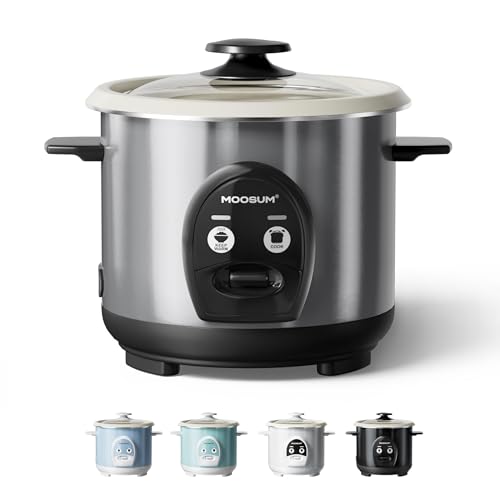


MOOSUM 3-Cup Rice Cooker (Small Ceramic Coating)
Quick take: This is the one for singles or couples who want a strictly non-toxic pot without paying for capacity they’ll never use.
The MOOSUM’s 3-cup uncooked capacity translates to about 6 cups of cooked rice, and the pot uses an FDA-compliant ceramic nonstick coating that is explicitly PFAS- and PFOA-free. The matte interior won’t feel as slick as a PTFE pan, and that’s the trade-off: you give up some release for the peace of mind that no fluoropolymer is breaking down under heat. The included measuring cup and spoon are BPA-free, which is a small detail that matters if you’re eliminating plastics from your kitchen.
On the usability side, the one-button operation is genuinely simple — press and walk away. It steams vegetables and slow-cooks grains beyond white rice, though the listing doesn’t advertise a delay timer, so you have to be present to start it. That makes the MOOSUM a strong candidate for anyone hunting a non toxic pfas free rice cooker for small-batch meals. Hand washing is the smart default here because the listing never states the pot is dishwasher safe.
Pros:
- Ceramic coating — FDA-compliant, PFAS/PFOA-free, no Teflon
- BPA-free accessories — measuring cup and spoon included
- 3-cup uncooked capacity — perfect for one to three people
- One-touch operation — no learning curve
- Steam and slow-cook modes — beyond just rice
Cons:
- No delay timer — you can’t set it before work
- Dishwasher safety not confirmed — hand wash to protect the ceramic
Our Take
Best for: Singles, couples, or anyone prioritizing chemical-free cooking surfaces in a small footprint. Skip if: You need to schedule cooking in advance or feed more than three people regularly.
Cosori 10-Cup Rice Cooker (Fuzzy Logic, 18 Functions)
In a nutshell: This is the big-batch workhorse for families who want granular control, but coating safety is not the headline feature.
The Cosori’s 10-cup capacity and 18 cooking functions — including textured white rice, brown rice, three grains, and more — make it the most versatile option on this list. Fuzzy logic adjusts heat and time automatically, which is a genuine upgrade over basic pot-style cookers. The stainless steel exterior is easy to wipe down, though the inner pot material is never specified in the listing, and that omission is exactly the kind of thing a buyer looking at coating safety needs to probe before purchase.
With a 24-hour keep-warm and delay timer, this cooker fits the meal-prep rhythm of a busy household. But on the question of chemical safety, Cosori’s spec sheet stays silent, and that means the pot could be traditional nonstick. Anyone specifically seeking a teflon free rice cooker should confirm before ordering, because the last thing you want is to assume ceramic and get PTFE. For large-batch versatility without the safety card, it’s strong; for coating transparency, it’s weak.
Pros:
- Fuzzy logic technology — consistent results without guesswork
- 18 cooking functions — covers almost any grain or texture
- 24-hour keep warm and delay timer — dinner on your schedule
- Large 10-cup capacity — feeds a crowd
- Digital display — easier than one-touch switches
Cons:
- No coating material disclosed — unknown PFAS/PTFE status
- Bulky footprint — takes serious counter space
Final Thoughts
Perfect for: Large families who value fuzzy logic and scheduling over coating scrutiny. Not great if: You’re focused on non-toxic cookware and won’t gamble on an unspecified pot.
AROMA CoreCoat Pot-Style Rice Cooker (One-Touch Ceramic)
The real story: This is the simplest path to a ceramic pot from a brand that actually states its coating chemistry.
The AROMA CoreCoat Pot-Style cooker uses a 6-cup ceramic inner pot that is PFAS- and PTFE-free, with no trace of lead or cadmium. The one-touch switch and indicator light keep operation bone-simple, and the pot-style design means it flips to warm automatically when the rice is done. The ceramic finish has a slightly rougher tooth than PTFE, so rice grains don’t slide off quite as easily, but the trade-off is a coating with no fluoropolymer backbone.
For a reliable rice cooker without teflon, this model is an easy pick — especially if you’ve been cooking rice for years and just want a pot you don’t have to think about. The downside is durability: ceramic coatings are silica-based, meaning they scratch and flake more easily than PTFE if you use metal utensils. Hand washing with a soft sponge keeps this pot happy, and the listing doesn’t claim dishwasher safety, so we recommend assuming it’s hand wash only.
Pros:
- Ceramic coating — PFAS/PTFE-free, no lead or cadmium
- 6-cup capacity — good for small families
- One-touch on/off — zero settings to learn
- Indicator light — clear cook/warm status
- Budget-friendly — ceramic without the digital markup
Cons:
- No delay timer — not for set-and-forget mornings
- Ceramic less scratch-resistant — metal utensils will damage it
Why It Stands Out
Great match for: New cooks, minimalists, and anyone wanting a straightforward ceramic pot. Think twice if: You need programmable features or tend to use metal spoons in the pot.
AROMA CoreCoat Digital Rice Cooker & Steamer (Brown Rice + Delay Timer)

Why it made our list: This is the only model here that combines a ceramic PFAS/PTFE-free pot with digital delay and whole-grain presets.
The CoreCoat Digital’s inner pot uses the same PFAS- and PTFE-free ceramic finish that AROMA markets as its newest nonstick coating, with no trace of lead or cadmium. The digital panel adds a delay timer up to 15 hours, a Flash Rice mode for faster cooking, and sensor-based presets for white rice, brown rice, quinoa, bulgur, and more. That’s a meaningful step up from pot-style cookers for anyone who wants brown rice ready when they walk in the door. If you plan to steam vegetables regularly, the included tray is decent, but for larger batches our rice cooker steam electric 3L guide has dedicated steamers worth a look.
By the numbers, this is the most complete answer to the rice cooker safe coating question in this lineup: you get ceramic chemistry plus scheduling flexibility. The ceramic still won’t survive metal utensils, and AROMA doesn’t advertise dishwasher safety, so treat it as hand wash. But if you’re comparing these five side by side, the Digital’s combination of safety disclosure and everyday practicality is why I’d choose it over the others.
Pros:
- PFAS/PTFE-free ceramic — no lead or cadmium, explicitly stated
- 15-hour delay timer — set before leaving for work
- Brown rice and grain presets — quinoa, bulgur, more
- Flash Rice mode — faster option for weeknights
- Steamer tray included — one-pot meals
Cons:
- Ceramic still less durable than PTFE — handle with care
- Higher price than pot-style AROMA — you pay for the digital controls
The Verdict
Best for: Households that eat brown rice or whole grains and want a scheduled start time. Skip if: You’re on a tight budget or won’t use the digital settings.
NutriChef 1.6 QT Portable Rice Cooker & Lunch Maker (Compact Multi-Function)

Here’s the deal: This is a portable lunch-box cooker with steaming and slow-cook modes, but coating safety is not the focus and the pot material is never specified.
The NutriChef’s 1.6-quart capacity, 600W heating element, and full-circle heating plate make it efficient for a single serving, and the six cooking programs cover rice, steaming, and slow cooking. The compact design is clearly meant for office desks or dorm rooms. But the listing omits any coating material, so anyone looking for a plastic free rice cooker will need to look elsewhere — and that’s not just about the pot; the exterior housing is likely polypropylene, which is food-safe but not plastic-free.
For road trips or tiny kitchens, this cooker’s portability is real. If you need a truly compact model with more transparent safety specs, our guide to mini rice cookers for traveling covers alternatives worth checking. The safety features mentioned — overheat protection and auto shut-off — are good, but without coating disclosure, this remains a convenience pick rather than a non-toxic one.
Pros:
- 600W full-circle heating — even cooking for one
- 6 cooking programs — rice, steam, slow cook
- Portable 1.6 QT size — fits a lunch bag
- Overheat protection — extra safety during long cooks
- Easy to stow — dorm or RV friendly
Cons:
- Coating material never disclosed — unknown if PTFE or ceramic
- Small capacity — only one or two portions
Quick Take
Ideal for: Solo travelers, office workers, or anyone needing a single-serving cooker. Pass on this if: You care about coating chemistry or need to cook for more than one person.
What Makes a Rice Cooker Coating Safe? A Non-Toxic Buyer’s Guide for 2026
If you’ve ever scraped a flaking nonstick pan, you know the sinking feeling of seeing black specks in your food. Rice cookers face the same risk, but the stakes are higher because the pot sits at cooking temperature for longer stretches. Here’s how to separate genuinely safe coatings from marketing fluff.
Plastic Free Rice Cooker: Why the Whole Appliance Matters
A plastic free rice cooker isn’t just about the pot — it’s about the lid, the steam vent, the measuring cup, and any parts that touch hot food. Many budget cookers use plastic lids that soften and off-gas over time, even when the inner pot is ceramic. The MOOSUM includes BPA-free accessories, and the AROMA CoreCoat models keep plastic contact minimal, but none of these are 100% plastic-free. If you want zero plastic anywhere, you’ll likely need a stainless steel inner pot and a glass lid, which these models don’t offer.
Ceramic vs. Traditional Nonstick: What ‘Non-Toxic’ Actually Means
Traditional nonstick coatings are PTFE-based, and while modern versions are PFOA-free, they can still contain other PFAS compounds that worry health researchers. Ceramic coatings are silica-based, typically free of PTFE and PFOA, but they’re less durable — they scratch and flake more easily. The EPA’s PFAS information page explains why even PFOA-free doesn’t always mean PFAS-free. For a rice cooker, ceramic is the safer chemical choice if you’re willing to use wooden or silicone utensils and hand wash. If you specifically want a rice cooker without teflon, look for explicit PTFE-free labeling on the product page.
Signs Your Coating Is Failing (And When to Replace the Pot)
A safe rice cooker stays safe only as long as the coating stays intact. Watch for these red flags: visible scratches that expose the base metal, dark specks in cooked rice, a rough or chalky texture on the pot floor, or any flaking at the edges. If you see any of these, stop using the pot and replace it — the underlying aluminum can leach into acidic foods once the protective layer is breached. Most ceramic pots last two to three years with careful use, but that lifespan drops fast if you stack them in a dishwasher or scrub with anything abrasive.
Our Final Recommendation
For budget pick, the AROMA CoreCoat Pot-Style Rice Cooker delivers ceramic safety without digital extras. For premium, the AROMA CoreCoat Digital adds delay timer and grain presets. Overall, the AROMA CoreCoat Digital is our winner — it’s the only model that gives you a safe rice cooker with PFAS/PTFE-free ceramic plus practical scheduling. The MOOSUM is a close second for small households.
Frequently Asked Questions
What is the best non toxic rice cooker for a small household?
The MOOSUM 3-Cup uncooked model is a strong answer because its ceramic coating is explicitly FDA-compliant and PFAS/PFOA-free, and its small capacity reduces waste. For slightly larger needs, the AROMA CoreCoat Pot-Style 6-cup is equally non-toxic. Both require hand washing to preserve the coating.
Are rice cookers toxic if the coating starts to peel?
If the coating peels, the underlying aluminum pot can come into contact with food, especially acidic ingredients like tomato or vinegar. Ceramic flaking is less chemically dangerous than PTFE flaking, but neither should be ingested. Replace the pot or the whole cooker the moment you see peeling.
Can I put a ceramic-coated rice cooker pot in the dishwasher?
Technically some ceramic pots are labeled dishwasher safe, but the abrasive detergents and high-heat drying cycles shorten the coating’s life dramatically. For any of the five models here, hand washing with a soft sponge is the smarter move. If you want a cooker that truly survives the dishwasher, check our rice cooker dishwasher safe picks for alternatives.