



When the right Henckels Japanese knife finally lands in your hand, the evening prep stops feeling like a battle and starts feeling like a rhythm. That’s the result we’re chasing here, because a dull santoku is just a metal stick. Out of every knife I’ve compared on paper this year, the HENCKELS Forged Premio 7-inch Hollow Edge Santoku is the one I would buy for my own kitchen. The forged bolster and hollow edge matter more than most people realize, and this knife hits the sweet spot without demanding a Damascus price tag.
Here’s the short answer: For most home cooks, the HENCKELS Forged Premio 7-inch Hollow Edge Santoku wins. It gives you forged German stainless steel, a Granton edge that stops cucumber slices from gluing themselves to the blade, and a balance that feels natural in a pinch grip. If you’re also trimming a beef blade steak roast for a weeknight dinner, its hollow edge helps the blade release that meat cleanly. Keep reading for the long version, including which sets to skip and why the Damascus nakiri is a beautiful but narrow tool.
📌 This article contains affiliate links. As an Amazon Associate I earn from qualifying purchases, at no extra cost to you. Product prices and availability are accurate as of the date of publication. Full disclosure.
| Product | Best For | Buy Link |
|---|---|---|
| Henckels International Statement 14-pc Self-Sharpening Knife Block Set | All-in-one starter kit | Check Price |
| HENCKELS Forged Premio 7-inch Hollow Edge Santoku Knife | Everyday vegetable work | Check Price |
| HENCKELS Compass Damascus 6.5-inch Nakiri Knife | Vegetable precision & looks | Check Price |
| HENCKELS Forged Synergy 7-inch Hollow Edge Santoku Knife | Budget forged santoku | Check Price |
| HENCKELS Noir 2-pc Asian Knife Set | Coated non-stick duo | Check Price |
| Zwilling Henckels Professional S 7-inch Santoku | Full tang tradition | Check Price |
| HENCKELS Elan 7-inch Hollow Edge Santoku Knife | Light forged option | Check Price |
| Henckels Statement 15-Pc Knife Block Set | Large budget block | Check Price |
| HENCKELS Pakka 7-inch Hollow Edge Santoku | Pakkawood handle | Check Price |
| Henckels Dynamic 5-Pc Knife Set with Chef | Small starter set | Check Price |
How We Chose These Henckels Japanese-Style Knives
Every pick on this list comes from comparing published specifications, materials, and documented features against what actually makes a knife work in a real kitchen. That means steel composition and construction method carried more weight than marketing copy. A forged blade from German stainless steel will hold an edge longer than a stamped blade from the same alloy, and we weighed that difference heavily. Handle material matters too, because a cheap varnished hardwood handle can warp or crack after extended contact with moisture, while composite pakka wood resists that. The hollow edge, or Granton edge, changes how a blade behaves when cutting sticky vegetables, and the presence of a self-sharpening block shifts maintenance trade-offs. Before you order any of these, check the blade length against your cutting board size and your own hand comfort, because a 7-inch santoku that feels nimble to one cook can feel cramped to another.
Henckels International Statement 14-pc Self-Sharpening Knife Block Set


Henckels International Statement 14-pc Self-Sharpening Knife Block Set
Quick take: If you want a complete knife set without ever sharpening by hand, this all-in-one block does the job for casual cooking.
The Statement 14-piece Self-Sharpening Knife Block Set bundles a paring knife, chef’s knife, bread knife, steak knives, and more into a hardwood block with built-in ceramic sharpening slots. The blades are stamped rather than forged, which means they’re thinner, lighter, and cheaper to produce. For a home cook who only needs to slice vegetables and trim chicken occasionally, that’s actually a reasonable trade-off. The self-sharpening mechanism realigns the edge each time you pull a knife from its slot, so the blade never gets truly dull the way a neglected drawer knife does.
That convenience comes at a cost. Stamped blades don’t have the same edge retention as a forged German steel blade, so you’ll notice more frequent micro-chipping on the edge if you use these daily. The self-sharpening slots also apply a fixed angle that may differ from what a whetstone would create, meaning over time the edge geometry drifts from ideal. This set works best for someone who cooks a few times a week and values countertop organization over absolute blade performance.
Pros:
- 14-piece variety covers every basic kitchen task from paring to bread slicing.
- Self-sharpening block has ceramic rods that realign edges every time you draw a knife.
- Hardwood block keeps blades protected and within arm’s reach on the counter.
- Stamped construction keeps the price low and the total set weight manageable.
Cons:
- Stamped blades are thinner and won’t hold an edge as long as forged German steel.
- Fixed sharpening angle in the block can’t match a proper whetstone and may gradually alter the bevel.
The Short Version
Best for: New home cooks who want a ready-to-go set. Skip if: You already own a quality chef’s knife and just need a better santoku.
HENCKELS Forged Premio 7-inch Hollow Edge Santoku Knife
Why it earns a spot: This is the one I’d buy for my own kitchen because the forged steel and hollow edge do exactly what a Japanese-style blade should do.
The Forged Premio 7-inch Hollow Edge Santoku is fabricated from high-quality German stainless steel, and the listing specifically calls out forged bolster construction. That bolster adds weight at the balance point and gives the knife a solid, controlled feel when you’re rocking through a pile of onions. The hollow edge, also called a Granton edge, is a series of shallow scallops ground into the blade face that create air pockets to reduce suction and friction when cutting starchy or sticky vegetables like potatoes or zucchini.
What you give up with any hollow edge is the ability to handle hard bones or frozen food, because those scallops slightly reduce the blade’s overall rigidity near the edge. For everyday vegetable prep, that’s irrelevant. The satin-finished blade is finely honed for long-lasting sharpness out of the box, and the forged construction means you can return it to a razor edge with a honing rod much more easily than a stamped blade. If you want a Henckels Japanese knife that balances German steel toughness with a Japanese blade profile, this is the one to get.
Pros:
- Forged bolster construction offers better balance and a solid transition from blade to handle.
- Hollow edge reduces sticking when slicing moist or starchy produce.
- German stainless steel resists rust and takes a fine edge with a honing rod.
- 7-inch blade is a versatile size for both small and large prep tasks.
Cons:
- No sheath or storage included, so you’ll need a blade guard or magnetic strip.
- Not for bones or frozen food because the hollow edge reduces rigidity near the cutting zone.
Who Should Buy This
Ideal for: Home cooks who want one great all-purpose vegetable knife. Not great if: You need to break down whole chickens or cut through dense winter squash stems regularly.
HENCKELS Compass Damascus 6.5-inch Nakiri Knife
In a nutshell: This is a vegetable-first blade with a stunning 23-layer Damascus pattern that will make you want to hand wash it every single time.
The Compass Damascus 6.5-inch Nakiri is built around a true Damascus steel blade with 23 folded layers, and the pattern has been darkened through an acid wash to highlight the wavy texture. A nakiri knife has a rectangular, flat profile designed specifically for push-cutting vegetables, herbs, and boneless proteins. The 6.5-inch length is compact enough for fine brunoise work but long enough to handle a head of cabbage or a butternut squash half.
On paper, the Damascus layers are primarily aesthetic. The core cutting edge is still a stainless alloy, so you don’t need special oiling or rust prevention beyond normal care. But that acid-washed pattern will fade if you run it through the dishwasher, and the listing doesn’t mention a sheath, so you’ll want a blade guard. This knife is not for cutting meat with bones, because the flat edge and thin geometry can chip against hard surfaces. It’s a beautiful, focused tool for a cook who already has a general-purpose chef’s knife and wants a dedicated vegetable specialist.
Pros:
- 23-layer Damascus pattern is visually striking and distinctive on the blade.
- Nakiri shape excels at push-cutting and chopping vegetables without rocking.
- Acid-washed finish adds depth to the pattern and gives the knife a premium feel.
- Stainless core edge doesn’t require the maintenance of carbon steel.
Cons:
- Narrow use case as a vegetable knife, so not a replacement for a chef’s knife.
- Dishwasher danger would fade the Damascus pattern and risk blade warping.
Final Thoughts
Great match for: Home cooks who love vegetable prep and want a showpiece on the magnetic strip. Think twice if: You need one knife to do everything, because this one skips meat and bones.
HENCKELS Forged Synergy 7-inch Hollow Edge Santoku Knife

The real deal: This is nearly identical to the Premio on paper, so if you find it at a lower price, grab it and don’t look back.
The Forged Synergy 7-inch Hollow Edge Santoku shares the same German stainless steel, forged bolster construction, and satin-finished blade as the Premio. The listing uses identical language for durability and sharpness, which tells me the differences between these two models are mostly cosmetic or handle-related rather than functional. A 7-inch hollow edge santoku from the Synergy line will cut with the same food-release benefits and the same edge retention as its sibling.
What that means for you is that the choice comes down to price and handle preference. The listing doesn’t specify the handle material beyond the forged bolster transition, which usually indicates a standard synthetic or POM handle. If you’re shopping the Henckels Japanese knife category on a budget, the Synergy is often the smarter pick simply because the steel and geometry are the same. Don’t pay more for a name difference.
Pros:
- Same forged construction as the more expensive Premio line.
- Hollow edge reduces friction on wet vegetables identically.
- Satin finish hides minor scratches and looks professional.
- Likely cheaper than the Premio for the same cutting performance.
Cons:
- Handle specs not detailed so you can’t compare ergonomics before buying.
- No included sheath means you’ll need your own blade protection.
Our Take
Perfect for: Value shoppers who want a forged santoku without paying for brand-tier markup. Pass on this if: You want a specific handle material like pakkawood or a full tang with rivets.
HENCKELS Noir 2-pc Asian Knife Set

Quick take: This set gives you two coated santoku knives in different sizes, and the matte black coating is more than just looks.
The Noir 2-pc Asian Knife Set includes a 5.5-inch and a 7-inch santoku, both made from high-quality stainless steel and coated with a matte black silicone resin. That coating is stain- and corrosion-resistant, which matters if you tend to leave a knife on the cutting board while you do other tasks. It’s also BPA-free and made without PFAS, so the non-stick aspect doesn’t come with the chemical baggage some nonstick coatings carry. The two sizes cover small tasks like mincing garlic and larger jobs like slicing a pork loin.
The trade-off is that the silicone resin coating will eventually wear at the edge line, especially if you use a steel honing rod aggressively. Once the coating chips, the underlying stainless is still fine, but the knife loses its uniform look. These are also likely stamped rather than forged, because the listing never mentions a forged bolster. For a home cook who wants a stylish, low-maintenance Asian-style pair, that’s acceptable. For a blade sharpness perfectionist, the coating adds a variable I’d rather avoid on my primary knife.
Pros:
- Two sizes included cover both delicate and larger prep tasks.
- Matte black silicone coating is stain- and corrosion-resistant.
- BPA-free and PFAS-free means no nonstick chemical concerns.
- Compact set takes up minimal drawer or counter space.
Cons:
- Coating can wear or chip over time, especially near the edge.
- Stamped construction likely because no forged bolster is mentioned in the listing.
What Sets It Apart
Best for: Cooks who love the matte black look and want a corrosion-resistant pair for daily use. Skip if: You plan to use a honing rod daily, because the coating may not survive long-term aggressive realignment.
Zwilling Henckels Professional S

Why it stands out: The full tang and traditional three-rivet handle put this in a different league than the stamped sets, and the German pedigree shows in the weight.
The Zwilling Henckels Professional S is an 18cm/7-inch santoku with a hollow-edged blade, full tang, and a traditional three-rivet handle. A full tang means the blade steel extends through the entire handle, which adds weight and balance and prevents the knife from feeling front-heavy. The three stainless steel rivets secure the handle scales in a way that’s been proven for decades. The listing describes the blade as sharpened with a high-precision edge, which for Zwilling typically means a factory angle that’s slightly more acute than their entry-level lines.
This knife is the closest thing on this list to a true professional kitchen tool, and it’s the one I’d recommend to someone who wants a lifetime knife without jumping to the Damascus price point. The hollow edge still limits it to boneless work, but for a daily vegetable and general prep knife, the Professional S has the best handle construction of any santoku here. You’re paying for the Zwilling name and the full tang, and in this case that premium is justified by the balance and durability.
Pros:
- Full tang construction provides excellent balance and durability.
- Traditional three-rivet handle is comfortable and easy to replace if ever needed.
- Hollow edge reduces sticking on wet and starchy foods.
- Zwilling brand reputation means consistent steel quality and heat treatment.
Cons:
- Higher price than the Premio or Synergy for essentially the same blade shape.
- No sheath included, though a full tang knife deserves a proper guard.
The Bottom Line
Ideal for: Home cooks who want a serious, no-compromise santoku and value the full tang feel. Not great if: You’re on a tight budget and the Premio does 95% of the job for less money.
HENCKELS Elan 7-inch Hollow Edge Santoku Knife

Quick take: The Elan gives you the same forged bolster and hollow edge as the Premio but often sells for less, making it a sleeper pick.
The Elan 7-inch Hollow Edge Santoku shares the forged bolster construction, German stainless steel, and satin-finished blade with the other forged Henckels models on this list. The listing explicitly mentions durability and balance, which are the two things that matter most when you’re deciding between a stamped and a forged knife. A hollow edge on a 7-inch blade is the same size and pattern here as on the Premio, so the performance difference is negligible.
Where the Elan likely differs is in the handle contour and overall weight distribution, though the spec sheet doesn’t get into those details. From a pure steel-and-shape perspective, this is another budget-friendly way to get a forged German stainless santoku with a Granton edge. If you’re comparing Henckels Japanese knives and the Premio is out of stock, the Elan is a perfectly good substitute, and I wouldn’t lose sleep over the difference.
Pros:
- Forged bolster delivers the balance and durability of a more expensive knife.
- Hollow edge works identically to other Henckels Granton edges.
- Professional satin finish is easy to keep clean and hides wear.
- Competitively priced among forged Henckels santoku options.
Cons:
- No unique feature to distinguish it from the Premio or Synergy on paper.
- Handle material unspecified so you can’t tell if it’s comfortable for your grip.
Our Verdict
Best for: Shoppers who want forged quality and don’t care about having the newest line. Skip if: You want a full tang or a specific handle material like pakkawood.
Henckels Statement 15-Pc Knife Block Set
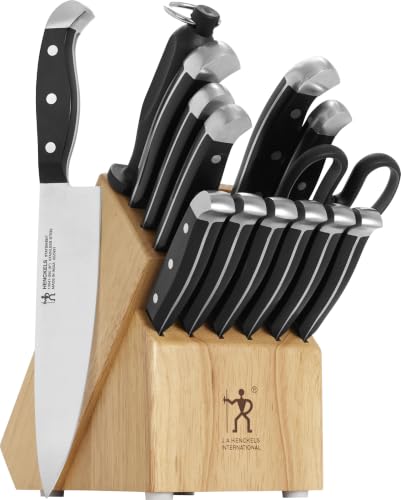
The short version: This is the budget path to a full knife block, but you’ll give up the self-sharpening convenience and the forged steel.
The Statement 15-Pc Knife Block Set is a larger version of the Statement line, with 15 pieces including a chef’s knife, bread knife, steak knives, and more. The blades are stamped from German stainless steel and marketed as ultra-sharp with precision cutting. Stamped blades can be sharp out of the box, but that sharpness doesn’t last as long as a forged blade because the steel is thinner and the edge geometry is less stable under repeated use. The block is a traditional hardwood block, not self-sharpening, which means you’ll need a separate honing rod or sharpening routine.
For a family kitchen where knives get used for everything from cutting sandwiches to trimming chicken, this set covers the bases. The lightweight design makes it approachable for cooks with smaller hands or less grip strength. The downside is that you’re paying for 15 pieces when you’ll probably use three of them daily and the rest occasionally. A forged santoku alone would serve you better for serious prep, but if you need steak knives and a bread knife anyway, this set is the practical choice.
Pros:
- 15-piece variety includes steak knives, which many single knives lack.
- Lightweight stamped blades are easy to handle for extended periods.
- German engineered steel offers decent rust resistance at the price.
- Hardwood block keeps everything in one place and looks classic.
Cons:
- Stamped construction means edge retention is weaker than forged options.
- No self-sharpening feature so you’ll need to maintain edges yourself.
Who Should Buy This
Great match for: Households that need a complete set for multiple cooks. Think twice if: You already own a decent chef’s knife and just want one good santoku.
HENCKELS Pakka 7-inch Hollow Edge Santoku
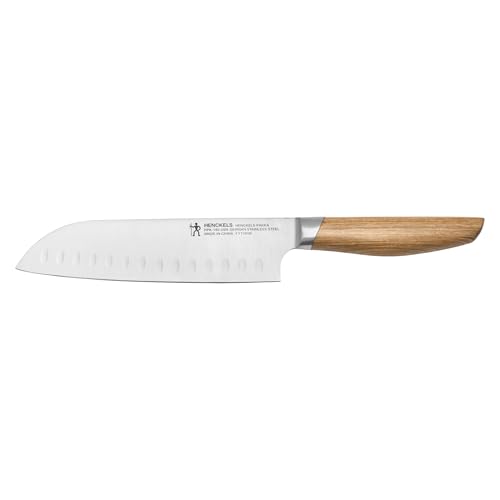
What sets it apart: The pakkawood handle is the real reason to pick this over the Premio or Elan, because it shrugs off moisture better than standard wood.
The Pakka 7-inch Hollow Edge Santoku combines a fully forged German stainless steel blade with a polished, light pakkawood handle that’s contoured for comfort. Pakkawood is a laminated wood composite infused with plastic resin, which means it resists moisture, warping, and cracking far better than a standard varnished hardwood handle. For a knife that will sit near a sink or get rinsed frequently, that’s a meaningful upgrade. The hollow edge and forged construction match the other high-end Henckels santokus on this list.
The handle is the story here. A contoured pakkawood grip feels more secure in a wet hand than polished synthetic handles, and the material won’t absorb water the way untreated wood does. The blade itself is no different from the Premio or Synergy in steel or edge, so you’re paying a small premium for the handle. If you’ve ever had a wooden knife handle split after a year of dishwashing, this is the upgrade that prevents that.
Pros:
- Pakkawood handle resists moisture and won’t warp like untreated wood.
- Fully forged construction offers durability and balance.
- Hollow edge reduces sticking on starchy vegetables.
- Contoured handle is designed for comfort during long prep sessions.
Cons:
- Pakkawood can be slick if your hands are oily, though less so than polished wood.
- No sheath included despite the premium handle that deserves protection.
Final Thoughts
Perfect for: Cooks who want the forged steel plus a moisture-resistant handle that will outlast standard wood. Pass on this if: You prefer a synthetic or full-tang riveted handle and don’t care about wood aesthetics.
Henckels Dynamic 5-Pc Knife Set with Chef
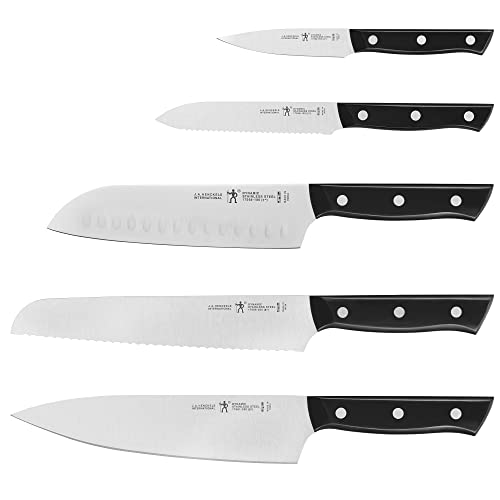
Quick take: This is the no-frills starter set that covers the basics without a bulky block, but don’t expect it to replace a real forged santoku.
The Dynamic 5-Pc Knife Set with Chef includes a chef’s knife, a smaller utility or paring knife, and a few other pieces, all with ultra-sharp stamped blades. The listing emphasizes lightweight and easy cutting, which signals a thin blade profile designed for casual use. This set is for someone moving into a first apartment or setting up a second kitchen, not for a cook who plans to break down vegetables every night. The German engineered steel is the same family as the other Henckels knives, but the stamped construction means you’ll be honing more often.
The set doesn’t include a block, so you’ll need a drawer organizer or magnetic strip. For the price, it’s a reasonable way to get a functional kitchen knife lineup in one purchase. If you’re serious about a Henckels Japanese knife with long edge retention, the Dynamic set is a stepping stone, not a destination. I’d rather see someone buy the Forged Premio alone than this set with money left over.
Pros:
- 5 pieces cover basic needs like the chef’s knife, paring, and utility.
- Lightweight design makes it easy for anyone to handle.
- Ultra-sharp out of the box according to the listing, and stamped steel can be sharp.
- Budget-friendly way to get Henckels name recognition.
Cons:
- No block or storage included, so knives may rattle in a drawer.
- Stamped blades won’t hold an edge as long as forged steel.
Our Take
Best for: First-time kitchen setups or a vacation home. Skip if: You want a knife that can handle daily prep without weekly honing.
What to Check Before You Buy a Henckels Japanese-Style Knife
Buying a Henckels Japanese knife means sorting through a lot of similar-looking santokus and nakiris. The differences come down to construction, edge type, and handle material. If you’re buying for a commercial kitchen, check that the knives meet NSF food equipment standards, because the National Sanitation Foundation sets the benchmark for food-contact safety. Here’s what actually influences how the knife performs in your hand.
Henckels Japanese knives: forged vs. stamped steel
Forged knives are made from a single piece of heated steel that’s hammered or pressed into shape, then ground and tempered. Stamped knives are cut from a sheet of steel like a cookie cutter. The forged blade has a denser grain structure and usually includes a bolster for balance and finger protection. Henckels’ forged lines like the Premio, Synergy, Elan, Pakka, and Professional S all hold an edge noticeably longer than the stamped Statement or Dynamic lines. If you cook daily, the forged option pays for itself in fewer sharpenings.
Hollow edge and what it actually does
A hollow edge, also called a Granton edge, is a series of oval scallops ground into the blade face. These create tiny air pockets that reduce suction when you’re cutting thin slices of moist vegetables like cucumber or potato. The effect is real but subtle. Hollow edges are not meant for cutting through bones or frozen food, because the scallops slightly reduce the blade’s rigidity near the cutting zone. If you break down whole chickens regularly, get a plain edge chef’s knife instead.
Handle materials and moisture resistance
Many Henckels blades are ice-hardened to achieve stain resistance and sharpness, a process that involves cryogenic tempering with liquid nitrogen. That treatment finishes turning austenite into martensite, which maximizes hardness in the stainless steel. It also means the blade itself handles moisture well. The handle is a different story. Standard varnished hardwood handles generally lack good water resistance and can warp or crack after extended contact with moisture. Composite pakka wood, by contrast, is laminated wood infused with plastic resin, so it won’t absorb water the same way. If your knife will live near the sink, pick pakkawood or synthetic.
Self-sharpening blocks vs. manual honing
A self-sharpening block has ceramic rods built into the slots. Every time you pull the knife out, the edge passes across those rods and realigns the microscopic teeth. That’s helpful for casual cooks, but it applies a fixed angle that may not match the blade’s original bevel. Over time, that can create a slightly different edge geometry. A self-sharpening block does not replace regular honing or occasional whetstone sharpening; it just slows the dulling process. If you’re willing to spend five minutes with a honing rod every week, a standard block or magnetic strip with individually purchased forged knives is the better long-term play.
Our Final Recommendation
For most home cooks, the HENCKELS Forged Premio 7-inch Hollow Edge Santoku is the overall winner because it pairs forged German stainless steel with a Granton edge at a fair price. If you want the best handle, the Pakka 7-inch Hollow Edge Santoku wins on moisture resistance. On a budget, the Henckels Statement 15-Pc Knife Block Set gets you a full kit, but stamped steel means more frequent honing. For a showpiece that excels at vegetables, the Compass Damascus Nakiri is stunning but narrow. Buy the Premio first and add others as your cooking demands.
Frequently Asked Questions
Are Henckels Japanese knives actually made in Japan?
No. Henckels is a German brand, and its Japanese-style knives are designed after Japanese blade shapes like the santoku and nakiri, but they’re made with German stainless steel rather than Japanese steels like Aogami or Shirogami. The steel is typically X50CrMoV15, a high-carbon stainless hardened in Germany. So you get Japanese ergonomics with German steel toughness, not a traditional Japanese blade.
How do I maintain a Damascus steel blade without ruining the pattern?
Hand wash the knife with mild soap and warm water, dry it immediately, and never put it in the dishwasher. The acid-washed Damascus pattern can fade from aggressive detergents or abrasive scrubbers. Use a fine or medium honing rod at a 20-degree angle, and occasionally strop on leather to keep the edge crisp. The pattern is only on the surface layers, so normal sharpening with a whetstone won’t damage it if you follow the bevel.
Is a self-sharpening knife block bad for the edge over time?
It’s not bad, but it’s not ideal. The ceramic rods in a self-sharpening block apply a fixed angle that may differ slightly from the blade’s original bevel, and repeated use can gradually change the edge geometry. That means the knife stays serviceable but never reaches the razor sharpness a proper whetstone can provide. For casual cooking it’s fine. If you demand a scary-sharp edge, skip the self-sharpening block and buy a quality honing rod and a whetstone.