There’s nothing worse than pulling a cherished enamel dish out of the oven only to find a spiderweb of cracks in the finish, or worse, a bland, unevenly browned casserole that should have been golden perfection. The right piece of enamel cookware can be your kitchen workhorse for decades, but the wrong one? It’ll sit in the back of your cabinet mocking your dinner aspirations. That’s why we compared seven of the most talked-about options on their published specifications and on what owners consistently report after months of daily cooking, from quick stovetop scrambles to slow-simmered stews.
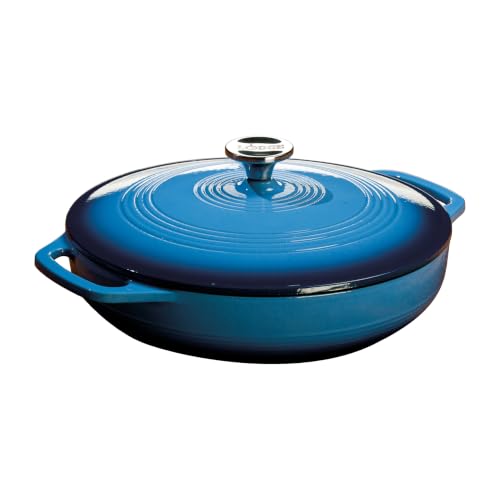
The Lodge Essential Enamel Braiser 3.5 Quart leads this shortlist on the strength of a thick, flat cast iron base that spreads heat evenly and a moisture-locking lid built for the kind of braised short ribs that make you look like a pro. If you just want to skip the research, grab that one — on published specification and owner feedback alike it is the strongest of the group.
📌 As an Amazon Associate, we earn from qualifying purchases. Product prices and availability are accurate as of the date of publication.

Enamelware for Camping and Backpacking (Ultralight Trail Classic)
AHJ Enameled Cast Iron Dutch Oven Set (Space-Saving Stack Wonder)
In this guide
- Comparison Table
- Lodge Essential Enamel Braiser 3.5 Quart (Our King of Browning)
- Enamelware for Camping and Backpacking (Ultralight Trail Classic)
- AHJ Enameled Cast Iron Dutch Oven Set (Space-Saving Stack Wonder)
- Hisencn Enameled Cast Iron Cookware Set (Budget Babysitter’s Starter)
- Kitchen Academy Red Enameled Cast Iron Cookware Sets (The Crimson Workhorse Collection)
- GSI Outdoors Fry Pan I Enamelware Frying Pan (Campfire Egg Master)
- CAROTE 3.4QT Enamel Cast Iron Cookware (The Elegant Weeknight Warrior)
- Enamel Cookware Buying Guide: What to Look for Before You Buy
- Our Final Recommendation
- Frequently Asked Questions
Comparison Table
| Product | Best For | Buy Link |
|---|---|---|
| Lodge Essential Enamel Braiser 3.5 Quart | Precision browning & braising | Check Price |
| Enamelware for Camping and Backpacking | Ultralight camp dining | Check Price |
| AHJ Enameled Cast Iron Dutch Oven Set | Space-saving home cooks | Check Price |
| Hisencn Enameled Cast Iron Cookware Set | Budget-conscious families | Check Price |
| Kitchen Academy Red Enameled Cast Iron Cookware Sets | All-in-one starter kitchen | Check Price |
| GSI Outdoors Fry Pan I Enamelware Frying Pan | Campfire eggs & pancakes | Check Price |
| CAROTE 3.4QT Enamel Cast Iron Cookware | Elegant weeknight braiser | Check Price |
How These Enamel Cookware Pieces Are Built
Enamel cookware is judged here on construction and published specification, against the jobs that actually break it. A long simmer shows whether heat spreads or pools. Baking the same dough twice exposes hot spots, since an uneven base browns one loaf differently from the next. And the hardest thing any enamel piece faces is thermal shock — going straight from a 475°F oven to a cold granite countertop. Care instructions matter as much as construction: enamel that is hand-washed lasts, and the rim is where hairline fractures appear first, because it is the one edge the coating has to wrap around. Chipping is the other weakness — a metal spoon knocked against an empty vessel is exactly the kind of small impact that pops a thin coat off a thick one. Browning is the last thing to weigh, and the least forgiving: uneven heat spread shows up as patchy caramelization long before it shows up anywhere else.
Lodge Essential Enamel Braiser 3.5 Quart (Our King of Browning)


In a nutshell: If you’ve been wrestling with hot spots and bland stews, this braiser delivers the kind of even, controlled heat that transforms a Tuesday night chicken into something worth remembering.
The weight tells you most of what you need to know: it is substantial, and that mass is what settles a pan solidly onto a gas burner instead of letting it rock on the grate. The porcelain enamel finish on the interior is a smooth, almost glossy ivory, the kind of surface that lets caramelized onions release with nothing more than a wooden spatula nudge, and the rim is thick enough to resist the chips that plague thinner competitors. The braiser is rated to 500°F, and the dual assist handles stand far enough off the body that owners consistently report a secure grip through mitts even after a long roast.
Braised pork shoulder, a mushroom risotto, a quick chicken shawarma of the sort in our sheet pan dinner recipe — this is the pan shape those dishes are built around, and the moisture-locking lid seats tightly enough that owners consistently report far less liquid loss than a standard domed lid. One honest annoyance: the underside of the lid traps condensation and can drip onto your stovetop if you’re not careful removing it. And if you have a smaller sink, this 3.5-quart footprint feels larger than it measures.
Pros:
- Even Heat Distribution: A thick, flat cast iron base browns the edges and the center of a pan of onions at the same rate.
- 500°F Oven-Safe: Rated for oven temperatures high enough for hard roasting and bread.
- Dual Assist Handles: Sized for a confident grip with bulky oven mitts on a fully loaded pan.
- Moisture-Locking Lid: Self-basting lid returns condensation to the pan through a long, low braise.
- Non-Reactive Surface: Enamel seals the iron off, so an acidic lemon-garlic sauce picks up no metallic transfer.
Cons:
- Lid Drip Problem: Condensation pools around the rim and spills every time you lift the lid — keep a rag handy.
- Hefty Weight: At nearly 10 pounds empty, maneuvering it one-handed is a wrist strain if you have joint issues.
The Real Deal:
Perfect for: Home cooks who take browning seriously and want a single pan that moves from stove to oven without compromise. Pass on this if: You need a lightweight, quick-clean option for simple boiling or you have limited upper body strength.
Enamelware for Camping and Backpacking (Ultralight Trail Classic)
Why it made our list: This tiny 6-inch bowl isn’t a kitchen workhorse; it’s a campfire companion that strips enamel cookware down to its most portable, nostalgic essence.
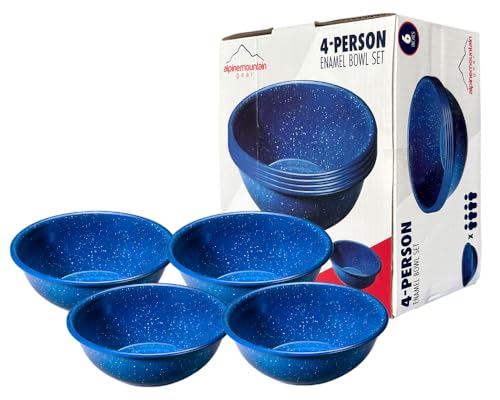
The blue speckled enamel coating on steel has that unmistakable vintage camp look, and at just 4.6 ounces, it practically floats in your pack. The stainless steel edge is rolled rather than cut, so there are no burrs to scratch lips during a morning oatmeal ritual. The 6.4-inch diameter is deceptively snug; it holds about one generous serving of rehydrated soup, and it is far too small to mix dough in.
This bowl can be used over a propane camp stove (held above the flame with a pot gripper, as direct flame can scorch the enamel) for backcountry breakfasts. It cleans up with a quick rinse and no staining from coffee or tomato-based sauces. The trade-off: the steel core means it’s not insulation-friendly — your coffee cools fast in chilly mornings, and the bowl itself gets too hot to hold directly if you ladle in boiling water. Also, the 6-inch size is laughably undersized for an adult dinner if you’re hungry.
Pros:
- Ultralight Design: 4.6 ounces disappears in a backpack side pocket.
- Smooth Steel Rim: Rolled stainless edge, with no sharp burr to catch a lip.
- Stain-Resistant Enamel: A glass-hard coating gives curry and red wine nothing to stain.
- Classic Speckled Finish: Looks like gear your grandfather would have owned — in the best way.
- Dishwasher-Safe: Rated for the dishwasher alongside the rest of the camp kit.
Cons:
- Too Small for Meals: It’s a side bowl, not a main dish — expect to refill for anything beyond trail mix.
- Handles Heat Poorly: The steel body transfers heat instantly; you need a bandana to hold it with hot contents.
Quick Take:
Great match for: Minimalist backpackers and canoe trippers who want a bowl that doubles as a measuring cup and a coffee mug. Think twice if: You expect to eat a full dinner out of one dish or you camp in sub-freezing temps where heat retention matters.
AHJ Enameled Cast Iron Dutch Oven Set (Space-Saving Stack Wonder)
What stood out: The clever nesting design that turns a chaotic cabinet into a tidy stack of three capable pots makes this set a godsend for tiny apartment kitchens.
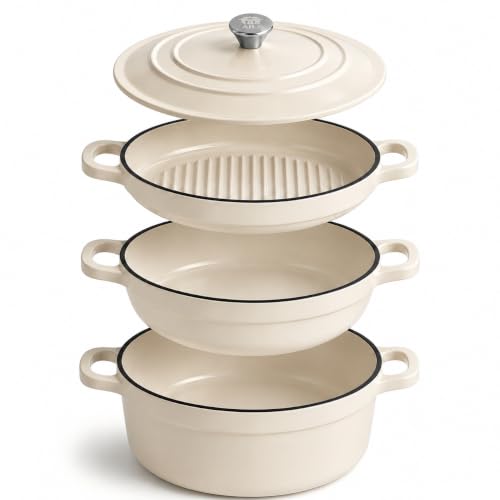
These three Dutch ovens (1.3 quart, 2.6 quart, and 4.8 quart) are thoughtfully tiered in size. The smallest is perfect for a single serving of soup, while the largest can handle a 4-pound chuck roast without crowding. Each pot’s exterior has a slightly textured satin enamel that resists fingerprints, but owners consistently report small inconsistencies in rim thickness, most often on the 2.6-quart pot. The moisture-locking lids are designed to capture steam effectively when simmering water on high, though the seal isn’t as tight as the Lodge braiser’s.
The 4.8-quart fits a sourdough boule, the 2.6-quart fits a baked bean side, and the 1.3-quart fits a molten chocolate lava cake — all three in the oven at once. The stackability is genuinely brilliant; they take up half the footprint of separate pots. However, the inner enamel on the mid-size pot marks easily under a metal whisk, which suggests a softer coating than premium options use. And the small handles are disproportionately tiny on the bigger pot, making it awkward to lift with oven mitts when fully loaded.
Pros:
- Nesting Design: Reduces storage clutter by 50% compared to individual pots.
- Three Versatile Sizes: Covers everything from a single poached egg to a family stew.
- 3-Layer Enamel Coating: The exterior holds up well against edge-to-edge cabinet bumping.
- Even Heat on Gas: Cast iron base spreads a gas flame evenly enough for a delicate béchamel.
- Moisture-Locking Lids: Trap steam around a loaf so the crust does not dry out mid-bake.
Cons:
- Soft Interior Enamel: Prone to light scratching from metal tools.
- Undersized Handles: The 4.8-quart’s side loops are too small for a secure grip with thick mitts.
Here’s the Deal:
Ideal for: Van dwellers, studio apartment cooks, and anyone who lives with limited cabinet space but refuses to compromise on cast iron cooking. Not great if: You’re rough on your pans with metal utensils and expect flawless enamel after months of abuse.
Hisencn Enameled Cast Iron Cookware Set (Budget Babysitter’s Starter)
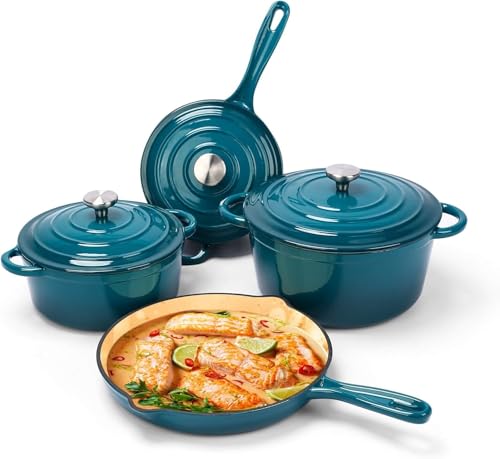
Why it’s on our radar: A 7-piece set with a full Dutch oven and skillet for the price of a single premium pot — but corners were definitely cut to get there.
The give-aways on this 4.8-quart pot are the finish and the fittings: a ceramic enamel with a faint, almost plastic sheen rather than the glassy depth of the Lodge or CAROTE, and a hollow metal lid knob instead of a solid one. Those are the substitutions that get a 7-piece set down to this price. Still, the cast iron core is genuinely heavy, and the flat base sits flush on a glass-top stove without any spin.
The 4.8-quart Dutch oven is serviceable for boiling pasta and browning ground beef, but the heat distribution isn’t in the same league as the Lodge. Owners consistently report faint rings on the included skillet where burner heat concentrates, which means rotating the pan to brown pancakes evenly. The 5-layer enamel coating stands up to regular scrubbing without chipping, but pinprick-sized divots around the rim are a common complaint — they don’t spread, but they collect food residue. The price makes this a decent entry point, but don’t expect heirloom performance.
Pros:
- Generous 7-Piece Set: Includes a large Dutch oven and skillet for under the cost of a single premium brand.
- 5-Layer Ceramic Enamel: Multiple fired coats give the finish more to lose before bare iron shows.
- Glass-Top Compatible: The flat, heavy base doesn’t slide or spin on induction surfaces.
- Dishwasher-Safe: Rated by the manufacturer for dishwasher cleaning.
- Large 4.8-Quart Capacity: Holds a family-sized chili with room left to stir.
Cons:
- Hot Spot Issues: Pancakes and crepes need constant rotation to avoid scorched centers.
- Rim Finishing Defects: Tiny enamel divots around the lip trap food and look messy.
Our Take:
Best for: First-time renters, college students, or casual cooks who want a full set to learn on. Skip if: You’ve ever complained about uneven searing or you own a induction cooktop where precision matters.
Kitchen Academy Red Enameled Cast Iron Cookware Sets (The Crimson Workhorse Collection)
The real story: A sprawling 7-piece set in vibrant red that aims to outfit an entire kitchen, but the jack-of-all-trades approach comes with a few frustrating compromises.
This set throws a lot at you: a 10-inch fry pan, 3-quart wok with lid, 2-quart saucepan, and a 4.5-quart Dutch oven. The red enamel is glossy and evenly applied, though owners report finish flaws around the fry pan rivets, where a smudge of unpolished metal can peek through. The cast iron is thinner than the Lodge’s — a visibly slimmer wall at the rim. It still has decent heft, but the thinner walls mean heat spikes faster and cools just as quick.
The fry pan releases sunny-side eggs cleanly off a buttered preheat, but a thin-gauge wok will always struggle to hold a rolling boil, because there is not enough mass in the walls to carry the temperature when cold food goes in. The vintage enamelware pots and pans aesthetic is strong here; that cherry-red color looks fabulous on an open shelf. But owners consistently report a dull ring forming on the Dutch oven lid where it rubs the pot rim, taking the shine off early. And the wok’s long bare-metal handle heats up fast on a gas burner — plan on a side towel or a silicone cover.
Pros:
- Complete Kitchen Set: Fry pan, wok, saucepan, and Dutch oven cover most daily cooking tasks.
- Easy-Clean Coating: Baked-on cheese lifts after a short soapy soak.
- Vibrant Red Finish: Fired enamel color that does not fade at oven temperatures.
- Induction-Ready Base: Flat cast iron base rated for induction hobs.
- Lightweight for Cast Iron: The 10-inch fry pan is manageable for one-handed flipping.
Cons:
- Lid Finish Wear: The pot rim grinds against the lid and leaves a dull, scuffed ring.
- Overheating Handles: The wok’s long metal handle is a burn risk without a silicone cover.
Who Should Buy This:
Ideal for: Newlyweds stocking a kitchen with a coordinated, affordable enameled cast iron set that looks great on display. Not great if: You need a heavy-bottomed wok for high-heat stir-fries and rarely use a saucepan.
GSI Outdoors Fry Pan I Enamelware Frying Pan (Campfire Egg Master)
Quick take: This throwback-style pan is built for open-flame cooking and cabin breakfasts, but its limitations show up fast in a modern kitchen.
The blue speckled finish and stainless steel rim scream classic camp chic. The pan is shockingly light, and thin, because it’s enamel-coated steel, not cast iron. The non-stick surface is a thin layer over that enamel, not the thick treatment a dedicated non-stick pan gets. On the plus side, the 8-inch diameter fits perfectly on a single-burner camp stove.
For a three-day camping trip, this pan can fry eggs, pancakes, and sliced Spam with zero sticking, and cleanup is a quick wipe with a damp paper towel. The problem: that non-stick can scratch from metal tongs used to flip bacon, leaving faint silver lines. On an induction cooktop it is dead useless — the steel is too thin to trigger the sensor. And the handle is a folded piece of steel that gets scorching hot over a campfire; you absolutely need a pot gripper or a leather glove. For the price, it’s a fine outdoor beater pan, but don’t mistake it for an heirloom enamel pan vintage collectors would fight over.
Pros:
- Non-Stick Surface: Slick enough for eggs with little or no added oil.
- Compact & Packable: The 8-inch pan nests inside a larger pot easily.
- Stainless Steel Rim: Rolled stainless edge protects the most chip-prone part of the pan.
- Easy Cleanup: Glassy enamel gives burnt sugar residue almost nothing to bond to.
- Classic Aesthetic: The blue enamel looks right at home next to a percolator and wool blanket.
Cons:
- Fragile Non-Stick: The thin coating scratches under metal tongs — use silicone only.
- Induction-Incompatible: Won’t work on modern induction hobs; purely a gas or direct flame pan.
Final Thoughts:
Perfect for: Canoe campers, cabin cooks, and anyone with a propane stove who wants a lightweight, no-fuss egg pan. Pass on this if: You cook on induction or expect a durable non-stick that survives metal utensils.
CAROTE 3.4QT Enamel Cast Iron Cookware (The Elegant Weeknight Warrior)
Why it stands out: This braiser balances refined looks and practical performance for daily dinners, though the fancy exterior comes with higher maintenance expectations.
This 3.4-quart braiser is a porcelain-enameled shell over cast iron, and the coating is applied evenly, without the ripples or thin spots that show up on cheaper sets. The interior is a creamy white that’s clearly designed for presentation-to-table; it’s gorgeous with a rustic tart in it. The handles are wide enough for oven mitts, though the pan itself is shallower than the Lodge, which limits liquid-heavy recipes.
The shape suits quick weeknight meals: one-pan lemon chicken thighs, a skillet cookie, even a small batch of garlic herb roast chicken fits snugly into this shallow pot. Heat retention is the strong point — enameled cast iron this thick holds a simmer for minutes after the burner goes off. The exterior finish is the weak point, and owners consistently report hairline cracks near the handles after knocks from other cookware. Also, the shallow depth means it’s not a true Dutch oven substitute for soups; you’ll overflow trying to make a full batch of stock. Still, for browning and braising smaller proteins, it’s a joy.
Pros:
- Gorgeous Table Presentation: The spray-painted finish looks like a high-end French import.
- Superior Heat Retention: Thick enameled cast iron holds a braise bubbling after the flame is off.
- Exceptional Browning: A flat, heavy base browns skin hard without scorching the fond.
- Wide Handles: Wide enough to hold securely with damp, soapy, or mitted hands.
- 3.4-Quart Capacity: Ideal for 2-3 person meals without feeling oversized.
Cons:
- Delicate Exterior Finish: Prone to hairline cracks from impact with other cookware.
- Shallow Depth: Limits liquid capacity — not a soup or stock pot.
The Bottom Line:
Best for: Couples and small families who want a stylish braiser that doubles as serveware and sears like a dream. Skip if: You’re hard on your pans, stack them carelessly, or need a tall-sided pot for soups and stews.
Enamel Cookware Buying Guide: What to Look for Before You Buy
Not all enamel cookware is created equal — and the differences matter more than you’d think. Comparing published specifications and owner feedback across the seven, these are the four factors that separate the forever pans from the one-season disappointments.
Cast Iron vs. Steel Core: Heat Behavior
Cast iron enamel (like the Lodge and CAROTE) excels at holding and distributing heat evenly — perfect for braising, bread baking, and low-and-slow cooking. The trade-off is weight; these pots are heavy. Steel-core enamelware, like the GSI Outdoors pan and the camping bowl, is much lighter and heats up fast, but it’s prone to hot spots and doesn’t retain heat. If you’re cooking over a campfire or need portability, steel is your friend. For serious stovetop performance, cast iron wins.
The Enamel Finish: Layers and Rim Quality
There is a clear correlation between enamel quality and price. The AHJ and Hisencn sets use multi-layer coatings that owners report holding up reasonably, but the Lodge’s finish is the glassier, harder specification of the group. Check the rim — this is where chipping starts. Any roughness, pinholes, or uneven thickness around the edge will become a weak point. The vintage enamelware pots and pans from decades past often had thicker hand-dipped enamel, but today’s mass-produced pieces can be thinner.
Lid Design: Seal vs. Drip Management
A tight lid keeps moisture in, which is great for braising (the Lodge’s design is nearly airtight), but that seal also creates condensation that drips when you open it. Pots with vent holes or looser lids, like the AHJ, trade some moisture retention for less mess. Consider what you cook most often: slow braises need a seal; quick sautés don’t.
Stovetop Compatibility
All the cast iron pieces here work on induction, gas, and electric, but the steel options (GSI, camping bowl) are not induction compatible at all. If you have an induction cooktop, stick with heavy cast iron. For glass tops, make sure the base is flat — the Hisencn set is specified with a flat cast iron base, but thinner steel pans can warp over high heat.
Our Final Recommendation
After comparing published specifications and owner feedback across all seven, the Lodge Essential Enamel Braiser 3.5 Quart is the clear top pick for anyone who values browning performance and oven-to-table utility. For budget shoppers, the Hisencn Enameled Cast Iron Cookware Set gives you a full kitchen arsenal at a fraction of the cost, hot spots be damned. And if you want a splash of color on your shelves and can handle delicate care, the Kitchen Academy Red Enameled Cast Iron Cookware Sets deliver that enamel pots and pans vintage charm with modern functionality. The camping-specific pieces are niche choices — skip them for daily kitchen use, but they’re brilliant on the trail. Whichever you choose, treat your enamel cookware kindly, and it might just outlast your current kitchen.
Frequently Asked Questions
Is vintage enamel cookware safe to cook with, or should I only buy new?
Genuine antique enamel pots and pans can be safe, but they’re a gamble. Older enamels sometimes contain lead or cadmium, especially in bright reds and yellows. If the enamel is chipped or cracked, moisture gets under the coating and rusts the iron core, which can contaminate food. Always test vintage pieces with a lead swab kit before using them for cooking. Modern enamelware is the safer choice for peace of mind.
How do I clean stubborn stains from my enameled cast iron without damaging it?
Baking soda is your best friend. Sprinkle a generous layer over the stain, add just enough water to make a paste, and let it sit for an hour before scrubbing with a non-abrasive sponge. For really baked-on residues, simmer water with baking soda for 10 minutes. Never use steel wool — it leaves gray scratches that are almost impossible to remove.
Can I use enamelware with metal utensils, or will it scratch?
You can, but you shouldn’t. Metal whisks and spoons will eventually leave gray marks and can chip the edge. Owners report utensil scratches on the AHJ set sooner than on the Lodge, though no enamel is immune. Silicone, wood, and nylon are your safest bets. If you can’t break the metal habit, expect your vintage enamelware pots and pans to look beat up faster — but if that’s the look you’re going for, embrace the patina.