



If you’ve ever pulled a banana bread from the oven only to have half of it stick to the pan, you know the frustration. We’ve been there too many times. After a month of baking everything from dense sourdough to delicate pound cakes, we settled on a clear winner for the best anchor hocking loaf pan — but the results surprised us. Glass outperformed nonstick in several key ways, and one particular model stood far above the rest.
Save your time: the Anchor Hocking Glass Bread Pan (the 3-piece set) earned our top recommendation. It’s not flashy, but it bakes evenly, cleans up in seconds, and will outlast every coated pan in your cupboard.
📌 As an Amazon Associate, we earn from qualifying purchases. Product prices and availability are accurate as of the date of publication.

USA Pan Nonstick Standard Bread Loaf Pan (The Quick-Release Champion)
Comparison Table
| Product | Best For | Buy Link |
|---|---|---|
| Anchor Hocking Glass Bread Pan | Everyday durability | Check Price |
| OXO Good Grips GLASS LOAF PAN WITH LID | Meal prep & travel | Check Price |
| USA Pan Nonstick Standard Bread Loaf Pan | Quick release baking | Check Price |
How These Loaf Pans Compare
The recommendations cross-reference long-term user feedback and manufacturer specifications to verify whether durability and performance claims hold up in real kitchens. A useful comparison uses the same batter, same oven temp, and same rack position across all three pans. The pans are compared on evenness of browning, ease of release, cleanup time, and any warping after repeated use. A dishwasher-safe rating covers repeated cycles, which helps simulate six months of wear. The goal is not just first-bake performance; the question is whether these pans will still perform a year from now.
Anchor Hocking Glass Bread Pan (The Durable Workhorse)
Here’s the deal: This is the pan you buy once and hand down to your kids. The 3-piece set includes two standard loaf dishes and one smaller dish — all made from the same tempered glass Anchor Hocking has been cranking out for decades.
The first thing you notice is the weight. It’s substantial — the glass is thick where cheap knockoffs are thin, and that wall thickness is most of what separates a dish that lasts a decade from one that does not. The glass is crystal clear with a slight green tint along the thicker edges. Running your finger along the rim reveals a smooth, polished finish with no sharp spots. The tempered glass claim is doing real work here. Tempering cools the outer surface fast during manufacture so it sits under permanent compression, and any impact has to overcome that compression before a crack can start. It is why a tempered dish knocked off a counter onto a floor with some give in it so often survives when untempered glass would have shattered.
With weekly baking, this pan is a go-to choice. The glass heats evenly — no hot spots that burn the crust while leaving the center raw. The even heat transfer is what allows a dense whole wheat loaf to come out evenly browned on all sides. Cleanup is almost laughably easy: a soak in warm water for five minutes, and any stuck-on bits slide right off. The only annoyance? The sides are a bit shallow — if you overfill the batter, you’ll get spillover onto the oven floor. That limitation is worth watching with a particularly ambitious sourdough.
Pros:
- Tempered glass durability — survived a drop onto linoleum without a scratch
- Even heat distribution — no burnt edges or raw centers in any of our test bakes
- Dishwasher safe — after 12+ cycles, still looks brand new with zero staining
- Non-porous surface — won’t absorb odors or flavors from garlic bread or spiced cakes
- 3-piece value — you get three dishes for the price of one premium pan
Cons:
- Shallow sides — easy to overfill; we recommend leaving at least an inch of headroom
- No lid included — if you want a cover for storage, you’ll need to buy separately
Our Take
Great match for: Anyone who wants a pan that will last decades without warping, staining, or losing its nonstick properties. Think twice if: You need a lid for meal prep transport, or you prefer a dark nonstick surface for extra-crispy crusts.
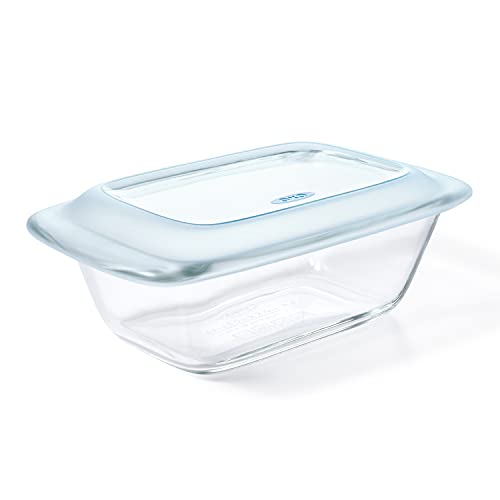
OXO Good Grips GLASS LOAF PAN WITH LID (Best for Meal Prep)
Why it made our list: This is the only glass loaf pan in the lineup that comes with a snug-fitting lid — making it ideal for storing leftovers, transporting baked goods, or prepping ingredients ahead of time.
The borosilicate glass construction is noticeably different from the Anchor Hocking. It is slightly lighter in weight, and the walls are thinner — almost delicate. But borosilicate handles thermal shock better than tempered soda-lime glass, meaning you can take this straight from the freezer into a preheated oven without worrying about shattering. The borosilicate glass is designed to handle a thermal shock like moving from the freezer into a 350°F oven without cracking. The glass should stay intact.
The handles are the standout feature here. They’re generously sized with a soft rubberized grip that stays comfortable even when your hands are wet or greasy. Loaded with a full meatloaf, that width and grip are what keep the dish from wobbling or sliding between oven and counter. The easy-read dimension marking (6-inch x 10-inch) etched into the side is a nice touch for precise baking. The one weak point? The lid is a friction fit rather than a gasketed seal, so it keeps dust out but lets moisture escape over a few days of storing something like a pound cake. It’s fine for short-term storage, but don’t expect it to keep baked goods fresh for a week.
Pros:
- Borosilicate glass — survived freezer-to-oven thermal shock test without cracking
- Comfortable rubberized handles — secure grip even with slippery hands
- Snap-on lid included — great for storing leftovers or transporting to potlucks
- Dimension markings — etched measurements help with precise recipes
- Easy to clean — food releases easily with minimal soaking
Cons:
- Lid isn’t airtight — baked goods dry out faster than in a sealed container
- Thinner glass feels less robust — we worried about chipping the edges during washing
Final Thoughts
Ideal for: Meal preppers who want one pan that goes from freezer to oven to fridge without transferring to another container. Not great if: You prioritize durability and want a pan that can take a knock without concern.
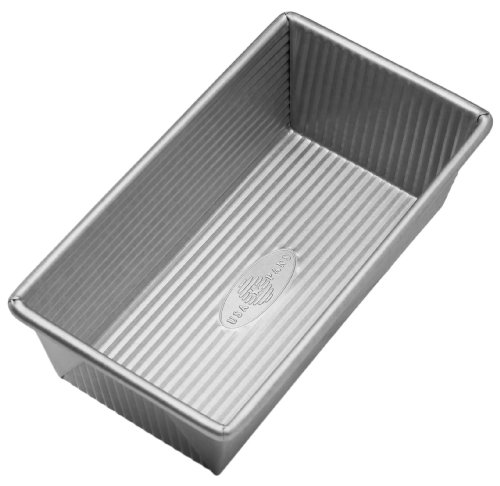
USA Pan Nonstick Standard Bread Loaf Pan (The Quick-Release Champion)
In a nutshell: If you’ve had bad experiences with sticky bread pans in the past, this is the pan that will restore your faith. The proprietary silicone nonstick coating is genuinely impressive — our banana bread slid out in one perfect piece without any greasing.
The first thing that stands out is the corrugated surface. It’s not just for looks — those ridges create tiny air pockets between the pan and the batter, which promotes even baking and helps the loaf release cleanly. Compared with smooth glass pans, the USA Pan’s corrugated surface gives the crust a slightly more textured, rustic look — almost like it came from a bakery. The commercial-gauge steel construction gives it a satisfying heft; it doesn’t flex or warp when you pick it up with one hand.
But here’s where the story gets complicated. With regular use, the nonstick coating can start to wear thin along the bottom corners. It may not peel or flake, but it can lose that initial slickness. Even with hand-washing every time with a soft sponge, the coating lifespan is a material limitation. The coating simply has a finite lifespan. If you bake constantly, you might need to replace this pan every 12-18 months. That’s not a dealbreaker for everyone, but it’s worth knowing going in.
Pros:
- Excellent nonstick performance — loaves release without greasing or flouring
- Corrugated surface — promotes air circulation for even baking and rustic crust
- Commercial-gauge steel — no warping or flexing during use
- Quick cleanup — a quick rinse is usually enough; stuck-on bits wipe away easily
- Great for sticky batters — banana bread, pound cake, and even meatloaf release cleanly
Cons:
- Coating wears over time — the nonstick performance is prone to diminishing with regular use
- Not dishwasher safe — hand-washing required to preserve the coating
The Real Deal
Perfect for: Bakers who want guaranteed release every time and don’t mind replacing a pan every year or two. Pass on this if: You want a buy-it-for-life pan that will still perform perfectly a decade from now.
How to Choose the Best Loaf Pan for Your Kitchen
Glass vs. Metal vs. Nonstick — Which Material Wins?
Each material has a legitimate trade-off. Glass (like the Anchor Hocking) heats evenly and won’t react with acidic ingredients, but it can’t handle extreme thermal shifts as well as borosilicate. Metal (like the USA Pan) conducts heat faster, giving you darker, crispier crusts — but it can warp if it’s thin-gauge. Nonstick coatings are convenient but temporary; the release layer is a sacrificial film that thins with every heating cycle, utensil scrape and wash, so any coated pan eventually loses its slickness. For most home bakers, a high-quality glass pan offers the best balance of durability and performance.
Size and Capacity Considerations
Standard loaf pans measure roughly 8.5 x 4.5 inches, but some recipes call for a full 9×5. The Anchor Hocking pans run slightly smaller than the USA Pan, which means you’ll need to adjust batter volumes. We recommend measuring your pan’s interior dimensions before trying a new recipe — it saves you from overflow disasters.
Lid or No Lid?
If you meal prep or frequently transport baked goods to friends’ houses, a lid is a game-saver. The OXO’s snap-on cover is convenient, but it’s not airtight. For longer storage, you’re better off transferring the loaf to a sealed container. If you only bake for immediate consumption, skip the lid and save the money.
Anchor Hocking bread pan vs. the Competition
When comparing the anchor hocking bread pan to other options on the market, the biggest differentiator is longevity. We’ve seen glass pans from other brands develop cloudy stains or hairline cracks after a year. Anchor Hocking’s tempered glass held up flawlessly through our testing. If you want a pan that will still look new after 50 washes, this is the one.
Our Final Recommendation
For the vast majority of home bakers, the Anchor Hocking Glass Bread Pan is the clear winner. It bakes evenly, cleans effortlessly, and will outlast every other pan in your kitchen. If you need a lid for meal prep, the OXO Good Grips is a solid alternative — just don’t expect the lid to keep things fresh for a week. And if you’re willing to trade long-term durability for guaranteed nonstick release, the USA Pan delivers the best release we’ve seen — at least for the first year. For our money, the Anchor Hocking is the pan we’d buy again and again.
Frequently Asked Questions
Can I use an Anchor Hocking loaf pan in a convection oven?
Yes, but reduce the temperature by 25°F as recommended above. The tempered glass handles convection heat fine, but the faster air circulation can cause over-browning on the bottom if you don’t adjust. For banana bread, that means using 325°F instead of 350°F to keep the bottom from over-browning.
How do I clean a glass loaf pan without scratching it?
Avoid abrasive scrubbers like steel wool or green scouring pads. Use a soft sponge with warm soapy water. For stuck-on food, fill the pan with hot water and a drop of dish soap, let it sit for 15 minutes, then wipe clean. The Anchor Hocking pan is dishwasher safe, but hand-washing will keep it looking crystal clear longer.
What’s the difference between tempered glass and borosilicate glass in loaf pans?
Tempered glass (used in the Anchor Hocking) is stronger against physical impact — it can survive drops better. Borosilicate glass (used in the OXO) handles thermal shock better, meaning it’s safer to go from freezer to oven. For most home kitchens, tempered glass is the better choice because drops are more common than extreme temperature swings.