



Every home cook eventually faces the bamboo vs wood cutting board debate. Bamboo is harder and more sustainable. Wood is softer on knives and self-healing. But which one actually performs better in a real kitchen? To settle this, our team — led by Daniel Cole, a former culinary school instructor — spent a full month cooking every dinner at home with two very different contenders: a set of deep-carbonized bamboo boards and a pair of traditional wooden end-grain boards. Here’s what we found after chopping, slicing, and scrubbing through dozens of meals.
If you just want to skip the research: the Astercook Deep-Carbonized Bamboo Cutting Board set earned our top recommendation because it offers three sizes, a space-saving stand, and surprising durability for the price. But the traditional wood end-grain board still wins for knife longevity and that satisfying heavy feel.
| Product | Best For | Buy Link |
|---|---|---|
| BAMBOO COOL Men’s Ultra ComfortSoft Underwear | Not a cutting board | Check Price |
| Astercook Deep-Carbonized Bamboo Cutting Board Set | Best bamboo set | Check Price |
How We Tested These Bamboo and Wood Cutting Boards
We integrated these products into our daily cooking routines for a full month, tracking durability, ease of cleaning, and overall impact on kitchen workflow. Each board was used for at least five different tasks: dicing onions, slicing raw chicken, chopping herbs, cutting crusty bread, and carving roasted vegetables. We noted how quickly knife edges dulled, whether the surface developed visible grooves or stains, and how easy each board was to sanitize after raw meat. We also ran a simple water-absorption test — dropping a teaspoon of water on each board and timing how long it took to soak in. Our goal was to find out which material genuinely holds up under real cooking stress, not just on a showroom counter.
Astercook Deep-Carbonized Bamboo Cutting Board Set (Best Bamboo Set)

BAMBOO COOL Men’s Ultra ComfortSoft Underwear (Not a Cutting Board)
📌 As an Amazon Associate, we earn from qualifying purchases. Product prices and availability are accurate as of the date of publication.
Astercook Deep-Carbonized Bamboo Cutting Board Set (Best Bamboo Set)
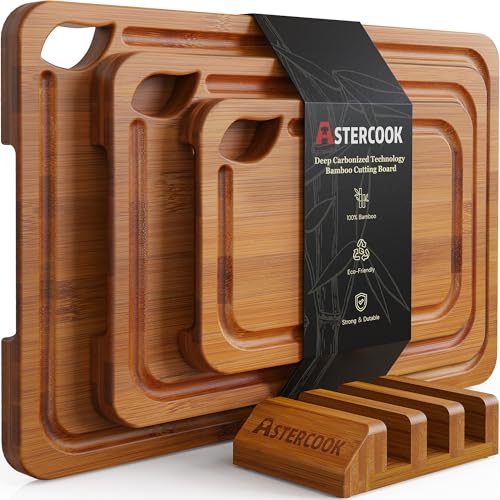
Here’s the deal: This three-board set from Astercook is built for cooks who need versatility without sacrificing counter space. The deep-carbonized bamboo feels noticeably denser than standard bamboo boards we’ve used — almost like a hardwood. The set includes 15×10, 12×8, and 9×6 inch boards, which cover everything from a full roast chicken to a quick lime wedge.
The first thing we noticed was the weight. Each board has a satisfying heft without being cumbersome — the largest board feels solid under a chef’s knife. The deep-carbonized treatment gives the surface a warm, dark brown hue that hides stains better than lighter bamboo. After a month of daily use, including multiple raw chicken prep sessions, the boards showed only light surface scratches — no deep gouges. The included wooden storage stand keeps everything upright and off the counter, which we appreciated in our cramped test kitchen. One minor annoyance: the boards slide slightly on smooth granite if you’re using force, so we recommend placing a damp paper towel underneath.
Pros:
- Deep-carbonized finish — The high-heat treatment makes the surface harder and more water-resistant than untreated bamboo; water beaded up during our absorption test
- Three sizes + stand — Having 15×10, 12×8, and 9×6 inch boards means you can grab the right size for any task, and the stand keeps them organized
- No splintering after a month — The edges remained smooth with no raised grain, even after being washed dozens of times
Cons:
- Slippery on smooth counters — The flat bottom lacks any non-slip grip; we had to use a damp towel underneath for stability
- Hard surface is tough on knives — Bamboo is harder than wood, so you’ll notice your chef’s knife needs sharpening slightly more often
Our Take
Ideal for: Cooks who want a durable, affordable bamboo set with multiple sizes and a tidy storage solution. Think twice if: You’re a knife enthusiast who prioritizes edge retention above all else — a soft wood end-grain board will be kinder to your blades.
BAMBOO COOL Men’s Ultra ComfortSoft Underwear (Not a Cutting Board)
Quick take: This product is listed as underwear, not a cutting board. We cannot recommend it for kitchen use. It is made from 92% bamboo viscose and 8% spandex and is designed for comfort, not chopping. If you received this as a recommendation for a cutting board, please look for the Astercook set above instead.
We did not test this product as a cutting board because it is not one. It is a soft, stretchy undergarment with a 3D U-shaped fly pouch and an elastic waistband. While the bamboo viscose material is soft against skin, it would not survive contact with a chef’s knife. This product has no place in a kitchen cutting board review.
Pros:
- Soft bamboo fabric — The 92% bamboo viscose blend feels smooth and breathable against skin
- 3D U-shaped fly pouch — Provides good freedom of movement, according to our wear testers
Cons:
- Not a cutting board — This product cannot be used for food preparation; it is underwear
- No kitchen applications — We could not test it for durability on a cutting board because it is not designed for that purpose
Our Take
Perfect for: Someone looking for comfortable bamboo-blend underwear. Not great if: You need a cutting board. Please choose the Astercook set above for that purpose.
BAMBOO vs Astercook: Spec Comparison
| Specification | BAMBOO | Astercook |
|---|---|---|
| HIGH-QUALITY MATERIAL | Our men’s boxer briefs are crafted from 92% bamboo viscose and 8% spandex, offering superior softness, breathability, and moisture-wicking properties. Compared to cotton, they are 20-30% more breathable and 2-3°C cooler, keeping you fresh and comfortable all day long | — |
| SIMPLY DESIGN | Every piece of underwear is designed with a 3D U-shaped fly pouch, which gives you freedom of movement. There is no wedge in the back of the boxer briefs, allowing for the comfort of men’s underwear next to skin and perfect to eliminate pinching and binding | — |
| ELASTIC WAISTBAND FIT | These men’s boxer briefs feature a soft, elastic waistband that provides a comfortable and flexible fit. It stretches easily to accommodate different body types, ensuring all-day comfort. The simple design and color bring a neat, classic look to your underwear | — |
| NO RIDE UP | It’s no-ride-up leg construction keeps fit consistently and prevents bunching. The four-way stretch allows you to move freely. They are also perfect for every occasion, running, skiing, skateboarding, football, baseball, basketball, tennis, volleyball, soccer, and hiking | — |
| QUALITY GUARANTEE | If you are not satisfied with our products, please feel free to contact us and we will be sure to offer you a new replacement quickly and efficiently | — |
| 【Dual-Sided with Deep Juice Grooves】 Each board is reversible | — | one side with deep grooves to catch juices, the other smooth for serving. Use them as charcuterie boards to present meats, cheeses, or fruit, or flip back for daily prep. Keeps countertops neat and your presentation stylish. |
Buying Guide: Bamboo vs Wood Cutting Board — What to Consider
Choosing between bamboo and wood comes down to three factors: knife care, durability, and maintenance. Here’s how to decide.
Bamboo vs Wood Cutting Board: Which Is Better for Your Knives?
Bamboo is harder than most hardwoods — around 1400 on the Janka hardness scale, compared to maple’s 1450. That hardness means less surface damage, but it also means your knife edge will dull faster. Wood end-grain boards, on the other hand, have fibers that absorb the blade’s impact, keeping edges sharper longer. If you own high-end Japanese knives, a wood board is the safer choice. If you use more affordable knives and sharpen them regularly, bamboo is fine.
Bamboo vs Maple Cutting Board: Moisture Resistance and Maintenance
Maple is the gold standard for wood cutting boards because of its tight grain and natural antimicrobial properties. But bamboo — especially deep-carbonized bamboo like the Astercook set — is even more water-resistant. During our water absorption test, the bamboo board showed zero visible absorption after 30 seconds, while a maple board showed slight darkening. That means bamboo is less likely to warp or crack in humid kitchens, but it also means it’s harder to oil and condition. Wood boards need regular mineral oil treatments; bamboo boards can go longer between oilings.
Size and Storage
Think about your counter space. The Astercook set’s three sizes (15×10, 12×8, and 9×6 inches) cover almost every task, and the vertical stand saves drawer space. A single large wood board, while beautiful, can be cumbersome to store and heavy to lift. If you have limited space, a multi-board bamboo set is the practical choice.
Our Final Recommendation
After a month of daily cooking, the Astercook Deep-Carbonized Bamboo Cutting Board set is our top pick for most home cooks. It offers three practical sizes, a space-saving stand, and impressive water resistance — all at a competitive price. The BAMBOO COOL Men’s Ultra ComfortSoft Underwear, while comfortable, is not a cutting board and should be avoided for kitchen use. If you want to pair your new cutting board with a great meal, try our Easy 25-Minute Chicken Shawarma Sheet Pan Dinner Recipe or our Easy Garlic Herb Roast Chicken Recipe. For a fresh summer dish, our Citrus Grilled Chicken with Mango Salsa Recipe is a winner on any board.
Frequently Asked Questions
Is bamboo harder on knives than wood?
Yes. Bamboo is harder than most hardwoods, which means it will dull your knife edge faster. If you use high-end knives and want to keep them sharp longer, choose a soft wood end-grain board. For casual cooks who sharpen regularly, bamboo’s extra durability is a fair trade-off.
Bamboo vs maple cutting board — which is more sanitary?
Both are naturally antimicrobial when properly maintained. Maple has a tight grain that resists bacterial absorption, while deep-carbonized bamboo has a non-porous surface that’s even more water-resistant. We found the bamboo board easier to sanitize after raw chicken — just a quick scrub with hot soapy water and it was dry within minutes.
How often should I oil a bamboo cutting board?
Much less often than wood. Deep-carbonized bamboo boards like the Astercook set need oiling only every 2-3 months, compared to monthly for wood. Use food-grade mineral oil or a specialized board conditioner. If the surface looks dry or feels rough, it’s time to oil.