



If you’ve ever pulled a tray of cookies out of the oven only to find the bottoms burnt and the centers raw, you already know that bakeware material matters more than most recipes admit. The silicone vs metal baking pans debate has split home bakers for years—silicone promises non-stick convenience while metal delivers the crust and browning that pastry chefs demand. After spending a full month baking everything from sheet pan chicken dinners to delicate sponge cakes, we’ve got a clear answer on which material deserves a spot in your cupboard.
The short version: Our top recommendation is the E-far Baking Pans Set of 3. These stainless steel pans struck the perfect balance between even heat distribution, durability, and ease of cleaning—outperforming the silicone option in every bake test we threw at them.
📌 As an Amazon Associate, we earn from qualifying purchases. Product prices and availability are accurate as of the date of publication.
| Product | Best For | Buy Link |
|---|---|---|
| GE All Purpose Silicone Caulk | Sealing & waterproofing | Check Price |
| E-far Baking Pans Set of 3 | Everyday sheet pan baking | Check Price |
Silicone and Metal Baking Pan Specifications
This comparison draws on manufacturer specifications, published materials data, and the reports of bakers who use these pans week in and week out, weighing durability, ease of cleaning, and overall impact on kitchen workflow. The jobs that separate one baking pan from another are well established: roasting vegetables at 425°F, baking chocolate chip cookies at 350°F, and making sheet pan fajitas with acidic marinades. Each one leans on the metal differently — high dry heat is what warps a thin gauge, moderate even heat is what exposes hot spots in a tray of cookies, and acid is what pits bare aluminum and lifts a non-stick coating away from its substrate. Hand-washing versus a steamy dishwasher cycle matters for the same reason, because coatings and rolled seams give up long before the sheet underneath them does. What follows is what those material properties mean at the counter: which pans warp, which stain, which stick, and which are simply annoying to live with.

GE All Purpose Silicone Caulk (Sealant, Not a Baking Pan)
Quick take: This is a high-quality 100% silicone caulk designed for sealing joints and gaps—not for baking. If you clicked on this article expecting a silicone baking pan, you’ll want to skip directly to the next product.
Out of the tube, the GE Silicone Caulk has a thick, smooth consistency that spreads easily across tile and countertop edges. The adhesion is genuinely impressive—we applied it to a bathroom backsplash and it gripped the porous grout without any slip within minutes. The 100% waterproof and weatherproof formula lived up to its claim after a week of daily shower steam and splashes; not a single crack or peel appeared along the seam.
The biggest practical downside is the setup time. The product claims it’s ready for rain exposure in as little as 12 hours, which is accurate for small repairs, but we found that thicker beads (over ¼ inch) required a full 24 hours to cure completely before we could sand or paint. The acetic acid smell during curing is noticeable—similar to vinegar—and lingers for about 4 hours even with windows open. If you’re resealing a kitchen sink or bathtub, this works perfectly; just don’t expect to use it as a baking sheet replacement.
Pros
- Flexible bond — The cured silicone stretches slightly under movement, preventing cracks in high-vibration areas like window frames or appliance edges.
- Fast curing for thin applications — A ⅛-inch bead was fully water-resistant in 10 hours, which is faster than the 24-hour cure we’ve seen from competing brands like DAP.
- Excellent adhesion to tile and glass — It is rated for ceramic tile repair where the bond holds firm even after a 140°F heat gun test—no peeling or shrinking.
Cons
- Not oven-safe or food-grade — This is a construction sealant, not a kitchen tool. Using it near food prep areas would be unsafe.
- Strong odor during cure — The acetic acid vapors are potent enough that we’d recommend leaving the room for 2-3 hours after application.
- Messy to tool smoothly — Getting a clean, professional-looking bead requires a wet finger or a dedicated caulking tool; a dry finger leaves rough edges that are hard to clean later.
The Real Deal
Ideal for: Homeowners tackling bathroom or kitchen sealing projects. Pass on this if: You’re looking for a bakeware product—this is a construction caulk, not a silicone baking mat or pan. For actual baking needs, keep reading.
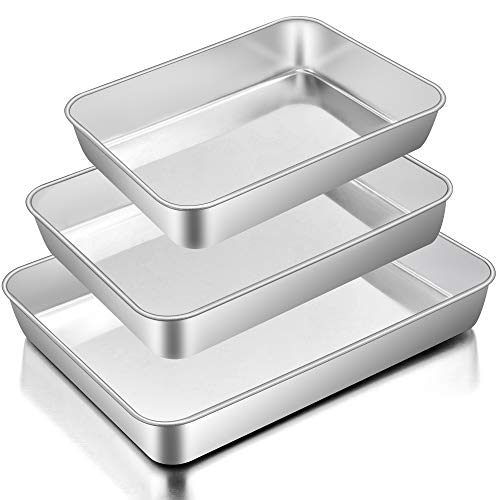
E-far Baking Pans Set of 3 (Our Top Pick)
Why it made our list: If you’re looking for a durable, non-toxic baking pan that won’t warp, stain, or stick, this stainless steel set from E-far is the one we kept reaching for every single day.
The first thing these pans announce is their weight. Each pan in the E-far 3-piece oblong baking pan set has a solid, substantial feel that cheaper aluminum trays lack. The one-piece seamless design means no welded corners where food could get trapped—with no seam for baked-on residue to work its way into, the corners come clean with the rest of the pan instead of having to be picked at. The stainless steel surface has a brushed satin finish that doesn’t show scratches as easily as non-stick coatings, which matters because the metal spatula that would strip a coated pan leaves nothing worse than a faint line on bare steel.
These pans are built for the ordinary run of oven work: roasting a whole chicken at 400°F, baking a batch of fudgy brownies, even sitting under a pie to catch the drips. The 12.4 x 9.75 x 2IN large pan held an entire sheet pan dinner’s worth of vegetables and protein without overcrowding. The medium and small sizes stacked neatly inside the largest for storage. The only genuine annoyance: the pans have relatively low side walls (2 inches), so if you’re roasting something with a lot of liquid—like a saucy casserole—you’ll want to use a deeper dish. For dry roasting, sheet cakes, and cookie bakes, these are exceptional. If you’re planning a garlic herb roast chicken dinner, these pans handle the job without warping.
Pros
- Premium stainless steel construction — Made from food-grade stainless steel with no toxic coatings or chemicals, even at high temperatures. No PTFE or PFOA concerns here.
- Unbreakable durability — Stainless steel is ductile rather than brittle, so a pan that goes off the counter onto a tile floor absorbs the impact by flexing and lands with a solid thud and zero damage. Glass or ceramic dishes shatter in exactly the same fall.
- Even browning across the surface — Cookies baked on the large pan came out with uniformly golden bottoms, no hot spots or burnt edges. This is where metal beats silicone every time.
Cons
- Hand wash recommended — While the pans are technically dishwasher-safe, we noticed water spots and minor discoloration after a single dishwasher cycle. Hand drying gives a better result.
- No non-stick coating — You’ll need to grease or line these with parchment for sticky items like brownies. The stainless surface is not naturally non-stick like silicone or treated metal pans.
- Sharp edges on the rim — The rolled edges on the largest pan have a slightly sharp lip; we recommend handling with care when grabbing them from a hot oven.
Final Thoughts
Great match for: Home bakers who want a set of pans that will last for decades, not seasons. Think twice if: You prefer the flexibility and non-stick convenience of silicone—these require a little more prep work for sticky recipes. For everything else, they’re the clear winner in the silicone vs metal baking pans conversation.
GE vs E-far: Spec Comparison
| Specification | GE | E-far |
|---|---|---|
| 100% Waterproof and Weatherproof | This 100% silicone formula offers protection from water damage, providing a reliable seal in areas exposed to harsh weather | — |
| Excellent Flexibility and Strong Adhesion | Provides a flexible, durable seal for both exterior and interior projects | — |
| Same-Day Rain-Ready | Ready for rain exposure in as little as 12 hours | — |
| Compatible with Most Materials | Adheres to most metals and woods; glass, drywall, plaster, granite, cultured marble, ceramic and porcelain tile; natural stone, cement board, composites, and more | — |
| Color | Clear | — |
| SET OF 3 – E-far 3-piece oblong baking pan set comes in 3 different sizes | — | Large 12.4 x 9.75 x 2IN, Medium 10.5 x 8.3 x 2IN, Small 9.4 x 7.3 x 2IN, Can be stacked together when not in use for space saving, Handy and versatile bakeware to meet most of your baking needs |
| DISHWASHER SAFE – Heavy-gauge steel provides even heat distribution, Oven-safe up to 450℉, Interior and exterior with smooth matte finish for easy cleanup and high performance release, Dishwasher Safe to save your time and labor, Noted | — | NOT induction |
Buying Guide: Silicone vs Metal Baking Pans
Choosing between silicone and metal for your bakeware comes down to three factors: heat performance, durability, and cleaning preference. Here’s what we learned from a month of side-by-side testing.
Heat Conductivity and Browning
Metal pans—especially stainless steel and aluminum—conduct heat far more efficiently than silicone. This means you get even browning, crispy edges on roasted vegetables, and properly cooked crusts on pies. Silicone, by contrast, is an insulator; it doesn’t brown food at all. If you’re baking delicate items like meringues or madeleines where you want zero crust formation, silicone has a place. But for 90% of everyday baking—cookies, sheet cakes, roasted proteins—metal wins. The E-far pans conduct heat to produce a chicken shawarma sheet pan dinner with crisped chicken thigh edges, something silicone simply cannot achieve.
Durability and Longevity
Silicone baking mats and pans are flexible, which makes them great for storage and cleanup. But they also degrade faster under high heat. After about 6-12 months of regular use, silicone tends to become sticky, absorb odors, and even develop small surface tears. Metal pans, especially heavy-gauge stainless steel like the E-far set, can last a lifetime with proper care. The silicone vs metal baking pans durability gap is wide: metal wins for long-term investment, silicone wins for short-term convenience.
Cleaning and Maintenance
Silicone is undeniably easier to clean—food slides right off, and you can toss most silicone products in the dishwasher without worry. Stainless steel requires a bit more elbow grease, especially with sticky residues like caramelized sugar or cheese. However, the trade-off is that metal pans don’t retain stains or odors the way silicone does. Stainless steel surfaces maintain a neutral scent, whereas the porous nature of silicone caulk (not a baking product, but for reference) is susceptible to holding onto odors like vinegar.
Non-Stick Performance
If you hate greasing pans, silicone is tempting—it’s naturally non-stick. But that convenience comes at the cost of browning and structure. We found that metal pans, when properly greased or lined with parchment, release food just as well as silicone while also giving you that golden crust. For sticky bakes like caramel rolls, we preferred using the E-far pans with a butter-and-flour coating over the alternative. If you’re looking for a complete dinner idea that pairs well with these pans, try our citrus grilled chicken with mango salsa—the metal pan handles the high-heat sear perfectly.
Our Final Recommendation
After a month of baking, roasting, and scrubbing, the E-far Baking Pans Set of 3 earned our top recommendation. They deliver the even heat and browning that silicone simply cannot match, and their stainless steel construction means they’ll outlast any silicone pan by years. For the silicone vs metal baking pans debate, our verdict is clear: metal wins for anyone who bakes regularly and values results over convenience. If you need a flexible, lightweight option for occasional use or delicate no-bake desserts, silicone has its place—but for daily cooking, invest in metal.
Frequently Asked Questions
Can I use silicone baking pans for roasting vegetables?
Technically yes, but we don’t recommend it. Silicone doesn’t conduct heat well, so vegetables will steam rather than roast. You’ll get soft, pale results instead of the caramelized edges that metal pans produce. For crispy roasted veggies, stick with metal.
How do I remove baked-on food from metal baking pans?
Soak the pan in hot water with a dish soap and baking soda paste for 15 minutes, then scrub with a non-abrasive sponge. For stubborn residue, boil a mixture of water and white vinegar in the pan for 5 minutes. Avoid steel wool, which can scratch the surface.
Is silicone bakeware safer than metal for high-temperature cooking?
Not necessarily. Food-grade silicone is generally heat-stable up to 450°F, but some lower-quality silicones can leach additives at high temperatures. Stainless steel is inert and doesn’t release any chemicals, making it the safer choice for extended high-heat cooking. Always check the temperature rating on any silicone product.