



The right knife makes prep feel controlled: clean cuts, fewer redundant tools, and a blade you can maintain instead of replace. These japanese carbon steel knives vary sharply in what they actually disclose, so the safest choice is the one with the clearest steel and edge information.
My overall pick is the GLOBEHOME 8-inch Japanese Damascus Chef Knife because its listing gives buyers more useful information than most here: a named 10Cr15Mov core and a stated 10–12° edge. The Damascus layer claim is not enough on its own, but the disclosed core and geometry make the buying decision less vague.
easycookingways.com is funded by affiliate commission. Our picks come from comparing published specifications and documented features against what matters in the category — no brand pays for a place on this page. If you buy through a link here we may earn a commission at no extra cost to you, and it pays for the research behind the next guide. Full disclosure.
As an Amazon Associate we earn from qualifying purchases. This does not affect the price you pay.
The short answer on japanese carbon steel knives
- Best overall: XCHIEF PRO Japanese Knife Set with Bag — Broad task coverage with a storage bag.
- Best value: imarku 3 Pieces Knife Set — Three everyday shapes in one set.
- Best single chef knife: HOSHANHO Kitchen Knife — Named 10Cr15CoMoV steel and an 8-inch format.
- Best for disclosed edge geometry: GLOBEHOME 8-inch Japanese Damascus Chef Knife — 10Cr15Mov core with a stated 10–12° edge.
- Best lightweight option: EANINNO 8-inch Chef Knife — 0.45-pound listing weight and stain-resistant positioning.
How We Chose These Japanese Carbon Steel Knives
These picks come from comparing published specifications, materials, and documented features against what actually matters in this category. The most important information is the disclosed cutting-core steel, heat treatment, resulting Rockwell C hardness, edge geometry, and grind consistency. A high-carbon label or Damascus appearance cannot replace those details. Handle security, balance, corrosion behavior, included accessories, and the set’s practical usefulness also matter because buyers often pay for layer counts or broad marketing language, then face chipping, rust, difficult sharpening, or redundant pieces. None of these products was physically tested or handled for this article. The shortlist was narrowed from the information available in the listings, with missing specifications treated as missing rather than guessed. Before ordering, check the seller’s current page for the exact steel designation, hardness, edge angle, care instructions, and warranty. Those details can change, and they decide more than the word Japanese.
XCHIEF PRO Japanese Knife Set with Bag (broadest set)

- BrandXCHIEF PRO
- ModelJapan Knife Set
- Weight3.88 pounds
- Size / capacity7"
- ColourBrown
Quick take: This is the practical choice for someone who wants several cutting jobs covered and values the included bag more than a tightly documented steel specification.
The XCHIEF PRO Japan Knife Set is listed at 3.88 pounds, in a brown finish, with a listed size of 7 inches. The manufacturer describes four meat and vegetable cutters, including an 8-inch Kiritsuke Knife, but the listing does not disclose the blade material, dimensions, warranty, Rockwell hardness, or cutting-core steel. That missing information matters more than the premium Japanese wording.
A multi-knife set can make sense when the included shapes genuinely replace separate purchases. The bag improves storage and portability, yet the absence of steel and heat-treatment details makes edge retention and sharpening behavior impossible to assess fairly. Compared with the standalone knives below, this set offers more task coverage but less evidence for judging the blade itself.
Pros:
- Four documented cutters — The manufacturer positions the set for meat and vegetable preparation.
- Included bag — Storage and transport are addressed without requiring a separate knife case.
- 8-inch Kiritsuke Knife — The named piece offers a larger format for general prep.
- 3.88-pound listed weight — Buyers have a disclosed total weight for planning storage.
- Classic Japanese handle design claim — The maker identifies stability and comfort as design goals.
Cons:
- Core steel not listed — The buyer cannot verify the cutting steel or compare it with 10Cr15Mov and 10Cr15CoMoV options.
- Hardness not listed — There is no Rockwell C figure to help estimate sharpening or chipping risk.
- Specification ambiguity — The listing gives a 7-inch size while also describing an 8-inch Kiritsuke Knife, so the exact set contents deserve confirmation.
Who Should Buy This
Ideal for: Cooks who want a Japanese knife set with a bag and several task-specific pieces. Pass on this if: You want a documented steel grade, HRC hardness, or edge angle before buying.
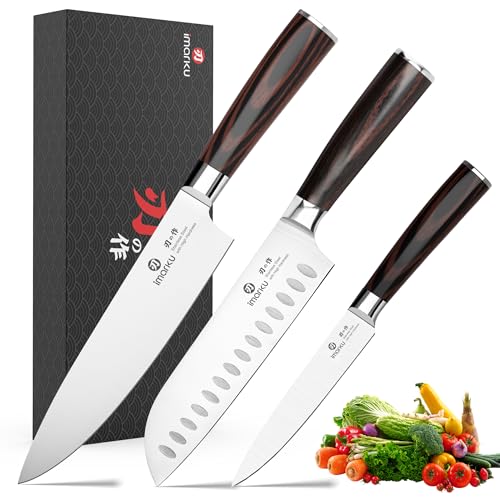
imarku 3 Pieces Knife Set (everyday coverage)
- Brandimarku
- ModelI-KS0784DB
- ColourRed Brown
In a nutshell: imarku is the sensible set pick for buyers who want a chef knife, santoku, and utility knife without buying a larger collection.
The imarku I-KS0784DB set includes one chef knife, one santoku knife, and one utility knife, according to the manufacturer. Its listed colour is red brown, while dimensions, weight, capacity or size, material, and warranty are not listed. The handle is described as full tang with ergonomic pakkawood, but the cutting-core steel is not identified by grade.
The manufacturer claims a 57 HRC edge, which is more useful than a bare sharpness slogan, although the listing does not identify the steel or explain the heat treatment behind that figure. A chef knife and santoku overlap in everyday prep, so this set is useful only if the buyer specifically wants both profiles; otherwise, one well-specified eight-inch knife may be the cleaner purchase.
Pros:
- Three-piece lineup — The chef knife, santoku, and utility knife cover common preparation roles.
- Stated 57 HRC edge — The listing supplies a hardness figure that many vague listings omit.
- Full-tang handle claim — The maker identifies a construction detail relevant to handle security.
- Pakkawood handle — The listed handle material gives the buyer more information than an unnamed grip.
- Compact task selection — The set avoids the extra pieces found in broader knife collections.
Cons:
- Steel grade absent — A 57 HRC claim cannot tell you whether the core is reactive carbon steel or high-carbon stainless steel.
- Size and weight absent — Buyers cannot assess balance or storage fit from the listing.
- Chef knife and santoku overlap — The second main knife may be redundant for a minimalist kitchen.
Why It Earns a Spot
Great match for: A buyer who wants a small set and values the disclosed 57 HRC claim. Think twice if: You need a known steel designation, exact dimensions, or a single chef knife with clearly documented geometry.
HOSHANHO Kitchen Knife (named Japanese high-carbon steel)

- BrandHOSHANHO
- Model8 inch Chef Knife
- Dimensions13.46 inches x 0.01 inches x 0.01 inches
- Weight0.77 pounds
- Size / capacity8"
- Colour8 inch Chef Knife
Here’s the deal: HOSHANHO is the strongest choice for buyers who want one 8-inch chef knife with a named steel rather than a set filled with overlapping pieces.
The HOSHANHO 8 inch Chef Knife lists a 0.77-pound weight and dimensions of 13.46 inches x 0.01 inches x 0.01 inches. The manufacturer identifies the blade material as Japanese high-carbon steel 10Cr15CoMoV and describes a matte blade finish, a wood handle, and a sloped bolster. The listing does not state a warranty or Rockwell hardness.
10Cr15CoMoV gives the buyer a more specific starting point than an unqualified high-carbon claim, but the steel name still does not reveal the heat treatment or final hardness. Compared with the GLOBEHOME, HOSHANHO does not provide a stated edge angle; compared with the sets, it avoids redundant pieces. That makes it a focused buy, though not a fully documented one.
Pros:
- Named 10Cr15CoMoV steel — The listing identifies a specific Japanese high-carbon steel designation.
- 8-inch chef knife format — The size suits buyers seeking one general-purpose blade.
- 0.77-pound listed weight — The published weight helps frame the knife’s balance expectations.
- Matte blade finish — The finish is clearly identified rather than left to vague styling language.
- Wood handle and sloped bolster — Both construction details are documented in the listing.
Cons:
- HRC hardness absent — The steel name alone cannot predict edge stability or sharpening difficulty.
- Edge angle absent — There is no disclosed geometry to compare with the GLOBEHOME’s 10–12° claim.
- Material wording needs care — The listing does not clarify whether the knife behaves as reactive carbon steel or high-carbon stainless steel.
Our Take
Best for: Someone who wants a single chef knife and prefers a named steel over a broad set. Not great if: You need a verified hardness figure, precise grind details, or explicit corrosion guidance before ordering.
GLOBEHOME 8-inch Japanese Damascus Chef Knife (clearest geometry)

- BrandGLOBEHOME
- ModelGH-V1
- Dimensions13.0 inches x 1.73 inches x 0.09 inches
- Weight0.46 pounds
- Size / capacity8"
- ColourBlue,Silver
Why it stands out: GLOBEHOME gives the clearest edge information in this group, making it my overall recommendation despite the usual limits of marketing claims about Damascus.
The GLOBEHOME GH-V1 has an 8-inch size, a listed weight of 0.46 pounds, and dimensions of 13.0 inches x 1.73 inches x 0.09 inches. The manufacturer claims a 10Cr15Mov core steel, a 10–12° edge, and 67-layer folded Damascus construction. The colour is listed as blue and silver, while warranty and independent material verification are not listed.
The core steel and edge range are more decision-useful than the 67-layer number. Damascus steel can describe layered construction or visible cladding; it does not automatically establish hardness, grind consistency, edge retention, or superior cutting. The 0.46-pound listed weight also makes this the lightest product here with a published weight, but buyers who prefer a heavier knife should not choose by pattern alone.
Pros:
- 10Cr15Mov core claim — The listing identifies the cutting core instead of relying only on the word Damascus.
- 10–12° edge claim — The stated geometry gives buyers a useful comparison point.
- 67-layer construction claim — The listing explains the visible layered design as folded Damascus.
- 0.46-pound listed weight — The published figure supports a lighter-knife buying decision.
- 8-inch chef knife size — The format is versatile enough to serve as a single main knife.
Cons:
- HRC hardness not listed — Edge angle and core name still cannot confirm the heat treatment.
- Damascus claim is not independent proof — Layer count does not establish cutting performance.
- Warranty not listed — Buyers have no documented coverage information in the supplied listing data.
The Real Deal
Perfect for: Buyers who want one light 8-inch chef knife with the clearest stated core and edge geometry. Skip if: You are paying extra purely for 67 layers or need a published HRC number.
EANINNO 8-inch Chef Knife (light high-carbon stainless option)

- BrandEANINNO
- ModelE-PENK-1
- Dimensions13.2 inches x 4.6 inches x 0.97 Inches
- Weight0.45 pounds
- Size / capacity8"
- ColourStainless Steel
Quick verdict: EANINNO suits buyers who prioritise a light standalone knife and a stated high-carbon stainless material claim over detailed hardness data.
The EANINNO E-PENK-1 is listed as an 8-inch chef knife weighing 0.45 pounds, with dimensions of 13.2 inches x 4.6 inches x 0.97 inches. Its colour is stainless steel. The manufacturer claims 10Cr15Mov high-carbon stainless steel, a matte blade design, Japanese forging, and rust resistance, while the listing does not provide a warranty or Rockwell hardness.
High-carbon stainless steel generally offers more corrosion resistance than reactive carbon steel because chromium bolsters corrosion resistance, but high-carbon stainless is not rust-proof. EANINNO’s material wording is useful, yet the missing heat-treatment and edge-angle details keep it behind GLOBEHOME for specification transparency. Its 0.45-pound listed weight is marginally lighter than GLOBEHOME’s 0.46 pounds, but that difference should not decide the purchase by itself.
Pros:
- 10Cr15Mov high-carbon stainless claim — The listing names a specific material family.
- 0.45-pound listed weight — The knife is presented as a light standalone option.
- 8-inch chef knife format — The size is suited to buyers replacing a general kitchen knife.
- Matte blade design — The finish is documented and positioned as stain-resistant.
- Japanese forging claim — The manufacturer provides a construction description rather than only a colour or style label.
Cons:
- HRC hardness absent — The listing cannot confirm the final hardness of the 10Cr15Mov steel.
- Edge geometry absent — Buyers cannot compare its grind or angle with GLOBEHOME’s stated 10–12° edge.
- Rust-resistance claim is not rust-proofing — Moisture, soaking, abrasive cleaning, and poor storage can still damage a blade’s finish.
Who Should Buy This
Best for: A buyer who wants a light 8-inch knife and prefers high-carbon stainless steel to reactive carbon steel. Pass on this if: You want verified heat treatment, HRC hardness, or a stated edge angle.
Japanese Carbon Steel Knives Comparison
| Product | Best for | Core steel information | Second decisive spec |
|---|---|---|---|
| XCHIEF PRO Japan Knife Set Check price | Broad task coverage | Not listed | 3.88 pounds |
| imarku 3 Pieces Knife Set Check price | Small knife set | Not listed | 57 HRC claim |
| HOSHANHO Kitchen Knife Check price | Named steel | 10Cr15CoMoV claim | 0.77 pounds |
| GLOBEHOME 8-inch Damascus Chef Knife Check price | Documented geometry | 10Cr15Mov core claim | 10–12° edge claim |
| EANINNO 8-inch Chef Knife Check price | Light standalone knife | 10Cr15Mov high-carbon stainless claim | 0.45 pounds |
How to Choose Japanese Carbon Steel Knives
Japanese knife steel matters more than the label
Japanese and hand-forged are not proof of Japanese manufacture, a particular steel grade, or superior heat treatment. Look for the actual cutting-core designation, HRC hardness, and edge geometry. HOSHANHO names 10Cr15CoMoV, while GLOBEHOME and EANINNO name 10Cr15Mov; XCHIEF PRO does not list its core steel, and imarku supplies a 57 HRC claim without naming the steel.
Carbon content can improve hardness but can also reduce corrosion resistance and increase brittleness. Chromium significantly improves corrosion resistance, which is why high-carbon stainless steel is generally easier to live with than reactive carbon steel, though neither should be treated carelessly. The supplied product data does not establish the exact chemistry or heat treatment for every knife, so buyers should not infer more than the listing says.
Edge geometry beats Damascus layer counts
A 67-layer claim describes layered construction or cladding; it does not automatically prove a harder core, better grind, longer edge retention, or better cutting. GLOBEHOME’s stated 10–12° edge is more useful for comparison than its layer count, although the missing HRC figure still leaves a major gap. A gyuto, santoku, or Western chef knife can all be practical, but the shape should match the work rather than the marketing title.
Hard Japanese-style edges can chip against bones, frozen food, glass, stone, or twisting force. Use a suitable cutting board and controlled slicing technique, and keep these knives away from tasks that call for a cleaver. For a broader comparison of blade profiles, our Japanese and German knife guide explains why geometry and handling priorities differ.
Sets versus one good chef knife
A Japanese knife set with a bag is worthwhile when you need the included shapes and storage. XCHIEF PRO offers four described cutters and a bag, while imarku supplies a chef knife, santoku, and utility knife. Those sets provide coverage, but they also multiply the number of blades that need drying, sharpening, and safe storage.
One eight-inch chef knife is usually the cleaner value for a cook who wants a versatile daily tool. HOSHANHO, GLOBEHOME, and EANINNO each offer that focused format, while GLOBEHOME gives the most useful disclosed geometry. Our guide to Japanese chef knives under 100 is also useful for readers comparing standalone options.
Care, sharpening, and storage
Wash these knives by hand, dry them promptly, and avoid soaking, abrasive scouring, and loose-drawer storage. Reactive carbon steel may develop a patina and needs more careful drying; high-carbon stainless steel resists corrosion better but is not immune to discoloration or rust. A whetstone is the dependable route for restoring a consistent edge, while a honing rod can be unsafe for a harder, thinner edge if used aggressively or at the wrong angle.
Check the manufacturer’s care instructions before treating a knife as dishwasher-safe. For food-contact certification claims, look for documentation tied to the relevant safety body, such as NSF, rather than assuming that Japanese, professional, or high-carbon language confirms compliance.
Ongoing ownership costs can include a whetstone, professional sharpening, storage, and replacement after damage. A knife bag helps with transport, but it does not replace blade protection inside the bag.
If you also use carbon steel bakeware, our guide to the best carbon steel cookie sheet covers the same basic issue: carbon steel rewards proper drying and punishes neglect.
Our Final Recommendation
GLOBEHOME is the overall winner because its 10Cr15Mov core claim and 10–12° edge give buyers the clearest basis for comparison. HOSHANHO is my premium-leaning standalone pick for its named 10Cr15CoMoV steel, while imarku is the budget-friendly set choice for cooks who genuinely want three knife shapes. XCHIEF PRO suits buyers who need a bag and broad coverage; EANINNO is the light high-carbon stainless alternative. None earns a blind purchase: verify the current listing, care instructions, and missing hardness details first.
Frequently Asked Questions
How should japanese carbon steel knives be cleaned and sharpened?
Hand-wash and dry them promptly. Reactive carbon steel needs especially careful moisture control and may develop a patina, while high-carbon stainless steel offers greater corrosion resistance without being rust-proof. A whetstone is the safer maintenance choice for a thin edge because it controls angle gradually. Use a honing rod only with appropriate pressure and technique; aggressive honing can damage a harder edge.
What is the difference between carbon steel and high-carbon stainless steel knives?
Carbon steel generally prioritises hardness and sharpening response but has lower corrosion resistance, while high-carbon stainless steel adds chromium for better corrosion resistance. The exact result depends on steel grade, heat treatment, hardness, and geometry. EANINNO claims 10Cr15Mov high-carbon stainless steel, while HOSHANHO claims 10Cr15CoMoV; neither supplied listing states Rockwell hardness.
Is a Damascus pattern proof that a knife cuts better?
No. Damascus layer counts describe layered construction or cladding, not automatically the cutting-core steel, heat treatment, grind consistency, hardness, or edge retention. GLOBEHOME’s 67-layer claim is less useful than its stated 10Cr15Mov core and 10–12° edge. Buyers should also confirm whether the Damascus claim is supported by clear construction details rather than buying solely for the visible pattern.