



A teppanyaki station needs a controlled cutting tool, but many listings blur the line between a real blade and a belt-mounted knife case. This hibachi knife roundup separates two storage accessories from two knives, then matches each product to the job it can reasonably serve.
If I were choosing one cutting tool from this list, the imarku 8-inch chef knife would get my vote for its clearly stated size, low listed weight, and general-purpose gyuto format. The two HibachiPro cases are useful only after you confirm blade fit, while the Huusk is the more specialized meat option.
easycookingways.com is funded by affiliate commission. Our picks come from comparing published specifications and documented features against what matters in the category — no brand pays for a place on this page. If you buy through a link here we may earn a commission at no extra cost to you, and it pays for the research behind the next guide. Full disclosure.
As an Amazon Associate we earn from qualifying purchases. This does not affect the price you pay.

The short answer
- Best overall: OLIKIUS HibachiPro Knife Case — portable storage with a documented belt clip
- Best value: HibachiPro Two-Layer Knife Case — separate layers for different blade sections
- Recommended: imarku 8-Inch Chef Knife — light, multipurpose gyuto-style kitchen blade
- Best for meat prep: Huusk Viking Knife — compact butcher-style cutting option
How We Chose These Hibachi Knife Picks
Our shortlist comes from comparing published specifications, materials, and documented features against the actual roles these products serve. A knife needs suitable blade geometry, edge behavior, handle control, and an intended use that matches the work. A case needs compatible blade dimensions, secure retention, protective coverage, and enough clearance for the handle. Those distinctions matter here because the list contains two scabbards and two cutting knives; treating them as interchangeable would mislead a buyer. I weighted stated blade size, overall dimensions, listed weight, handle information, and the seller’s specific retention features most heavily. Missing data counted against a product, especially for case material, warranty, and exact fit. Before ordering, measure your own blade length, width, spine thickness, point shape, and handle clearance. A product title alone cannot prove that a knife sheath fits safely.
OLIKIUS HibachiProTeppanyaki Knife Case (Single-Layer Holster)

Quick take: This is a portable storage accessory for a hibachi or teppanyaki chef, not a knife; its belt clip is the reason to consider it.
The listing identifies the brand as OLIKIUS, the colour as silver, and the category as kitchen. Amazon does not list the case’s material, weight, warranty, or confirmed dimensions. The seller states a total height of 11 inches, room for a knife up to 8 1/2 inches, and a top width of 2 1/4 inches; those figures are marketing claims rather than independently verified specifications. A belt clip is also advertised for moving from station to station.
That belt clip makes the case relevant to a working station where quick transport matters more than countertop storage. The limitation is fit certainty: the listing does not provide a complete measurement set for blade width, spine thickness, point shape, or handle clearance. Compared with the two-layer HibachiPro case, this model offers less documented separation between blade areas. A case that grips too tightly can damage an edge, while one that leaves the blade loose can slip out, so the stated maximum length is only a starting point.
Pros:
- Portable belt clip — the seller says the holder can move with a chef from station to station.
- Stated 8 1/2-inch knife limit — gives buyers a starting measurement for checking blade length.
- 11-inch total height claim — provides more useful information than a title with no sizing language.
- Silver finish — clearly identifies the listed colour before purchase.
Cons:
- Material not listed — buyers cannot assess the case construction from the published specifications.
- Incomplete fit information — blade width, spine thickness, point shape, and handle clearance are not fully documented.
- Storage accessory only — the product does not replace a chef knife, knife roll, or block.
Who Should Buy This
Ideal for: A chef who already owns a compatible blade and wants belt-mounted transport between cooking stations. Pass on this if: You need a complete hibachi knife, a fully specified protective case, or storage for several blades.
HibachiPro Teppanyaki Knife Case (Two-Layer Design)

In a nutshell: This two-layer scabbard is the more purpose-specific storage choice, provided its unusual measurements match your blade.
The product is listed under the HibachiPro brand in the kitchen category. Amazon does not list its material, overall dimensions, weight, capacity, or warranty. The seller advertises a belt clip and describes a top layer measuring 50mm by 10mm alongside a bottom layer measuring 60mm by 14mm. Those layer measurements may help with comparison, but they do not explain the complete internal opening or handle clearance.
Separate upper and lower layers suggest a design intended to retain different portions of a knife rather than leave one broad cavity. That can be more practical than the single-layer version for a blade whose shape fits both sections, but the listing does not establish that the two-layer arrangement is safer for every knife. The case still needs to match the actual blade length, width, spine thickness, point shape, and handle. A two-layer label is not a substitute for measuring.
Pros:
- Two documented layers — the top and bottom sections offer more fit detail than a vague one-piece description.
- Belt clip — supports portable storage during station-to-station work.
- Top layer measurement — the seller states 50mm by 10mm for one section.
- Bottom layer measurement — the seller states 60mm by 14mm for the other section.
Cons:
- Overall case size not listed — the layer figures do not tell you the complete external dimensions.
- Construction material not listed — long-term protection and moisture behaviour cannot be judged from the sheet.
- Handle clearance remains unclear — a blade may fit the layers while the handle does not sit securely.
Why It Stands Out
Great match for: Buyers who want the more structured of the two portable knife cases and can compare the listed layer measurements with their blade. Think twice if: You cannot measure the knife’s spine, width, point, and handle, because forcing an uncertain fit risks edge damage or slippage.
imarku 8-Inch Chef Knife (Lightweight Gyuto)
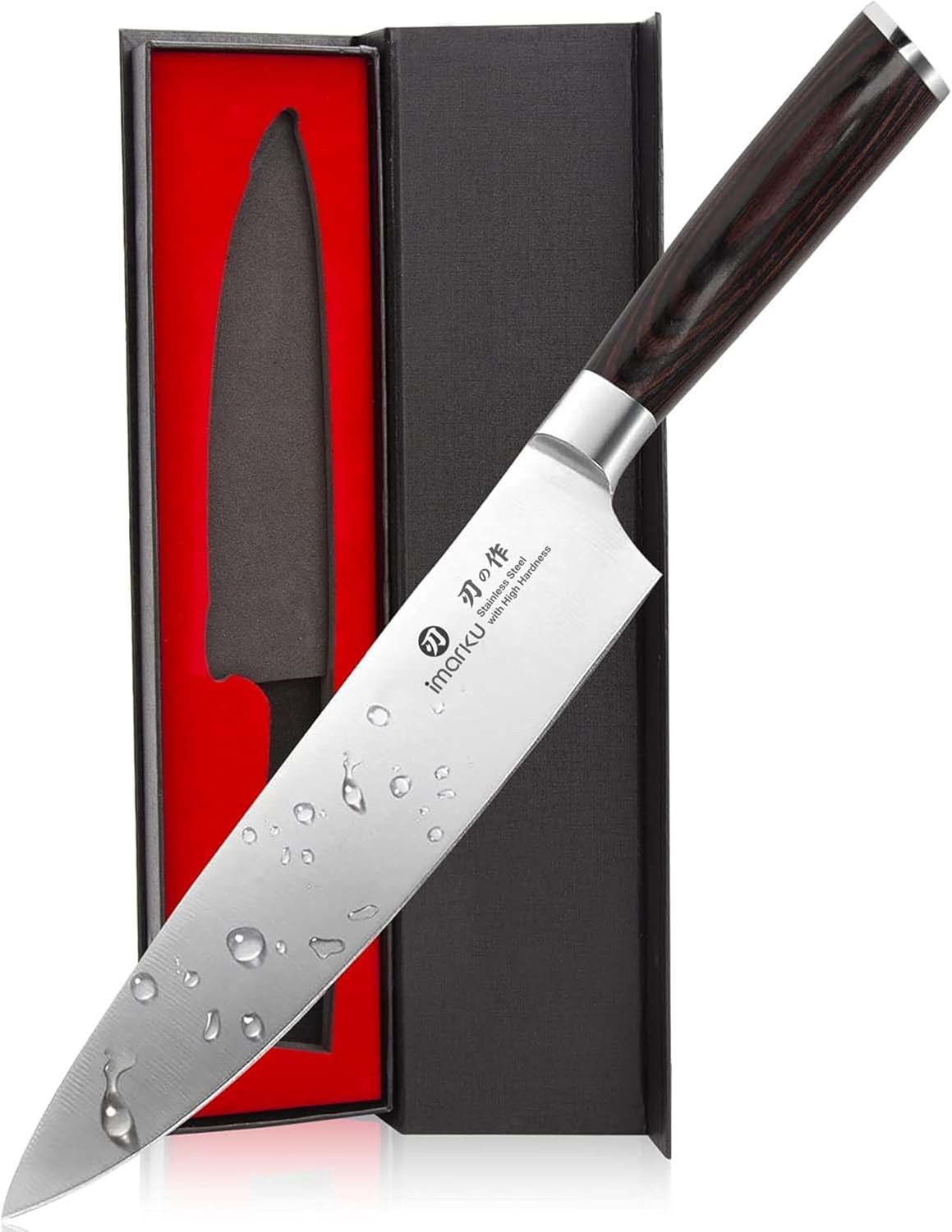
Here’s the deal: The imarku is the strongest all-purpose knife choice here for vegetables, meat preparation, and general griddle work.
The listed model is an 8-inch chef knife from imarku, with dimensions of 13.0 inches by 3.0 inches by 1.0 inch and a listed weight of 0.41 pounds. Its colour is deep brown, and the seller describes a high-carbon stainless steel blade, a multipurpose gyutou design, and an ergonomic Pakka handle. Amazon does not list a warranty. The published weight is useful for buyers who prioritize wrist fatigue, although balance and tang construction are not documented.
A gyuto-shaped chef knife makes more sense for mixed vegetable and protein preparation than a butcher-style blade, because the listing explicitly positions this model as multipurpose. The 8-inch size also gives a clear reference point for a knife roll or blade guard, unlike the cases whose complete dimensions are absent. Still, the listing does not state whether the handle is full tang, nor does it specify edge angle or blade thickness. Those omissions matter for control, sharpening decisions, and professional-level expectations.
Pros:
- 8-inch chef-knife size — a familiar length for general prep and griddle-side portioning.
- 0.41-pound listed weight — a comparatively clear figure for buyers concerned about wrist fatigue.
- High-carbon stainless steel claim — combines the seller’s stated steel description with a kitchen-focused blade format.
- Ergonomic Pakka handle claim — directly addresses grip comfort and finger fatigue in the listing.
Cons:
- Full tang not listed — buyers cannot confirm the handle construction from the available data.
- Edge geometry not listed — the sheet does not state the bevel, angle, or blade thickness.
- Warranty not listed — long-term support is an unanswered buying question.
Our Take
Best for: Home cooks and station chefs who want one hibachi knife for vegetables, meat, and broad prep duties, with a documented 8-inch blade and 0.41-pound weight. Not great if: You specifically need a heavy butcher knife, a confirmed full-tang build, or published edge geometry for sharpening work.
Huusk Viking Knife (Compact Butcher Knife)
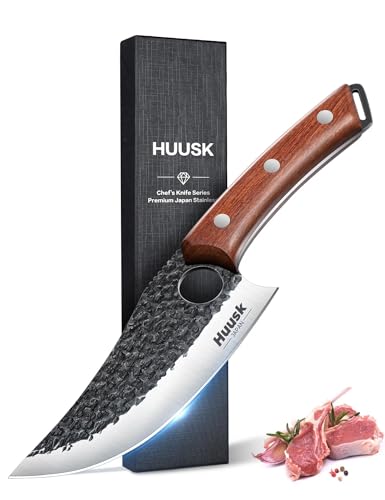
What sets it apart: The Huusk is the meat-focused option, not the natural first choice for fine vegetable prep or garnish work.
Huusk lists this model as the HK-KK-006b, with a 6-inch size and a colour entry of 1PCS. The seller states a 5.12-inch handle, a 5.9-inch blade, and an 11-inch overall length, while Amazon does not list the product’s weight, material, or warranty. Marketing copy calls it a Japanese steel Viking meat knife and describes it as suitable for professional chefs and home cooks, but the available data does not confirm full tang construction or a particular steel grade.
The shorter 5.9-inch blade and butcher-knife positioning point toward meat cutting rather than the broad, multipurpose role of the imarku gyuto. That distinction matters beside a hot griddle: a meat knife may suit portioning, yet it is not automatically the best tool for vegetables, garnishes, or precise cuts. Its 5.12-inch handle may provide useful clearance for some users, but the missing weight and balance information leaves wrist comfort harder to predict than with the imarku’s listed 0.41 pounds.
Pros:
- 5.9-inch stated blade length — gives meat-focused buyers a concrete size to compare with their prep needs.
- 11-inch overall length — clarifies the knife’s total footprint for storage planning.
- 5.12-inch handle claim — provides a useful handle measurement when checking grip and storage clearance.
- Meat-knife positioning — the seller clearly presents the model for meat cutting rather than only general kitchen use.
Cons:
- Material not independently specified — Japanese steel is a marketing description, not a stated grade.
- Weight not listed — wrist-fatigue and balance judgments remain limited.
- Less convincing as an all-purpose blade — the butcher orientation may not suit detailed vegetable or garnish work.
The Real Deal
Perfect for: Cooks who mainly need a compact meat-cutting knife and prefer the stated 5.9-inch blade length. Skip if: You want one blade for every hibachi task, because the imarku’s multipurpose gyuto description fits that role more directly.
| Product | Best for | Key category spec | Second decisive spec |
|---|---|---|---|
| OLIKIUS HibachiPro Knife Case | Portable storage | Up to 8 1/2-inch knife claim | Belt clip |
| HibachiPro Two-Layer Knife Case | Structured transport | 50mm by 10mm top layer | 60mm by 14mm bottom layer |
| imarku 8-Inch Chef Knife | General prep | 8-inch size | 0.41-pound weight |
| Huusk Viking Knife | Meat cutting | 5.9-inch blade claim | 11-inch overall length claim |
How to Choose the Right Hibachi Knife
First, separate hibachi knives from their storage
The phrase hibachi knife is not a standardized knife category. Casual product language often uses hibachi and teppanyaki interchangeably, although the cooking context and equipment can differ; in practice, the knife is usually a chef knife or meat knife used beside a hot cooking surface. The first two products here are cases, not blades. For a broader look at professional-style tools, our shortlist for serious cooks provides useful context without pretending that a sheath cuts food.
What matters in hibachi knives
Blade geometry should match the work. A santoku has a flat edge and a blade that is wider and shorter, which can suit controlled vegetable work. A nakiri is rectangular with a straight edge and is designed around vegetables. A gyuto, such as the imarku listing describes, is the more natural multipurpose format here. For focused fish work, a yanagiba has a single-beveled edge; a deba is single-beveled and notably heavy. Usuba, kiritsuke, takobiki, honesuki, petty, and sujihiki knives are specialty choices, not automatic upgrades for a hot griddle. Carbon steel is frequently used in Japanese knives, but a marketplace label alone does not establish the steel in a particular product.
Fit the sheath before you buy
Case compatibility depends on blade length, width, spine thickness, point shape, and handle clearance. The OLIKIUS case gives a seller-stated limit of up to 8 1/2 inches and a top width of 2 1/4 inches, while the two-layer case lists 50mm by 10mm and 60mm by 14mm sections. Neither listing supplies enough information to guarantee fit for every blade. Measure the actual knife, keep the edge from rubbing against a tight opening, and leave no trapped moisture inside the sheath.
Choose the blade for the prep, not the label
The imarku’s 8-inch size, 0.41-pound listed weight, multipurpose gyuto description, and Pakka handle claim make it the sensible generalist. Huusk’s 5.9-inch blade and meat-knife positioning make more sense for meat preparation, but that does not automatically make it suitable for vegetables, garnishes, or precise griddle work. If onions are the main job, our 2026 dicing knife roundup can help you think through edge shape and control before buying.
Maintenance, heat, and transport
Hand-wash the knife, dry it fully, and store it in a properly fitting sheath, blade guard, knife roll, or block. Heat, grease, and moisture around a teppanyaki grill can create avoidable problems, especially if moisture becomes trapped in a case. Sharpening may mean a whetstone, honing suited to the blade, professional sharpening, replacement sheaths, rust prevention, or eventual blade replacement; the listings do not state warranties or material grades that would let us predict those costs.
For food-contact questions, buyers should verify the product’s own claims against the U.S. Food and Drug Administration’s food-contact information at FDA.gov. A marketplace description that says Japanese, hand forged, or chef knife does not by itself prove professional suitability, food-contact compliance, full tang construction, or safe retention.
Our Final Recommendation
The imarku 8-inch chef knife is our overall winner because its 8-inch size, 0.41-pound listed weight, multipurpose gyuto description, and ergonomic Pakka handle claim align best with mixed hibachi prep. For a budget-friendly storage choice, the OLIKIUS case is the simpler pick, but only after measuring your blade. The premium-oriented option is the Huusk for cooks focused on meat, not general prep. The two-layer HibachiPro case earns consideration for structured portability, yet incomplete fit details keep it from a blanket recommendation.
Frequently Asked Questions
What should I look for in a hibachi knife set?
A set should match the work rather than simply include several pieces. This roundup contains two cases and two knives, so it is not a complete hibachi knife set. For mixed vegetables and meat, the imarku’s 8-inch multipurpose gyuto format is the clearest fit; the Huusk is more specialized for meat. Add a properly sized blade guard or roll only after checking dimensions and handle clearance.
How do I maintain a knife and avoid rust or a dull edge?
Hand-wash the blade, dry it completely, and keep it secured in a properly fitting storage system. Do not trap grease or moisture inside either HibachiPro case. Use appropriate honing or whetstone sharpening, or choose professional sharpening when the edge needs more work. The available listings do not state material grades, edge angles, warranties, or rust-resistance claims, so maintenance expectations should remain conservative.
Is the two-layer HibachiPro case safer than the single-layer OLIKIUS case?
Not automatically. The two-layer model gives the seller-stated measurements of 50mm by 10mm and 60mm by 14mm, while the OLIKIUS listing states room for a knife up to 8 1/2 inches and a 2 1/4-inch top width. Safe storage depends on actual blade length, width, spine thickness, point shape, retention, and handle clearance. A correct fit matters more than the layer count.
Should I choose the imarku or Huusk for meat and vegetables?
The imarku is the better all-purpose choice on paper because it is listed as an 8-inch multipurpose gyutou chef knife and weighs 0.41 pounds. Huusk lists a 5.9-inch blade and presents the HK-KK-006b as a Viking meat knife, making it the more focused option for meat preparation. Neither listing confirms full tang construction or detailed edge geometry, so neither should be selected on marketing language alone.