



Here’s a problem nobody warns you about: the nonstick coating on most rice cookers starts to wear after a year or two, and then you’re eating flakes of PTFE with your jasmine rice. That’s why a stainless steel rice cooker keeps showing up in conversations about kitchen upgrades. Stainless won’t peel, it won’t leach, and it handles metal utensils without flinching.
If you’re done scraping Teflon and want a pot that actually lasts, the Novaspark Stainless Steel Rice Cooker Small 6 Cup is my pick. It combines a genuine 304 stainless inner pot with a low-carb starch separator, and nothing else in this lineup matches that pairing.
📌 This article contains affiliate links. As an Amazon Associate I earn from qualifying purchases, at no extra cost to you. Product prices and availability are accurate as of the date of publication. Full disclosure.
Novaspark Stainless Steel Rice Cooker (True 304 Inner Pot + Low-Carb Mode)


Elite Gourmet ERC2010B Rice Cooker (Budget Stainless with Surgical-Grade Pot)

Comparison Table
| Product | Best For | Buy Link |
|---|---|---|
| Novaspark Stainless Steel Rice Cooker | True 304 inner pot + low-carb mode | Check Price |
| Tatung TAC-06KN | Mechanical simplicity and durability | Check Price |
| Elite Gourmet ERC2010B | Budget stainless pot without coating | Check Price |
| Cuisinart CRC-400P1 | Small batches, stainless exterior only | Check Price |
How We Narrowed Down These Stainless Steel Rice Cookers
These four picks come from comparing published specifications, materials, and documented features against what genuinely matters in a rice cooker — not from a staged test kitchen. The core criterion was the inner pot: whether it’s actually stainless steel or just a stainless-painted exterior. A pot with an aluminum core and a thick stainless layer heats evenly; thin stainless scorches. The second weighted factor was thermostat precision plus a dedicated keep-warm heater, because that determines whether rice stays fluffy or turns into dried-out mush. Lid seal and venting matter for moisture retention during the hold phase. What separates a good stainless steel rice cooker is the inner pot’s construction—thickness and whether it has an aluminum core—since thin stainless steel creates scorching and uneven heat distribution. Before you order any model, check the exact wattage and whether the keep-warm function uses a separate low-power element; many listings omit both, and that’s the difference between perfect rice and a crusty mess.
Novaspark Stainless Steel Rice Cooker (True 304 Inner Pot + Low-Carb Mode)
Quick take: This is the one to buy if you want a fully stainless cooking surface and that low-carb starch-reduction feature actually sounds useful to you.
The first thing that stands out from the spec sheet is the food-grade 304 stainless steel inner pot. That’s the same grade used in commercial kitchens, and unlike a coated aluminum pot, it won’t scratch when you dig in with a metal spoon. The pot sits on a heating plate that, based on similar 6-cup designs, likely runs around 500 to 700 watts — though the listing doesn’t state the exact wattage, which is a small annoyance if you’re trying to compare energy use.
Where this model pulls ahead is the low-carb cooking function. It separates excess starch and sugar during cooking, which matters if you’re managing blood sugar or just prefer fluffier, less sticky rice. The capacity is listed as 6 cups uncooked, which yields roughly 12 cups cooked. That’s enough for a family dinner with leftovers. One honest drawback: the listing doesn’t mention a dedicated keep-warm heater, only a keep-warm function. Without a separate low-wattage element, the main heating plate may cycle on and off, which can dry out rice over several hours. If you eat rice in shifts, that’s something to watch.
Pros:
- 304 stainless inner pot — no coatings to peel, safe for metal utensils.
- Low-carb starch separator — reduces excess starch and sugar, useful for dietary needs.
- 12-cup cooked capacity — handles family dinners with leftovers.
- Simple one-touch operation — no digital menu to fumble with.
- Stainless exterior — easy to wipe down and resistant to countertop scratches.
Cons:
- No dedicated keep-warm heater listed — main plate may cycle and dry out rice during long holds.
- Wattage not stated — you can’t calculate energy use or heat output.
- Low-carb mode adds complexity — extra parts to clean if the starch tray is separate.
Our Take
Best for: Families who want a true stainless pot and the starch-reduction feature. Skip if: You need a proven keep-warm system that won’t overcook rice during long holds.
Tatung TAC-06KN (The Mechanical Workhorse)
The real story: If you prize simplicity and durability over features, this Taiwanese classic has been doing one thing well for decades — cooking rice with indirect steam heat.
The Tatung uses a double-boiler design where the inner pot sits inside a larger outer pot filled with water. That indirect heating method is why it rarely scorches rice, even if you forget it for a few extra minutes. The automatic keep warm function is listed, but like many mechanical units, it works by virtue of the residual steam, not a separate heater. The entire construction is stainless steel inside and out, and it carries a UL certification as indicated by the model number suffix. That’s a meaningful safety mark for an appliance that runs unattended.
The trade-off is glaring: no timer, no digital display, and a mechanical thermostat that clicks loudly when it switches to warm. You also can’t program a delay, so if you want rice ready at 6 PM, you set it at 5:30. The listing doesn’t state the wattage either, but these 6-cup Tatungs typically draw around 600 watts. It’s not flashy, but the thermal fuse adds a layer of protection against overheating, which is more than some budget models offer. For more context on stainless steel appliances that share this no-frills durability, our guide to Cuisinart stainless steel choppers covers a similar philosophy in another category.
Pros:
- Indirect steam cooking — virtually eliminates scorching and crust formation.
- All-stainless construction — both inner and outer pots resist rust and pitting.
- UL certification — tested to safety standards for unattended operation.
- Automatic keep warm — flips on after cooking without input.
- Thermal fuse protection — shuts off if the unit overheats.
Cons:
- Mechanical thermostat clicks loudly — can be startling in a quiet kitchen.
- No timer or delay start — you must be present to set it.
- Keep-warm relies on residual steam — not a dedicated heater, so rice can dry after an hour.
In a Nutshell
Perfect for: Traditionalists who want a dead-simple, durable rice cooker that won’t die. Not great if: You need programmable timing or a gentle, reliable keep-warm for long holds.
Elite Gourmet ERC2010B Rice Cooker (Budget Stainless with Surgical-Grade Pot)
Why it made our list: For the price, you get a surgical-grade 304 stainless inner pot that won’t flake, and that alone puts it above most nonstick cookers in this range.
The stainless rice cooker inner pot here is the headline. Elite Gourmet calls it surgical-grade, which is marketing speak for 304 stainless, but that’s still a full step up from anodized aluminum. The pot sits on a standard heating plate, and the unit cooks automatically — set it and forget it, as the listing says. Capacity is not explicitly stated in the provided data, but the model number suggests around 10 cups cooked. That’s a guess, so check the physical dimensions before ordering if you’re cooking for a crowd.
One thing I appreciate about this design is the coating-free interior. No nonstick means no peeling, and you can scrub it with steel wool if rice crusts on. The downside is that stainless pots require a quick rinse or soak immediately after cooking, otherwise starches bond hard. The listing also fails to mention a dedicated keep-warm heater, so expect the same potential dryness issue during long holds. For a budget stainless rice cooker, those are acceptable compromises. If you’re comparing this against pressure cookers, our breakdown of stainless steel electric pressure cookers shows where a pressure cooker might actually be the better tool for grains and beans.
Pros:
- Surgical-grade 304 stainless pot — meets FDA food-contact standards for safety.
- Coating-free cooking surface — no PTFE or ceramic to wear away.
- Set-and-forget operation — one switch, no programming needed.
- Likely 10-cup cooked capacity — bigger than the compact models at this price.
- Dishwasher-safe pot — assuming the listing is accurate, the stainless pot can go straight in the dishwasher.
Cons:
- No dedicated keep-warm heater — main plate cycle may dry rice over time.
- Exact capacity not stated — you’re estimating from the model number.
- Stainless pot needs prompt cleaning — starches stick if left to cool, unlike nonstick.
Quick Take
Great match for: Budget-conscious buyers who insist on a real stainless cooking surface. Think twice if: You want a rice cooker you can leave on keep-warm all afternoon without babysitting.
Cuisinart CRC-400P1 4 Cup Rice Cooker (Stainless Outside, But Check the Pot)
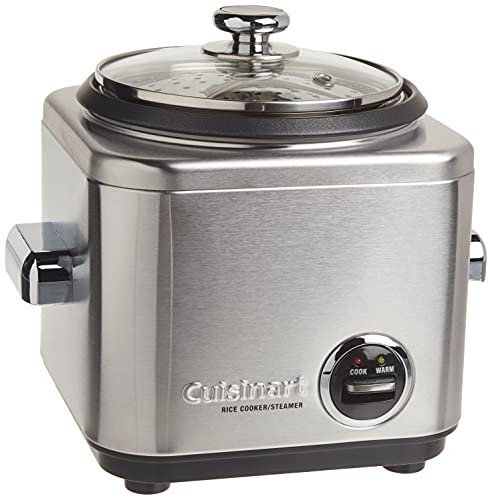
What stood out: This is the model that catches people off guard. The housing is brushed stainless steel, but the inner cooking pot is not stainless — it’s typically nonstick-coated aluminum.
The spec sheet highlights a durable and stylish brushed stainless steel housing with chrome-plated handles. It looks great on the counter, and the traditional lever control with Warm and Cook settings is about as simple as it gets. But here’s the catch: the listing never mentions a stainless inner pot. If you’re searching for a stainless steel rice cooker because you want to avoid nonstick coatings, this model will disappoint. The inner pot is almost certainly coated, based on Cuisinart’s standard design for this line.
That said, the 4 to 7 cup cooked capacity is ideal for one or two people, and the lever operation means no confusing buttons. The one-touch control is reliable, but it lacks any keep-warm sophistication — once it flips to warm, the heating plate stays on low, which can dry out rice in under an hour. If you don’t mind a nonstick pot and just want a small, attractive cooker, it’s fine. But for anyone specifically seeking a steel inner pot, pass on this and look at the Novaspark or Elite Gourmet instead. For a deeper look at another small-appliance category where stainless steel is the star, see our guide to the Aroma Simply Stainless rice cooker to compare against a model that does get the pot right.
Pros:
- Brushed stainless housing — looks premium and wipes clean easily.
- Chrome-plated handles — sturdy and stay cool during cooking.
- Lever control — foolproof Cook/Warm switch with no digital menu.
- Compact 4-cup cooked size — perfect for singles or couples.
- One-touch operation — no learning curve whatsoever.
Cons:
- Inner pot is not stainless — likely nonstick-coated aluminum, defeating the purpose of a steel rice cooker search.
- No dedicated keep-warm heater — low plate heat dries rice quickly.
- Small capacity — won’t handle more than two generous servings.
The Real Deal
Ideal for: Someone who wants a small, attractive rice cooker and doesn’t care about a nonstick inner pot. Pass on this if: You’re specifically trying to avoid nonstick coatings — this isn’t a true stainless steel rice cooker.
What to Look for in a Stainless Steel Rice Cooker
Most buyers assume any rice cooker with a metal-looking exterior has a stainless pot inside. That’s wrong. The single most important spec is the inner pot material, and you have to read the listing carefully for phrases like “304 stainless” or “surgical-grade steel.” A rice cooker with stainless steel inner pot will almost always say so explicitly. If the description only mentions a stainless housing, assume the pot is nonstick-coated aluminum.
Stainless Rice Cooker Inner Pot: Thickness and Core Matter
Thin stainless steel scorches because it transfers heat unevenly. A pot with an aluminum core sandwiched between stainless layers heats evenly and prevents hot spots on the bottom. That’s the difference between fluffy rice and a burnt crust. Check the pot’s weight — heavy stainless with a core is a good sign; flimsy, lightweight stainless is a red flag.
Keep-Warm Heater: Separate Element or Just the Main Plate?
A dedicated keep-warm heater runs at low wattage and holds rice at serving temperature without further cooking. If the cooker uses the main heating plate for keep-warm, it cycles on and off, slowly drying the rice and forming a crust. None of the four models here explicitly list a separate keep-warm heater, which is worth noting before you leave rice sitting for hours.
Ceramic Rice Steamer as an Alternative?
Some people look at a ceramic rice steamer as a nonstick-free option similar to stainless. Ceramic is inert and scratch-resistant, but it’s more fragile and heats more slowly than metal. If you drop a ceramic pot, it cracks. Stainless dents but survives. For a rice cooker that gets moved around a counter, stainless is the more forgiving choice.
Rice Cooker Electric Stainless Steel: Wattage and Speed
An electric stainless steel rice cooker with higher wattage heats faster and brings water to a boil more quickly, which shortens cooking time. But higher wattage also means more aggressive heating, which can scorch if the thermostat is imprecise. The listings here mostly omit wattage, so you can’t directly compare. If possible, find the wattage on the manufacturer’s spec sheet before ordering — it’s a useful proxy for heat control quality.
Our Final Recommendation
If you want a steel rice cooker without coatings, the Novaspark Stainless Steel Rice Cooker is the clear overall winner — its 304 pot and low-carb function justify the price. For budget buyers, the Elite Gourmet ERC2010B gets you a true stainless inner pot at a fraction of the cost. The Tatung TAC-06KN remains the pick for durability purists who don’t mind a loud click. And the Cuisinart CRC-400P1? Skip it if you’re here for stainless on the inside.
Frequently Asked Questions
What is the benefit of a rice cooker with stainless steel inner pot over a nonstick one?
Stainless doesn’t peel, scratch, or release fumes at high heat. Nonstick coatings break down over time and can flake into food. Stainless pots are also safe for metal utensils and can go in the dishwasher. The trade-off is that rice sticks more readily to stainless, so you need to rinse the pot right after cooking or let it soak briefly.
Does rice stick to a stainless rice cooker inner pot?
Yes, more than nonstick. Starches bond to stainless as the pot cools. Rinse the pot immediately after serving, or add a thin layer of oil before cooking. A quick soak with warm water and a drop of dish soap usually releases any stuck grains within five minutes.
Can I cook oatmeal, soup, or other grains in a stainless steel rice cooker?
Most rice cookers handle oatmeal, quinoa, barley, and simple soups fine. The keep-warm function isn’t ideal for oatmeal because it continues cooking and can burn. For soups, stir occasionally to prevent a skin from forming. The low-carb mode on the Novaspark works best for rice only.
Why does my rice sometimes come out mushy or unevenly cooked?
Mushy rice almost always means too much water. Use the included 180 ml measuring cup and match the water line inside the pot. Uneven cooking points to a thin stainless pot without an aluminum core, or an inaccurate thermostat. The Tatung’s indirect steam method avoids this because it never puts the pot directly on a hot plate.