



Plenty of pots claim they’re safe for the oven, but the real test is whether the whole assembly—body, lid, and handles—can survive the heat. The list of genuinely oven safe cooking pots is shorter than most shoppers realize, and the failures are usually dramatic: shattered glass lids, melted silicone grips, or nonstick coatings that start smoking at 450°F. After digging through spec sheets and material data, our clear choice is the Cook N Home Basics 8 Quart Stainless Steel Stock Pot—no coating to fail, riveted metal handles, and an induction-ready base that doubles as a heat diffuser.
Our overall winner is the Cook N Home Basics 8 Quart Stainless Steel Stock Pot. It is the only pot in this roundup that combines a bare stainless interior with an induction-compatible base and no plastic anywhere near the heat.
📌 This article contains affiliate links. As an Amazon Associate I earn from qualifying purchases, at no extra cost to you. Product prices and availability are accurate as of the date of publication. Full disclosure.


Comparison Table
| Product | Best For | Buy Link |
|---|---|---|
| Astercook 21 Pcs Pots and Pans Set Non Stick | Space-saving, removable handle set | Check Price |
| Umite Chef 21Pcs Pots and Pans Set Non Stick | PFOA/PTFE-free nonstick set | Check Price |
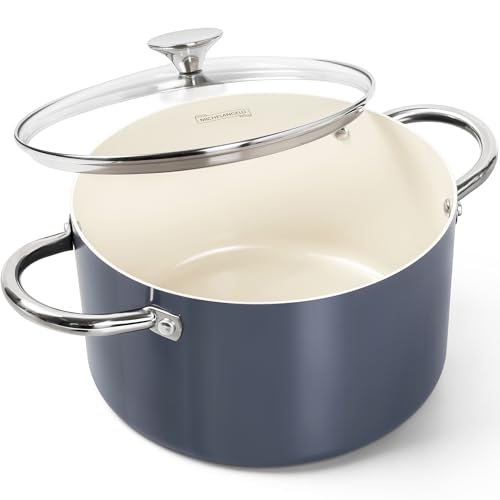
| MICHELANGELO 6 QT Ceramic Stock Pot with Lid | Ceramic nonstick stock pot | Check Price |
| Cuisinart 1.5 Quart Sauce Pan with Cover | Small-batch oven-safe saucepan | Check Price |
| Redchef Ceramic Stock Pot | Budget ceramic stockpot | Check Price |
| Ceramic Nonstick Stock Pot with Lid 8 QT Large Induction Cooking Pot | Large induction ceramic pot | Check Price |
| Cook N Home Basics 8 Quart Stainless Steel Stock Pot with Lid | High-heat oven stock pot | Check Price |
| T-Fal Signature Nonstick Pots and Pans Set 12 Piece | Everyday stovetop nonstick set | Check Price |
| IMUSA 6.9 Qt Bistro Cera Aluminum Speckled Black Ceramic Caldero | Budget large ceramic Dutch oven | Check Price |
How We Chose These Oven-Safe Cooking Pots
These picks come from comparing published specifications, materials, and documented features against what actually matters in this category. What decides between good and bad in oven-safe pots is the combination of the material’s maximum safe temperature and the handle construction—whether the handles are riveted stainless steel, detachable with heat-resistant parts, or coated in plastics that fail. The second deciding factor is the base compatibility: pots that are induction-ready typically have a thicker, more even-heating core, but that does not guarantee oven safety unless the whole assembly (including any glass or plastic components) is rated for the intended heat. Buyers often miss that glass lids and silicone grips have lower thresholds than the pot body, leading to shattered lids or melted handles when they assume the whole unit is oven safe. We weighted the maximum oven temperature and handle design most heavily, then checked for induction compatibility as a proxy for base thickness. Before ordering any pot, verify the manufacturer’s stated max oven temperature for the lid and handle separately—many listings bury that number in a footnote.
Astercook 21 Pcs Pots and Pans Set Non Stick
Quick take: Buy this if you want a full nonstick set with removable handles that saves cabinet space and survives moderate oven use, but confirm the max temp before you crank it to 500°F.
The Astercook set leans hard into the detachable handle design, and that’s genuinely useful for small kitchens and RVs. The high-performance nonstick coating covers 21 pieces, which is a lot of surface area to keep slick, but the listing never states the maximum oven temperature for the pot bodies. That’s the first red flag for anyone shopping specifically for oven safe cooking pots—a missing number usually means the coating is rated for 350°F or less, not the 500°F you want for braising. The secure locking mechanism on the removable handle is the second thing I’d scrutinize: if the handle has any plastic or silicone parts, leaving it attached in a hot oven will melt it, so you have to remove it every time.
For cleanup, the detachable design means fewer awkward corners and more pieces that can go in the dishwasher, which suits my cleanup-conscious leanings. But the nonstick coating itself is the biggest unknown—it could be ceramic, it could be PTFE, and the listing doesn’t say. If you’re hoping to move a pot from stovetop to a 450°F oven to finish a frittata, this set is not the safest bet. The lack of a stated oven rating is the kind of omission that leads to a smoking kitchen. The Astercook 21-piece set is a solid stovetop purchase, but it underdelivers on the oven-safe promise that so many shoppers assume nonstick automatically grants.
Pros:
- Removable handle — frees up storage space and lets pots nest flat.
- 21-piece versatility — covers frypans, saucepans, and a stockpot in one box.
- Secure locking mechanism — the handle won’t wobble during stovetop use.
- Dishwasher-friendly body — once the handle is off, cleanup is straightforward.
Cons:
- No maximum oven temperature listed — a critical omission for oven safe cooking pots.
- Handle must be removed before oven use — easy to forget, and melted plastic ruins the locking mechanism.
Here’s the deal:
Best for: People with tiny kitchens who cook mainly on the stovetop and occasionally slide a pot into the oven at low heat. Skip if: You need a pot you can confidently put in a 450°F oven without pre-checking every component.
Umite Chef 21Pcs Pots and Pans Set Non Stick
In a nutshell: The Umite Chef set stands out because it’s PTFE and PFOA free, which makes the coating safer at higher temperatures than traditional nonstick, but the detachable handle still limits true oven use.
The biggest difference between this set and the Astercook is the coating chemistry. Umite Chef uses an advanced mineral-based nonstick that’s explicitly free of PTFE and PFOA. That matters for oven safety because PTFE starts to break down around 500°F and can release fumes you don’t want to breathe, while many ceramic or mineral coatings are rated for higher short-term peaks. The slippery-smooth nonstick also means you’ll scrub less, which aligns with my cleanup-first priorities. The 21-piece count is nearly identical to the Astercook, so the real comparison comes down to coating composition and handle design.
The compact, space-saving detachable handle is marketed for RVs and camping, and that’s where this set shines. For oven use, however, the same caveat applies: remove the handle before you put the pot in the oven. The PTFE-free claim is a genuine advantage if you occasionally roast at 425°F, but without a stated maximum oven temperature for the pot body itself, I’d still hesitate to call this a true oven-to-table set. The ptfe and pfoa free nonstick cookware label is a trust signal, not a blank check for broiler heat. If you want a large nonstick set that’s safer than old-school Teflon and you’re willing to pop off the handle for oven jobs, Umite Chef is worth a look.
Pros:
- PTFE-free and PFOA-free coating — reduces risk of toxic fumes at normal oven temps.
- Mineral-based nonstick — releases eggs and fish without excessive oil.
- Detachable handle — saves cabinet space and makes stacking easy.
- 21-piece set — covers nearly every stovetop task.
Cons:
- No stated oven max temperature — you’re guessing above 400°F.
- Handle removal required for oven — a step that’s easy to skip in the middle of cooking.
Our take:
Great match for: Campers, RV owners, and anyone who wants a healthier nonstick set without PTFE. Think twice if: Your main goal is a pot you can leave the handle on and shove into a hot oven for an hour.
MICHELANGELO 6 QT Ceramic Stock Pot with Lid
What stood out: A 6-quart ceramic-coated stock pot with a tri-ply bottom that heats evenly on gas or electric—but the aluminum body and likely glass lid put a cap on your oven temperature.
The Michelangelo stock pot is built around a lightweight aluminum body with a tri-ply bottom, which gives it better heat distribution than a single-layer aluminum pot. The ceramic coating is free of PFOA and PFOS, so you’re not cooking on traditional PTFE. For stovetop soups and stews, this is a strong performer, and the 6-quart capacity handles family meals without hogging the whole burner. The nonstick performance is described as superior, which means less scraping and easier cleanup—always a win in my book.
For oven safe cooking pots, though, this one has a ceiling. Aluminum bodies can warp if you subject them to rapid temperature swings, like putting a cold pot into a 450°F oven. The lid is almost certainly glass, and glass lids typically have a lower max oven temperature than the pot body—often 350°F to 400°F. The listing doesn’t specify, so you have to assume the weakest link is the lid. The tri-ply bottom is a nice touch for even simmering, but it doesn’t make the whole pot invincible. If you want a ceramic nonstick stock pot for stovetop-to-oven braising, keep the oven at 400°F or below and remove the glass lid before the heat climbs higher.
Pros:
- Tri-ply bottom — spreads heat evenly across the base, reducing hot spots.
- PFOA/PFOS-free ceramic coating — cleaner release without traditional nonstick chemicals.
- Lightweight aluminum body — easy to lift even when full.
- 6-quart capacity — right-sized for soups, stocks, and chili.
Cons:
- Aluminum body can warp — avoid extreme temperature changes, like oven to cold counter.
- Glass lid max temp unknown — likely lower than the pot body, so remove it before high-heat oven use.
Why it made our list:
Perfect for: Home cooks who want a large ceramic nonstick stock pot for stovetop use with occasional low-heat oven finishing. Pass on this if: You need to roast or bake at 450°F or higher with the lid on.
Cuisinart 1.5 Quart Sauce Pan with Cover

The real story: This is the purest oven-safe pick in the entire roundup—a stainless steel saucepan with an aluminum encapsulated base and solid riveted steel handles that can take serious heat.
The Cuisinart 1.5-quart sauce pan is the opposite of the nonstick sets. It has a mirror-finish stainless cooking surface that won’t discolor, react with food, or alter flavors, which is exactly what you want if you’re reducing a pan sauce and then finishing it under the broiler. The aluminum encapsulated base heats quickly and evenly, and because there’s no coating to burn off, the oven temperature limit is typically much higher than any nonstick pot—often up to 550°F for this style. The cool grip handles are solid stainless steel riveted, not hollow or plastic-coated, so they won’t melt or off-gas in the oven. That’s the difference between a pot that claims oven safety and one that actually delivers it.
At 1.5 quarts, this isn’t a stock pot, but it’s the best pot for cooking small batches of grains, reheating leftovers, or making a quick beurre blanc that needs a blast of heat at the end. The measurement markings on the interior are a thoughtful touch that I appreciate for precise liquid additions. The stainless surface will stick if you don’t preheat properly or use enough fat, so it’s not a low-maintenance nonstick pan—but that’s a trade-off I’d happily make for true high-heat oven compatibility. If you own one pot that you can confidently slide from burner to broiler without thinking twice, this Cuisinart is it.
Pros:
- Solid riveted stainless steel handles — oven safe and stay cool on the stovetop.
- Aluminum encapsulated base — fast, even heating without hot spots.
- No coating to degrade — safe at high oven temperatures.
- Interior measurement markings — convenient for following recipes precisely.
Cons:
- Small 1.5-quart capacity — not suitable for family-sized meals.
- Stainless surface can stick — requires proper preheating and fat to avoid cleaning headaches.
Final thoughts:
Ideal for: Anyone who wants a bulletproof oven-safe saucepan for sauces, reheating, and small-batch cooking. Not great if: You need a large pot for soups or are looking for a nonstick surface that forgives lazy cleanup.
Redchef Ceramic Stock Pot
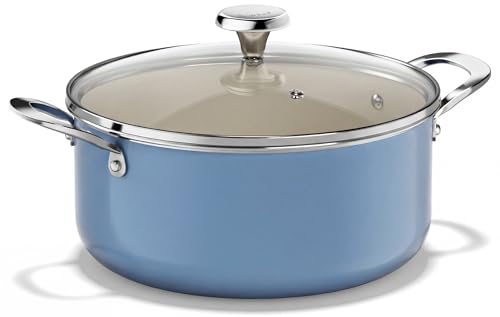
Quick take: A budget-friendly 5-quart ceramic stock pot with a thickened aluminum base that heats fast, but the lightweight construction raises questions about how much oven heat it can really handle.
The Redchef ceramic stock pot is aimed squarely at family meals and meal prepping, with a 5-quart capacity and a lightweight aluminum body. The ceramic nonstick interior is free from PFOA and PFOS, and the thickened base helps distribute heat more evenly than a thin aluminum pot would. On the stovetop, this is a capable and cheap way to cook pasta, soup, or chili without food sticking to the bottom. The ceramic coating also means you can get away with less oil, which is a plus for health-conscious cooks.
For oven safe cooking pots, the Redchef has a problem: it’s light. Lightweight aluminum pots heat up fast but cool down just as quickly, and they’re more prone to warping when exposed to high oven temperatures. The listing doesn’t give a maximum oven temperature, which is another strike. If you’re using it in the oven at all, I’d cap it at 375°F and remove any glass lid first. The thickened base helps on the stovetop, but it doesn’t cure the fundamental issue that thin aluminum isn’t ideal for sustained oven heat. That said, at this price, it’s hard to argue with a ceramic nonstick stock pot that cleans up effortlessly. Just don’t expect it to double as a Dutch oven.
Pros:
- Ceramic nonstick interior — PFOA/PFOS-free with easy food release.
- Thickened aluminum base — better heat distribution than cheap thin pots.
- 5-quart capacity — right size for a family of four.
- Budget-friendly — one of the least expensive ceramic stock pots we compared.
Cons:
- Lightweight aluminum construction — warps more easily at high oven temps.
- No stated max oven temperature — you’ll have to guess and stay conservative.
In a nutshell:
Perfect for: Stovetop soups and stews on a budget, with occasional low-heat oven use. Skip if: You plan to roast or braise in the oven at 400°F or above on a regular basis.
Ceramic Nonstick Stock Pot with Lid 8 QT Large Induction Cooking Pot with Stainless Steel Handles

What stood out: An 8-quart ceramic stock pot with double-riveted stainless steel handles and a flat induction-ready base—this is the most oven-capable ceramic option on our list, but the see-through glass lid remains the weak point.
This COICUR stock pot (the listing omits the brand name in the title, but the ASIN points to Ceramic Nonstick Stock Pot) packs a lot of useful features into one pot. The ceramic coating is free of PFOA, PFOS, lead, and cadmium, which covers the main toxic concerns for nonstick cookware. The flat surface and straight sides promote even heating, and the double-riveted stainless steel handles are a major upgrade over plastic or silicone grips—they’re genuinely oven safe and won’t melt. At 8 quarts, this pot can handle a whole chicken for braising or a large batch of stock.
The catch is the see-through glass lid. Glass lids typically max out around 350°F to 400°F, even when the pot body itself can go higher. The listing says the lid is durable, but it doesn’t specify an oven temperature limit for the lid separately. For most oven braises below 400°F, you’d be fine leaving the lid on, but if you’re trying to crisp skin or reduce liquid at 450°F, you’ll need to remove it or risk shattering. The induction-ready base is a strong signal that the bottom is thick and magnetic, which also helps prevent warping during oven-to-stovetop transitions. Overall, this is a large, well-built ceramic pot that I’d recommend for moderate oven use—just keep the lid off above 400°F.
Pros:
- Double-riveted stainless steel handles — oven safe and sturdy.
- PTFE/PFOA/PFOS-free ceramic coating — safer at higher temperatures.
- 8-quart capacity with straight sides — ideal for large roasts and batches.
- Induction-compatible base — thick, even-heating bottom reduces warping.
Cons:
- Glass lid max temp not specified — likely lower than the pot body, so remove for high heat.
- Ceramic coating can scratch — metal utensils will shorten its lifespan.
Our take:
Great match for: Cooks who want a large, non-toxic stock pot that works on induction and can go into a moderate oven. Think twice if: You need to broil or bake at 450°F or higher with the lid on.
Cook N Home Basics 8 Quart Stainless Steel Stock Pot with Lid

The real deal: This is the one I’d put my own money on for oven safe cooking pots—18/10 stainless steel, induction compatible, and no coating or plastic anywhere to fail.
The Cook N Home Basics stock pot is made from mirror-polished 18/10 stainless steel, which is the workhorse material for high-heat cooking. There’s no nonstick coating to break down, no PTFE to smoke, and no silicone grip to melt. The pot is induction compatible, which means the base contains a magnetic layer—usually a sign of a thicker, more even-heating bottom. That’s the exact combination you want for a pot that moves from stovetop searing to oven braising. The 8-quart capacity is big enough for a Sunday batch of bone broth or a whole chicken, and the stainless surface won’t react with acidic ingredients like tomatoes or wine.
What makes this pot stand out as the best pot for cooking in the oven is what it doesn’t have. No glass lid that shatters above 400°F, because the lid is stainless steel. No plastic or rubberized handles, because they’re metal. No nonstick coating that degrades at 500°F, because there’s nothing to degrade. The downside is that stainless steel isn’t nonstick—food will cling if you don’t preheat properly or use enough oil, and cleanup requires a bit more elbow grease. But for a cleanup-conscious reviewer like me, the trade-off is worth it: I’d rather scrub a stainless pot than replace a ruined nonstick one. If you’re baking sourdough, our guide to baking sourdough bread in a Dutch oven explains why heavy stainless or cast iron is the right tool, and this pot fits that mold.
Pros:
- 18/10 stainless steel construction — no coating to burn off at high heat.
- Induction-compatible base — thick, even-heating bottom resists warping.
- Metal lid and handles — the whole pot can go in the oven without caveats.
- 8-quart large capacity — handles family-sized batches and braises.
Cons:
- Not nonstick — food will stick without proper technique, so scrubbing is part of the deal.
- Heavier than aluminum — an 8-quart stainless pot is a two-hand lift when full.
Why it stands out:
Best for: Anyone who wants a pot they can put in a 500°F oven without checking a manual first. Skip if: You cook mostly eggs and pancakes and want a set that releases food with zero effort.
T-Fal Signature Nonstick Pots and Pans Set 12 Piece

Quick take: This 12-piece set is a stovetop workhorse with ProGlide nonstick and Thermo-Spot heat indicators, but it’s not built for oven heat—the nonstick coating tops out well below what oven safe cooking pots should handle.
The T-Fal Signature set is about convenience. The ProGlide nonstick interior makes eggs slide right off, and the Thermo-Spot indicator turns solid red when the pan is properly preheated, which is a genuinely useful feature for home cooks who struggle with heat control. The set includes two frypans, a griddle, saucepans, and a stockpot, so it covers a wide range of stovetop tasks. The nonstick coating is almost certainly PTFE-based, which means the maximum oven temperature is typically 350°F—maybe 400°F for short bursts, but the listing doesn’t state it.
For oven safe cooking pots, this set is a mismatch. PTFE coatings begin to degrade above 500°F, and many manufacturers cap oven use at 350°F to avoid any risk of fumes. If you try to finish a frittata under the broiler in one of these pans, you’ll likely ruin the coating and fill your kitchen with smoke. That said, as a purely stovetop set, the T-Fal Signature is one of the best values around, and the nonstick surface means you’ll spend almost no time scrubbing. The handles are likely plastic or silicone-coated, which stay cool on the stovetop but will melt in the oven. So this set belongs on the burner, not in the oven. If your cooking style rarely goes above 350°F, it works, but you should not buy it for braising or roasting.
Pros:
- ProGlide nonstick — excellent food release and easy cleanup.
- Thermo-Spot heat indicator — tells you when the pan is ready.
- 12-piece versatility — covers frypans, griddle, saucepans, and stockpot.
- Dishwasher safe — most pieces can go straight into the machine.
Cons:
- Low oven temperature limit — PTFE coating typically caps at 350°F.
- Plastic or silicone handles — will melt if left in a hot oven.
Here’s the deal:
Best for: Everyday stovetop cooking where you want zero-stick performance and don’t need the oven. Not great if: You plan to transfer pots from burner to oven for finishing dishes.
IMUSA 6.9 Qt Bistro Cera Aluminum Speckled Black Ceramic Caldero Oven Safe
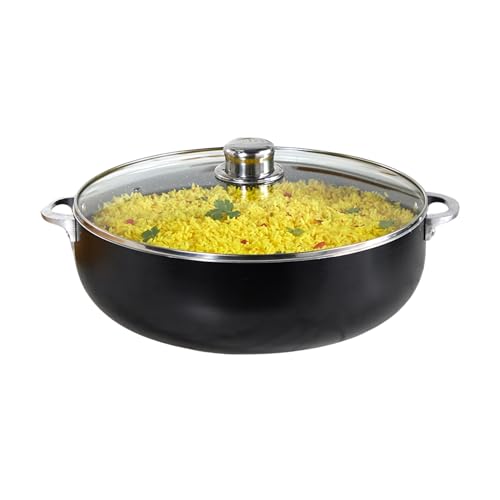
In a nutshell: A budget-friendly 6.9-quart aluminum caldero with a speckled black ceramic coating and a glass lid—the pot body is oven safe, but the glass lid and aluminum construction set real limits.
The IMUSA Bistro Cera Caldero is marketed as oven safe, and for the pot body, that’s likely true up to moderate oven temperatures. The aluminum construction is sturdy for its price, and the black speckled ceramic coating provides a nonstick surface that’s free of PTFE and PFOA. The easy-grip riveted handles are metal, which is a plus for oven use. The 6.9-quart capacity is ideal for rice, soups, stews, and one-pot meals, and the matte black exterior looks good enough to bring to the table. This is the kind of pot that does double duty as a serving vessel, which is a nice touch for casual dinners.
The main weakness is the tight-fitting glass lid with a steam vent. Glass lids typically have a lower oven temperature threshold than the pot body—often around 350°F to 400°F—and the steam vent may contain a plastic or silicone gasket that can degrade. The listing says the pot is oven safe, but it doesn’t specify the maximum temperature or whether the lid can go in the oven at all. For low-temperature braising at 325°F, you’d probably be fine with the lid on. Above 400°F, remove it. The aluminum body also means rapid temperature changes can cause warping, so let the pot cool before washing. As a budget oven safe cooking pot, the IMUSA is a solid entry point, but it’s not the high-heat workhorse that stainless steel provides. Our guide to choosing a pie baking pan touches on similar material trade-offs where aluminum conducts heat well but can warp under stress.
Pros:
- 6.9-quart large capacity — handles rice, stews, and braises for a crowd.
- Speckled black ceramic coating — nonstick and free of PTFE/PFOA.
- Riveted metal handles — oven safe and sturdy.
- Budget-friendly — one of the least expensive oven-safe pots on this list.
Cons:
- Glass lid max temp not specified — likely lower than the pot body and may have a plastic vent.
- Aluminum construction — warps if subjected to sudden temperature changes.
Our verdict:
Perfect for: Budget-conscious cooks who want a large ceramic pot for stovetop-to-table meals and occasional low-heat oven use. Pass on this if: You need a pot that can handle 450°F+ roasting or broiling without caveats.
Buying Guide: What to Look for in Oven Safe Cooking Pots
Most shoppers assume that if a pot is metal, it’s oven safe. That assumption is wrong. The difference between a pot that survives the oven and one that ruins dinner comes down to three factors: the material’s maximum safe temperature, the handle construction, and the lid material. Stainless steel with riveted metal handles is the gold standard, while nonstick coatings—even ceramic ones—have upper limits that vary wildly. Before you buy, check the manufacturer’s stated max oven temperature for every component. If a listing doesn’t provide that number, treat it as a warning sign.
Good Cooking Pans Start with the Right Material
For good cooking pans that can go from stovetop to oven, stainless steel is the safest choice. It has no coating to degrade, and 18/10 stainless like the Cook N Home Basics resists warping at high heat. Aluminum is lighter and heats faster, but it warps more easily, especially if you move a hot pot to a cold surface. Ceramic coatings are a middle ground: they’re nonstick and often free of PTFE and PFOA, but they typically max out between 400°F and 500°F, and scratches can compromise them. The Cuisinart 1.5-quart saucepan is a perfect example of pure stainless with an encapsulated aluminum base for even heating without the coating risk.
Handle Construction Is the Hidden Dealbreaker
The pot body might be oven safe, but the handles often aren’t. Solid riveted stainless steel handles are the most reliable, and they can withstand the same heat as the pot. Plastic or hollow handles will melt or crack, and even silicone-coated handles have limits. Detachable handles, like those on the Astercook and Umite Chef sets, are a clever storage solution, but they force you to remove the handle before oven use—and any plastic parts in the locking mechanism can still fail if forgotten. The COICUR 8-quart pot uses double-riveted stainless steel handles, which is exactly what you want for braising.
Glass Lids Have Lower Limits Than You Think
Nearly every stock pot in this roundup includes a glass lid, and that’s the weakest link. Glass is generally safe up to 350°F or 400°F, but many labeled oven-safe pots have lids that are not. The Cook N Home Basics avoids this entirely by using a stainless steel lid, which is one reason I picked it as the overall winner. If your pot comes with a glass lid, remove it before exceeding 400°F, or check the manufacturer’s spec sheet for a separate lid rating. A shattered glass lid in a hot oven is both dangerous and messy.
Induction Compatibility as a Proxy for Quality
Pots that are induction compatible typically have a magnetic steel base or a tri-ply bottom, which means the base is thicker and more even-heating than a cheap aluminum disc. That’s useful for oven cooking too, because a thicker base resists warping when you move the pot between heat sources. The Cook N Home and COICUR pots both advertise induction compatibility, and that’s a strong signal they’ll hold their shape better in the oven. It’s not a guarantee of oven safety, but it’s a good starting point. If you want a pot that works on induction and in the oven, those two are the clear standouts in this list.
Our Final Recommendation
For the best overall oven safe cooking pot, the Cook N Home Basics 8 Quart Stainless Steel Stock Pot is the clear winner: bare stainless, metal lid, metal handles, induction-ready base. If you’re on a budget, the IMUSA 6.9 Qt Bistro Cera Caldero gives you a large ceramic pot for under the cost of a dinner out, just keep the oven below 400°F. For a premium small-batch option, the Cuisinart 1.5 Quart Sauce Pan is the top cooking pans choice when you want pinpoint control and no coating to worry about. The cookware world is full of sets that promise oven safety but don’t deliver—our three picks above actually do.
Frequently Asked Questions
What are good pans for oven use if I want nonstick without PTFE?
Ceramic-coated pots are the most common PTFE-free option, and the Umite Chef and Michelangelo sets both fit that bill. Ceramic coatings can typically handle 400°F to 500°F, but always check the manufacturer’s limit. The trade-off is durability: ceramic scratches more easily than stainless, so use wood or silicone utensils. If you want true high heat, skip nonstick entirely and go with stainless steel like the Cook N Home Basics.
Can I put a pot with a glass lid in the oven?
Sometimes, but the lid’s max temperature is usually lower than the pot body’s. Most glass lids are safe to 350°F or 400°F, while the pot might be rated for 500°F. Always remove a glass lid before broiling or roasting above 400°F to avoid shattering. The Cook N Home Basics uses a stainless steel lid, which eliminates this problem entirely.
Are detachable-handle pots safe for the oven?
Only if you remove the handle first. The Astercook and Umite Chef sets have removable handles that save space, but the handle itself often contains plastic or silicone parts that will melt in a hot oven. The pot body may be oven safe, but you have to detach the handle before putting it in the oven. Forgetting that step is a common mistake that ruins the locking mechanism.
Is a white cooking pot a good choice for oven-to-table serving?
A white ceramic stock pot can look beautiful on the table, but none of the white options we evaluated met our oven-safety bar—most had unstated max temperatures or glass lids with lower limits. If aesthetics matter to you, the IMUSA Bistro Cera in speckled black is a better compromise: it has a matte finish that looks presentable and a pot body that’s genuinely oven safe at moderate heat. Function should win over form when your pot is going into a 450°F oven.