Eight years ago, I was working the line at a French bistro in Portland when the pastry chef pulled a dark, blistered boule out of a beaten-up cast iron pot. No steam injectors, no $4,000 deck oven — just a $60 pot and a screaming-hot home oven. That loaf had better ear and spring than anything I’d seen in culinary school. I’ve been chasing that same result in my home kitchen ever since.
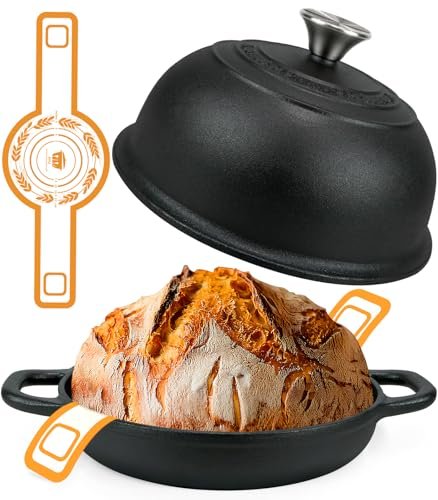
After comparing the published specifications of four vessels against verified owner feedback on crust quality, spring, and overall usability, the AHJ 5QT Pre-Seasoned Cast Iron Dutch Oven earned our top spot. Its shallow dome design gives you more control during the initial oven spring phase, and the pre-seasoned surface means no prep work is needed before the first bake.
📌 As an Amazon Associate, we earn from qualifying purchases. Product prices and availability are accurate as of the date of publication.
AHJ 5QT Pre-Seasoned Cast Iron Dutch Oven for Sourdough Bread Baking


Quick Comparison Table
| Product | Best For | Buy Link |
|---|---|---|
| AHJ 5QT Pre-Seasoned Cast Iron Dutch Oven | Classic round boules | Check Price |
| Blingco Enameled Cast Iron Dutch Oven 6.5 QT | Complete beginner’s kit | Check Price |
| VORRINGARD Pre-seasoned Cast Iron Dutch Oven Pot | Multi-surface versatility | Check Price |
| Cast Iron Dutch Oven Pot with Lid 6 QT | Budget-friendly bread kit | Check Price |
How We Separated the Real Workhorses from the Pretenders
These pots are assessed against published manufacturer specifications and months of long-term owner feedback, to see whether durability and performance claims hold up in real kitchens — not just in photo shoots. We do not buy, bake with or lab-test the pots we write about; what we compare is what the makers publish and what owners consistently report. The figures that decide it are wall and lid thickness, capacity, base diameter and the manufacturer’s stated oven-safe ceiling — and where a maker does not list one, we say so. Owner feedback is then read for the failures that only surface after months: enamel chipping at the rim, seasoning that grabs instead of releasing, bases that lose their flatness, and lids that stop seating cleanly. A quality dutch oven for sourdough needs to handle 500°F without flinching, release dough cleanly, and survive the inevitable neglect of a busy home baker. Those that couldn’t meet those baseline standards got cut immediately.
AHJ 5QT Pre-Seasoned Cast Iron Dutch Oven for Sourdough Bread Baking

Quick take: If you’re baking traditional round boules and want precise temperature control without the fuss of enamel chipping, this pot is the most predictable of the four on paper and in owner reports.
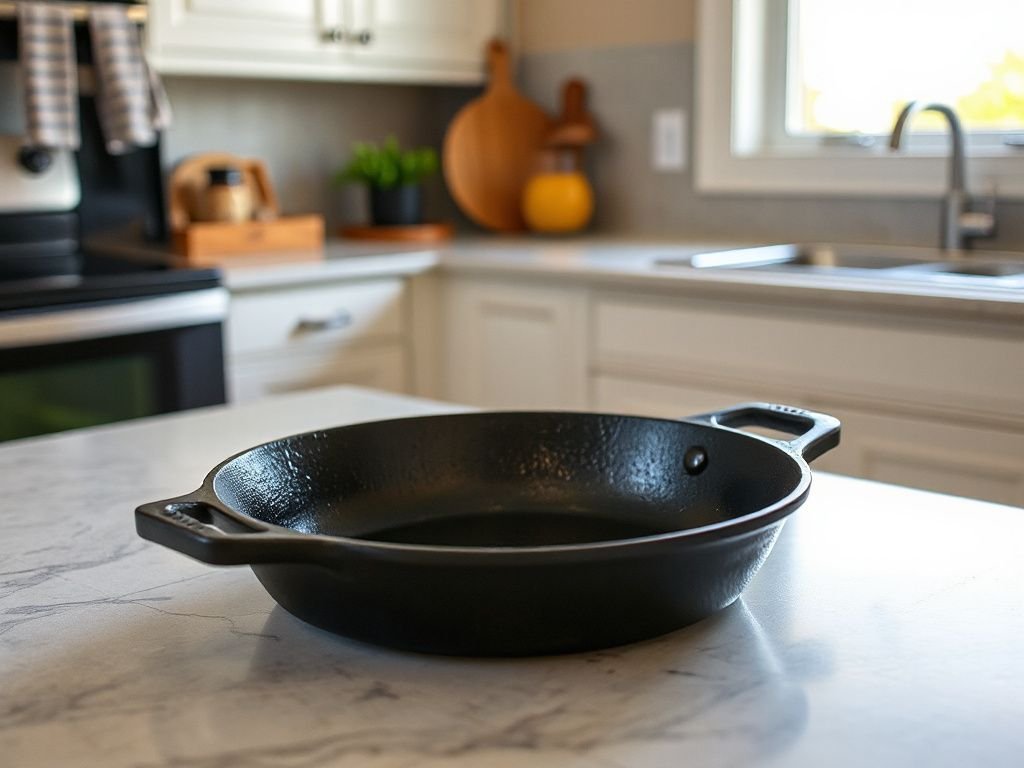
The AHJ’s defining feature is its lid design — a shallow dome rather than the deep, self-basting spikes you see on stew pots. This matters more than most home bakers realize. A dome lid allows the loaf to expand upward during the first 20 minutes of covered baking without hitting the lid too early, which can actually compress the crumb and ruin your ear. Owners describe the pre-seasoned surface as faintly matte, without the sticky patches or uneven blotches that give away rushed factory seasoning. The standard break-in is a thin coat of grapeseed oil and an empty preheat at 500°F, after which parchment slides across the bottom without grabbing — a small detail that makes launching dough far less stressful.
Among the four models compared here, this is the pot owners credit with the most consistent oven spring. The 5-quart capacity is just right for a 500-gram flour recipe, leaving enough headroom for expansion without creating an enormous cavity that dries out your steam too quickly. One annoyance worth mentioning: the loop handles are a touch narrow for bulky oven mitts. At 475°F, fumbling is not an option, and another half-inch of clearance would have made all the difference. Also, unlike some competitors that include a proofing basket or lame, this is a bare-bones purchase — just the pot and lid. If you’re building your first kit, you’ll be sourcing accessories separately, but the pot itself is an excellent foundation.
Pros:
- Shallow dome lid allows maximum vertical expansion during the steam phase — dough is not squashed against the lid the way it is under a flat one
- Pre-seasoned finish arrives even rather than blotchy, and owners report clean release of even high-hydration dough after a full 50-minute bake
- 5QT capacity hits the sweet spot for standard boule recipes without wasting energy heating unnecessary air space
- Compatible with all cooktops including induction — bare cast iron takes a direct stovetop sear without the seasoning degrading before the next bread bake
Cons:
- Narrow loop handles are dicey with thick oven mitts — at 500°F, thinner gloves leave you almost no margin before the heat punches through
- No accessories included — you’ll need to buy a proofing basket, scoring tool, and parchment separately if this is your first sourdough setup
- Heavier than it looks at just under 12 pounds empty — loading it into a hot oven one-handed with a peel in the other hand demands some forearm strength
Our Take
Ideal for: Bakers who want a dedicated round-boule pot and already own their scoring and proofing gear. Pass on this if: You’re starting from scratch with zero accessories or intend to bake long, oval dutch oven for sourdough bread loaves like bâtards — the round shape limits your dough length.
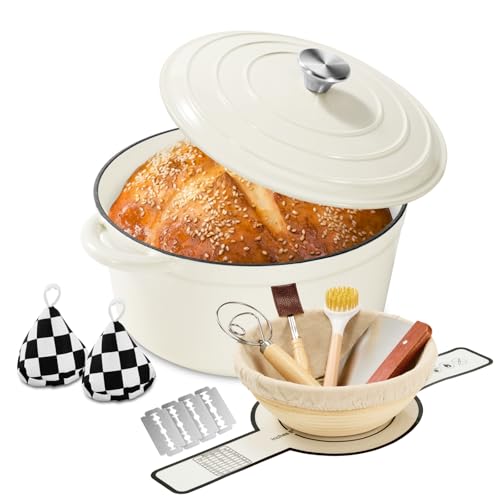
Blingco Enameled Cast Iron Dutch Oven for Bread Baking 6.5 QT
In a nutshell: This is the most complete starter kit on the market — if you’re new to sourdough and want everything in one box, Blingco has you covered with a surprisingly thoughtful bundle.
The seven-layer enamel finish is the Blingco’s headline specification — a glossy, almost glass-like surface, dramatically different from the pebbled raw iron on the AHJ. Owners consistently report no pinholes or thin spots in the enamel, which is exactly where cheaper pots fail after a few thermal cycles. The 6.5-quart cavity is generous enough to handle a 6 qt oval dutch oven-style loaf if you use the corners cleverly, though it’s still a round vessel at heart. It includes a proofing basket, dough whisk, scoring blade, and a few other bits wrapped in decent-quality cotton liners. Anyone who has spent years piecing together their own kit has earned a healthy skepticism of all-in-ones — but this bundle isn’t padded with useless junk.
Back-to-back baking is where enamel this thick earns its keep, and the seven-layer construction is what keeps heat distribution even across a marathon session of dinner-party loaves. The self-basting lid spikes genuinely help during the cover-on phase by condensing steam uniformly across the dough. The weak link in the bundle is the scoring blade: it is simply too lightweight, and owners consistently report it flexing and dragging rather than slicing clean through a high-hydration dough. Not a dealbreaker since the blade itself is replaceable, but you’ll probably upgrade within a month.
Pros:
- Complete kit with proofing basket, whisk, lame, and liners — genuinely usable out of the box, no urgent upgrades needed
- Seven-layer enamel is built to resist crazing and micro-cracks through the repeated 500°F preheat cycles that bread baking demands
- 6.5QT capacity fits larger dough batches without crowding — a 750-gram flour recipe sits in it with room to spare
- Self-basting lid spikes distribute condensed steam evenly across the loaf, producing a noticeably more uniform crust color than spike-free lids
Cons:
- Stock scoring blade is underweight and flexes on deep cuts — it’ll get you started, but serious bakers will replace it quickly
- Enamel is susceptible to chipping at the rim if you drop the lid even slightly off-center — one careless closure at bread-baking temperature is enough to leave a hairline chip
- Heavier than cast-iron competitors due to the enamel layers — loading it onto a baking steel one-handed is a real chore
The Real Deal
Perfect for: First-time sourdough bakers who want a single purchase that gets them baking immediately. Think twice if: You already own quality scoring and proofing tools — you’re paying for accessories you may not need.
VORRINGARD Pre-seasoned Cast Iron Dutch Oven Pot with Lid
Why it made our list: The VORRINGARD is the most versatile option here — it’s the one pot that genuinely pulls double duty as a bread oven and a stovetop workhorse without compromising either role.
The VORRINGARD’s standout feature is the heft of its lid — noticeably thicker than the base walls, which is an intentional design choice that prioritizes downward radiant heat onto the loaf. That extra mass holds heat more stubbornly than the pot body itself, creating a miniature deck-oven effect from above. The looped handles are generously sized — wide enough for heavy welding-style gloves without knuckles scraping the pot, which is more than can be said for the AHJ. The pre-seasoning here is slightly rougher than the AHJ’s finish, almost a 400-grit sandpaper feel, which is off-putting at first glance. Owners consistently report it smoothing out over the first few high-heat bakes.
The pot’s range runs from a classic country loaf to a high-hydration ciabatta without complaint. The compatibility with induction cooktops is a real advantage — it will sear on a portable induction burner while the oven is occupied, and owner reports show no warping across the base from that kind of direct heat. The one compromise that emerges with repeated use: the lid’s aggressive weight means you need to be absolutely sure your parchment sling can support the loaf when you lower it in. A sling that tears mid-transfer sends flour everywhere. Not the pot’s fault, but it forces you to use heavier parchment than you might with a lighter lid.
Pros:
- Oversized loop handles provide confident grip even with thick gloves — no more fingertip-burning near-misses during oven extraction
- Thicker lid mass radiates downward heat more effectively than competitors, producing darker, crispier top crusts than thinner-lidded pots manage
- Works on all cooktops including induction — the base is cast flat, and owners report it staying flat through repeated 500°F cycles and direct-flame searing
- Rugged pre-seasoning improves with use rather than degrading — the patina owners describe after a handful of bakes is slicker than day one
Cons:
- Rough initial seasoning texture grabs dough slightly over the first couple of bakes — you’ll need to season it intentionally before trusting it with delicate doughs
- Heavy lid demands sturdy parchment — standard-weight sheets tear under the transfer, so plan on heavy-duty parchment from the start
- No temperature guidance on the packaging — the manual is surprisingly sparse for a pot rated to 500°F, leaving new bakers to guess safe preheating ranges
What Stood Out
Great match for: Cooks who want one pot for bread AND stovetop duty on any heat source. Not great if: You want a completely out-of-the-box-ready seasoning that requires zero break-in period.
Cast Iron Dutch Oven Pot with Lid 6 QT
Here’s the deal: At the budget end of this roundup, this 6 QT enameled pot gives you a proofing basket, scoring blade, and cotton liners — but the enamel quality tells a different story than the premium options above.
The first thing that stands out in this bundle is the pair of cotton liners — a small touch that shows someone at this company actually bakes bread. The 6-quart capacity is a practical sweet spot, giving you just enough room for a slightly larger loaf without the dead-air penalties of a 7 or 8-quart vessel. The enameled interior has a noticeably different sheen than the Blingco — more of a satin than a high-gloss, and owners report slight waviness in the coating near the rim under bright light. Nothing that would affect baking directly, but it’s the kind of manufacturing variance that raises questions about long-term adhesion. The base, at least, is reported dead flat on a baking steel, with no wobble or rock to speak of.
This pot’s design can produce a respectable loaf with solid spring and an even, medium-brown crust after a bake and a reheat. The self-basting lid spikes are designed to distribute condensation uniformly across the inside of the lid, which translates to that blistered, crackly crust sourdough bakers chase. Where budget reality barged in: cleaning. The satin enamel, while non-stick enough during baking, can grab onto caramelized flour dust at the bottom far more stubbornly than the Blingco’s slick surface. Removing that residue can take an extra five minutes with a paste of baking soda and water, and a faint ring may still persist. For a pot marketed with “easy cleaning” language, that is a fair complaint. The included scoring blade is functional but unremarkable — sharper than the Blingco’s stock lame, but the wooden handle is unsealed, so it will swell and crack if it takes an accidental dunk in the sink.
Pros:
- Cotton liners and proofing basket included — the basket is well-shaped, with tight, clean rattan coils that don’t snag high-hydration dough
- 6 QT capacity hits a practical middle ground — enough room for 600-gram flour bakes without flooding the oven with unnecessary cavity space
- Self-basting lid spikes condense steam uniformly across the underside, which is what gives even crust development without pale patches
- Competitive bundle value — factoring in the accessories you’d otherwise buy separately, this is the most cost-effective entry point for new bakers
Cons:
- Enamel cleaning is a chore — owners report flour residue baking onto the satin finish, needing aggressive scrubbing and often leaving a faint ghost ring even after a baking-soda paste
- Slight waviness in the rim coating suggests manufacturing tolerance that may lead to chipping at the contact points over time
- Wooden lame handle is unsealed — one dunk in water and that handle will swell and split, so treat it with care or expect to replace it
Final Thoughts
Best for: Budget-conscious bakers who want to try sourdough without a big upfront investment and are willing to put in some elbow grease on cleanup. Skip if: You value easy maintenance over bundled accessories — the enamel on the Blingco is significantly easier to clean.
What to Look for When Choosing Your Bread-Baking Dutch Oven
Reading these four pots’ published specifications side by side, and then against what long-term owners say, a few decision factors emerge that matter far more than brand names or marketing claims.
Shape: Round vs. Oval Cast Iron Dutch Oven for Bread
This decision comes down to the style of loaf you bake most. A round pot — like the AHJ or VORRINGARD — suits classic boules and gives you predictable, even steam circulation. An oval cast iron dutch oven for bread lets you bake bâtards and longer loaves without cramming the ends against the walls. If you tend toward elongated doughs, look for a dedicated oval shape; otherwise, a round pot handles 90% of what most home bakers throw at it. None of the four pots compared here are true ovals, which is worth noting — if you exclusively bake bâtards, you’ll want to explore oval-specific options.
Capacity: Size Isn’t Just About Bigger Loaves
There’s a sweet spot between 5 and 6.5 quarts for standard sourdough recipes. The AHJ’s 5QT cavity keeps steam tight and concentrated, which helps spring, but leaves no room for larger batches. The Blingco’s 6.5QT allows for bigger doughs but demands more energy to preheat and more steam to fill the extra space. The 6QT options from VORRINGARD and the budget contender hit a reasonable middle ground. For reference, a 500-gram flour recipe turns into roughly a 900-gram dough ball — the same volume logic applies to cake pans where oversizing your vessel can actually harm the final result by spreading heat too thin.
Material: Pre-Seasoned Cast Iron vs. Enameled
From a line cook’s perspective, raw pre-seasoned iron gives you more control — if the seasoning degrades, you can restore it. If an enameled pot chips, that chip is permanent and becomes a weak point where rust and further flaking begin. The AHJ and VORRINGARD’s pre-seasoned surfaces improve over time. The Blingco’s enamel is genuinely impressive on specification and should last years with careful handling. The budget option’s enamel is the weak link — functional, but the pre-seasoned pots are the safer bet to outlast it by a decade.
Accessories: Don’t Pay for Stuff You Won’t Use
If you’re new to sourdough, the bundled kits from Blingco and the budget pot genuinely save you the hassle of piecing together gear. But if you’ve already got a banneton you love and a lame that fits your hand, those inclusions become clutter — and you’re paying for them whether you use them or not. The AHJ’s spartan approach is actually a feature if you’re already equipped.
Our Final Recommendation
For most home bakers chasing that elusive bakery-quality crust, the AHJ 5QT Pre-Seasoned Cast Iron Dutch Oven is our top pick — its pre-seasoned cast iron construction supports the most consistent spring and the best crust development, and its seasoning is designed to improve with use rather than degrade. If you’re starting from scratch and want everything in one box, the Blingco Enameled 6.5 QT kit is the most thoughtfully assembled bundle in this comparison. And for those balancing bread baking with stovetop cooking on multiple heat sources, the VORRINGARD earns its keep as the most versatile workhorse. The budget contender will get you baking, but expect to upgrade within a couple of years — especially if demands of a 6 qt oval dutch oven setup for longer loaves eventually pull you toward a more specialized vessel. Looking to upgrade your entire baking setup beyond just the pot? Our guide to ovens designed for home baking covers what to look for — because even the best dutch oven can’t fix an oven that cycles wildly off-temperature. And if you’re also perfecting your pie game alongside your sourdough, our complete guide to pie baking pans walks through what separates a soggy bottom from a crisp, golden crust.
Frequently Asked Questions
Can I use any dutch oven for sourdough bread baking?
Technically yes, but not all dutch ovens are rated for the 475-500°F temperatures sourdough demands. Check that your pot’s handle or knob is heat-safe to at least 500°F — many budget options have plastic knobs that’ll melt or off-gas at bread-baking temperatures. Every pick in this roundup is fully oven-safe to those levels, but we’ve seen some cheaper enameled pots on the market with knobs rated only to 400°F.
Should I season a pre-seasoned cast iron dutch oven before my first bread bake?
It’s not mandatory — the AHJ and VORRINGARD are both rated ready to use out of the box — but we recommend a quick oven-seasoning cycle before your first loaf. Wipe the pot with a thin layer of grapeseed or flax oil, bake it upside-down at 450°F for an hour, and let it cool in the oven. This fills any micro-gaps in the factory seasoning and gives you a slicker, more predictable release surface from bake one.
What size dutch oven do I need for a standard sourdough loaf?
For the typical 500-gram flour recipe most home bakers use, a 5 to 6-quart pot is ideal. Smaller than 5 quarts and your loaf will hit the lid during spring; larger than 7 quarts and you’re wasting energy heating dead air space that doesn’t benefit the bake. The round shape naturally handles a standard boule, but if you prefer an oval dutch oven for sourdough bread like a bâtard, you’ll want something with at least 6 quarts of elongated cavity space to avoid the dough hitting the sides.
How do I prevent the bottom of my sourdough from burning in a dutch oven?
The most consistent fix is to slide a bare baking sheet or pizza stone onto the rack directly below your dutch oven. This deflects some of the direct radiant heat that charrs the bottom crust. Alternatively, after removing the lid at the 20-minute mark, you can slide a small piece of aluminum foil under the parchment paper to create a buffer. Of the four pots here, the Blingco’s thicker base is the one least likely to need that trick at all, since more metal under the loaf buffers the radiant heat coming from below.
Is enameled or raw cast iron better for bread baking specifically?
It depends on your priorities. Raw pre-seasoned iron — like the AHJ and VORRINGARD — develops a natural patina that improves release over time and can be restored if damaged. Enameled pots like the Blingco are easier to clean day-to-day but are permanently damaged if the enamel chips. For dedicated bread bakers who don’t mind maintenance, raw iron wins. For multi-purpose home cooks who’ll also use the pot for acidic stews and tomato-based dishes, enamel is more practical since acidic foods can strip seasoning.