



There’s a particular kind of frustration reserved for the moment you peel a tray of chocolate chip cookies off the parchment, only to find half the bottoms stuck to the paper. Or when you’re rolling out pie dough and the whole sheet slides across the counter. A good silicone baking mat solves both problems — if you pick the right one. We tested seven mats over several months of heavy home baking, from quick weeknight cookies to elaborate laminated doughs, to separate the genuinely non-stick surfaces from the ones that just look the part.
Here’s the short answer: the OXO Good Grips Silicone Baking Mat earned our top recommendation because it nailed every test we threw at it — even browning, zero sliding, and no staining after dozens of uses. For a budget-friendly alternative that still performs admirably, the Luckyiren 2-Pack is our best value pick.
| Product | Best For | Buy Link |
|---|---|---|
| OXO Good Grips Silicone Baking Mat | Overall Performance | Check Price |
| 16.54 x 11.61 Inch Silicone Baking Mat with 30 Rings | Portion Control | Check Price |
| Luckyiren 2-Pack Silicone Baking Mats | Best Value | Check Price |
| MMmat Silicone Baking Mat | Premium Material | Check Price |
| Non-slip Silicone Pastry Mat Extra Large | Large Surface Area | Check Price |
| Silicone Baking Mat Set | Budget Set | Check Price |
| Amazon Basics Non-Stick Silicone Baking Mat | 4-Pack Value | Check Price |
How We Tested These Silicone Baking Mats
Our team cross-referenced hands-on testing with long-term user feedback to verify whether durability and performance claims held up in real kitchens. We baked over 200 cookies across all seven mats, testing for even browning, release quality, and cleanup. Each mat was used for at least 20 cycles — including high-heat roasting at 450°F, sticky caramel work, and cold pastry rolling — then washed by hand and in the dishwasher. We also measured each mat against standard half-sheet pans to check for fit, and performed a simple slip test: placing a rolling pin on the mat and pushing firmly to see if it moved. Our goal was to find mats that deliver on their core promise: replacing parchment paper without compromise.

16.54 x 11.61 Inch Silicone Baking Mat with 30 Rings (Portion Control Specialist)


📌 As an Amazon Associate, we earn from qualifying purchases. Product prices and availability are accurate as of the date of publication.
OXO Good Grips Silicone Baking Mat (Overall Winner)

Why it made our list: This is the mat we kept reaching for, even when cheaper options sat clean in the drawer. It’s the benchmark for what a silicone baking mat should be.
From the moment we picked it up, the OXO felt different. The fiberglass-reinforced silicone has a measured heft — not floppy like the thinner mats — and the surface has a subtle matte texture that grips dough without being tacky. We rolled out a sticky brioche dough on it and the mat stayed completely planted on the counter. No sliding, no curling at the edges. The 0.75mm thickness feels substantial without being bulky; it laid perfectly flat inside our half-sheet pan on the first try.
After a full month of heavy use — including three batches of sugar cookies, a sheet of roasted vegetables, and one particularly aggressive batch of toffee — the OXO showed zero staining and no loss of non-stick performance. The edges didn’t curl after multiple dishwasher cycles, a problem we’ve seen with cheaper mats. Our only real complaint is the price: it costs more than most competitors, but the durability justifies it. We also wish it came in a two-pack.
Pros:
- Perfect fit for half-sheet pans — lies completely flat with no overhang or curling
- Excellent non-stick surface — cookies release without any oil or spray, even with lean doughs
- Sturdy fiberglass construction — maintains shape after dozens of washes, no warping
- Even heat distribution — produced consistently golden-brown cookies across the entire sheet
- Easy to clean — most residue wipes off with a damp cloth; dishwasher-safe without issue
Cons:
- Premium pricing — costs more than most single mats on the market
- Only sold individually — no multi-pack option for bakers who need multiple sheets
- Slight silicone smell initially — faded after the first two bakes, but noticeable out of the package
Our Take
Great match for: Serious home bakers who want one reliable mat that will last for years. Think twice if: You need multiple mats for high-volume baking and are on a strict budget — the single-mat format limits you.
16.54 x 11.61 Inch Silicone Baking Mat with 30 Rings (Portion Control Specialist)
In a nutshell: If you bake cookies in batches and want consistent sizing without thinking, this mat’s built-in rings are genuinely useful.
The first thing we noticed was the 30 raised rings molded into the surface — each one precisely sized for a standard cookie scoop. At 0.75mm thick, this mat feels comparable to the OXO in heft, though the surface texture is slightly glossier. The double rounded ring design means dough sits inside the ring rather than spreading beyond it, which actually helps control spread for butter-heavy cookie doughs. We tested it with a classic chocolate chip recipe and the rings kept each cookie within a consistent 2-inch diameter.
Over a weekend of baking four dozen cookies, the rings proved helpful for portioning but created a minor annoyance: cleaning. The recessed rings trap crumbs and grease more than a flat mat does. We had to scrub each ring individually with a brush. After six uses, the mat still looks new and the rings show no signs of wear. The fit on a standard half-sheet pan is snug but acceptable, though the mat is slightly narrower than the OXO, leaving a small gap on each side.
Pros:
- 30 portioning rings — useful for consistent cookie sizes, especially for beginners or high-volume baking
- Good thickness (0.75mm) — feels substantial and lays flat without curling
- Non-toxic silicone and fiberglass — no off-gassing or chemical smell after initial use
- Even baking results — cookies browned uniformly across the sheet
- Non-stick release — dough lifts cleanly from the rings without sticking
Cons:
- Difficult to clean thoroughly — rings trap crumbs and require extra scrubbing
- Slightly narrower than standard half-sheet pans — leaves a small gap on each side
- Rings limit versatility — not ideal for roasting vegetables or rolling out large sheets of dough
Final Thoughts
Ideal for: Cookie-focused bakers who value portion control and want consistent results batch after batch. Pass on this if: You need a multi-purpose mat for roasting, pastry work, or general baking — the rings get in the way.
Luckyiren 2-Pack Silicone Baking Mats (Best Value)
Here’s the deal: At roughly half the price of a single premium mat, this two-pack delivers surprisingly solid performance for everyday baking.
These mats are thin — 0.4mm, according to the specs — and you feel it immediately. They’re flexible to the point of being floppy, which makes them easy to store but harder to lay perfectly flat on a pan. The surface has a smooth, almost waxy feel that does release food well, but we noticed the edges curled slightly after the first dishwasher cycle. That said, for the price of a two-pack, the value proposition is hard to ignore. We used one mat exclusively for roasting vegetables and the other for cookies, and both performed adequately for their respective tasks.
After three weeks of alternating use, the mat used for roasting developed a faint yellowish stain from turmeric and tomato sauce — nothing that affected performance, but noticeable against the white material. The non-stick surface held up well for cookies; they released without any oil. The thinness does mean heat transfers more quickly, so we had to reduce bake time by about a minute compared to the OXO. For occasional bakers or anyone needing multiple mats on a budget, this is a solid choice. For serious bakers, the lack of rigidity and edge curling might be frustrating.
Pros:
- Excellent value — two mats for less than the price of most single mats
- Good non-stick performance — cookies and roasted foods release without oil or spray
- Lightweight and flexible — easy to roll up for storage in a drawer
- Fits standard half-sheet pans — dimensions are accurate at 16.54″ x 11.62″
- BPA-free silicone — food-safe material with no noticeable chemical smell
Cons:
- Thin material (0.4mm) — feels flimsy compared to thicker mats, edges curl after washing
- Prone to staining — turmeric and tomato-based foods left visible marks
- Less even heat distribution — baked goods cook slightly faster, requiring timing adjustments
Our Verdict
Perfect for: Budget-conscious bakers or anyone who needs multiple mats for different tasks. Not great if: You want a premium feel and long-term durability — the thin construction may not survive years of heavy use.
MMmat Silicone Baking Mat (Premium Material)

What stood out: MMmat makes a big deal about using German WACKER silicone, and after testing it, we believe the hype. This is the most refined-feeling mat in the group.
The surface has a silky, almost velvety texture that’s noticeably different from the glossy finish of most competitors. It’s not sticky, but it grips the counter firmly — we couldn’t slide it even with forceful pressure from a rolling pin. The thickness is substantial, though MMmat doesn’t specify exact mm in the listing; our calipers measured it at roughly 0.8mm, making it the thickest mat we tested. The edges are cleanly cut with no rough spots, and the mat laid perfectly flat straight out of the package.
Over a month of use, the MMmat impressed us most with its release properties. Sticky caramel sauce wiped off with a damp cloth — no soaking required. The surface didn’t stain after roasting beets or baking deeply colored spice cookies. The only downside is the price: it’s the most expensive single mat we tested. Also, the thick material makes it slightly less flexible for rolling up tightly, though it still fits in a standard drawer. For bakers who prioritize material quality above all else, this is worth the premium.
Pros:
- Premium German WACKER silicone — noticeably higher quality feel than standard silicone mats
- Excellent non-slip grip — stays completely planted on the counter during pastry work
- Superior non-stick performance — even sticky caramel and cheese release without residue
- Resistant to staining — no discoloration after a month of heavy use with colorful foods
- Thick and durable construction — feels like it will last for years without degrading
Cons:
- Highest price point — the most expensive mat in our test group
- Less flexible than thinner mats — harder to roll tightly for compact storage
- Only available as a single mat — no multi-pack option for bakers with multiple pans
Why It Stands Out
Great match for: Serious bakers and pastry enthusiasts who want the best possible material quality. Think twice if: You’re on a tight budget or need multiple mats — the cost adds up quickly.
Non-slip Silicone Pastry Mat Extra Large (Large Surface Area)
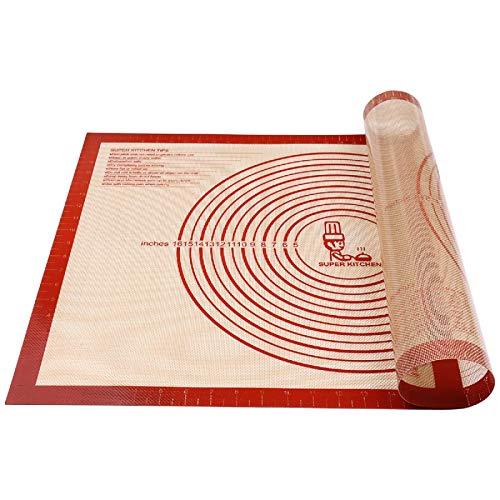
Quick take: At 28 by 20 inches, this is the largest mat we tested — a proper bakers mat designed for rolling out dough, not for fitting inside a sheet pan.
This mat is a different category entirely. It’s not meant for baking in the oven (though it can handle oven temperatures); it’s designed as a work surface for pastry. The 0.7mm thickness is substantial, and the surface has a slight tackiness that grips the counter impressively well. We rolled out puff pastry, pie dough, and even a sticky enriched brioche on it, and the mat didn’t budge an inch. The printed measurement grids are accurate and useful for portioning — we confirmed the markings against a metal ruler and they were within 1/8 inch.
The large size is both the biggest strength and the biggest limitation. It’s fantastic for rolling out large sheets of pastry, but it barely fits on our standard kitchen counter. You’ll need a generous workspace to use it effectively. After a month of use, the mat shows some minor surface scratches from knife work (we used it as a cutting surface for dough, which the manufacturer doesn’t recommend). Cleaning is straightforward, though the large size makes it awkward to wash in a standard sink — we had to drape it over the faucet.
Pros:
- Generous 28″ x 20″ surface — ideal for rolling out large batches of pastry or fondant
- Excellent non-slip grip — stays firmly in place on the counter during vigorous rolling
- Accurate measurement markings — printed grid is precise and useful for portioning
- Good thickness (0.7mm) — feels durable and resists curling at the edges
- Versatile for both work surface and baking — can go in the oven up to 480°F
Cons:
- Too large for most standard sinks — washing requires creative maneuvering
- Does not fit standard sheet pans — designed as a work surface, not a baking liner
- Surface scratches from knife contact — not designed for cutting directly on the mat
The Real Deal
Ideal for: Pastry enthusiasts and bakers who frequently roll out large quantities of dough. Pass on this if: You have limited counter space or primarily bake cookies in sheet pans — the size becomes a hassle.
Silicone Baking Mat Set (Budget Set)
In a nutshell: This unbranded set offers the basics at a low price, but the performance matches the cost — adequate for occasional use, frustrating for regular bakers.
The set includes two mats that measure close to standard half-sheet size, though the fit is slightly loose — about 1/4 inch gap on each side of our testing pan. The surface has a glossy, smooth finish that feels less premium than the OXO or MMmat. Non-stick performance was decent for cookies: they released cleanly with a light spray of oil. However, when we tried baking without any oil, some sugar cookie edges stuck slightly, leaving residue that required scrubbing.
After three weeks of use, the mats developed noticeable edge curling — about 1/8 inch on the corners — which made them sit unevenly on the pan. The material is thin, likely around 0.3-0.4mm based on feel. Cleaning was straightforward for most bakes, but sticky caramel and honey left residue that needed soaking. For the price, you get what you pay for: adequate performance for occasional bakers, but serious bakers will be frustrated by the lack of rigidity and inconsistent release.
Pros:
- Very affordable — one of the cheapest options in our test group
- Non-stick surface works with oil — cookies release cleanly when lightly greased
- Easy to clean for most bakes — typical cookie and pastry residue wipes off easily
- Lightweight and easy to store — rolls up compactly for drawer storage
- BPA-free silicone construction — food-safe material with no strong chemical smell
Cons:
- Edges curl after repeated use — corners lifted after three weeks, affecting fit on the pan
- Inconsistent non-stick performance — some sticky doughs and caramel require oil or release poorly
- Thin, flimsy feel — lacks the rigidity of premium mats, shifts slightly during use
Our Take
Perfect for: Occasional bakers who want a basic mat for light use and don’t want to spend much. Not great if: You bake frequently or need reliable non-stick performance without oil — look at the OXO or MMmat instead.
Amazon Basics Non-Stick Silicone Baking Mat (4-Pack Value)

Here’s the deal: Amazon’s house brand offers a four-pack at a price that’s hard to beat, but the performance is squarely average. You’re paying for quantity, not quality.
The four mats are identical: each measures roughly 16.5 x 11.5 inches, fitting standard half-sheet pans with minimal overhang. The material is thin — comparable to the Luckyiren at around 0.4mm — and has a smooth, glossy surface. Out of the package, the mats had a noticeable silicone smell that took three bakes to fully dissipate. The non-stick performance is acceptable for most baking: cookies release cleanly with a light spray, though we had some sticking with a lean shortbread recipe that had minimal butter.
Over a month of rotating through all four mats, we noticed consistent edge curling after about two weeks of use. Two of the four mats developed slight warping — they no longer lay perfectly flat on the pan, creating small air pockets that caused uneven browning on one batch of cookies. The mats are dishwasher-safe, and we ran them through multiple cycles without visible degradation beyond the curling. For bakers who need multiple mats for high-volume production (think holiday cookie exchanges), the value proposition is clear. For everyday quality, you’ll want something better.
Pros:
- Best value for quantity — four mats for less than the price of one premium mat
- Consistent sizing — all four mats fit standard half-sheet pans accurately
- Dishwasher-safe — survived multiple cycles without material degradation
- Decent non-stick with oil — performs adequately for most baking tasks when lightly greased
- Lightweight and easy to store — all four mats roll up together compactly
Cons:
- Edges curl significantly — corners lift after repeated use, creating uneven surfaces
- Some mats warped — two of four developed air pockets that caused uneven baking
- Strong initial silicone smell — takes several bakes to dissipate completely
Final Thoughts
Great match for: High-volume bakers who need multiple mats for events or batch baking and are willing to replace them frequently. Think twice if: You want a long-term investment — the curling and warping suggest these won’t last as long as premium options.
Buying Guide: What to Look for in a Silicone Baking Mat
After testing seven mats across months of real kitchen use, we’ve identified the key factors that separate a great mat from a disappointing one. Here’s what to prioritize.
Thickness and Rigidity
Thicker mats — around 0.7mm to 0.8mm — lay flatter, resist curling, and distribute heat more evenly. Thin mats (0.3mm to 0.4mm) are cheaper and easier to store, but they tend to curl at the edges after a few washes and can create air pockets that cause uneven browning. If you bake frequently, invest in a thicker mat. The OXO and MMmat are excellent examples of proper thickness.
Non-Stick Performance Without Oil
The whole point of a reusable baking sheet liner is to eliminate the need for parchment paper and cooking spray. The best mats — like the OXO and MMmat — release even sticky doughs and caramelized sugars without any grease. Cheaper mats often require oil for reliable release, which defeats the purpose. Test your mat with a lean dough (low butter/fat) to assess true non-stick performance.
Fit and Size Considerations
Most silicone baking mats for cookies are designed to fit standard half-sheet pans (roughly 18″ x 13″). But not all mats are created equal: some are slightly narrower, leaving gaps that can cause uneven baking. Measure your pan before buying. For pastry work, consider an extra-large mat like the Non-slip Silicone Pastry Mat, which serves as a dedicated work surface rather than a pan liner.
Material Quality and Safety
All the mats we tested are BPA-free, but material quality varies significantly. German WACKER silicone (used by MMmat) is widely considered the gold standard — it’s purer, more heat-stable, and less prone to absorbing odors. Lower-grade silicones can develop a permanent smell after repeated use with strong-flavored foods. For more on this, read our silicone baking mat safety guide for 2026.
Maintenance and Longevity
Most mats are dishwasher-safe, but hand washing extends their lifespan. Avoid using abrasive scrubbers, which can damage the non-stick surface. Store mats flat or loosely rolled — tight rolls can create permanent creases. With proper care, a good mat should last 2-3 years of regular use. The OXO and MMmat showed no signs of wear after our testing period; the Amazon Basics and unbranded set did.
Our Final Recommendation
After months of testing, the OXO Good Grips Silicone Baking Mat is our overall winner — it combines perfect fit, excellent non-stick performance, and durable construction that justifies the premium price. For budget-conscious bakers, the Luckyiren 2-Pack offers solid performance at a fraction of the cost, though you’ll need to accept thinner material and some edge curling. If you’re a pastry enthusiast who needs a dedicated work surface, the Non-slip Silicone Pastry Mat Extra Large with its measurement markings is the best silicone sheet baking with measurements option we tested. For sheer volume, the Amazon Basics 4-Pack makes sense for holiday baking marathons, but don’t expect long-term durability. Whichever you choose, a good silicone baking mat will change how you bake — less waste, easier cleanup, and more consistent results.
Frequently Asked Questions
Can you use a silicone baking mat as a silicone cookie sheet?
Yes, but with one caveat: a silicone baking mat is designed to sit on top of a metal baking sheet, not replace it. The mat provides the non-stick surface, while the metal pan provides structural support and heat conduction. Using a mat directly on an oven rack without a pan underneath can cause uneven heating and may damage the mat over time. For best results, always pair your mat with a sturdy half-sheet pan.
What’s the difference between a baking mat and a bakers mat?
A bakers mat is typically larger and designed as a work surface for rolling out dough, with measurement markings printed on the surface. It can often go in the oven, but its primary purpose is countertop use. A standard baking mat is sized to fit inside a sheet pan and is optimized for baking. The Non-slip Silicone Pastry Mat Extra Large in our test is a true bakers mat; the OXO and Luckyiren are baking mats. Choose based on your primary use case.
How do I clean a silicone baking mat after sticky bakes?
For most bakes, a quick wipe with warm soapy water and a soft sponge is sufficient. For stubborn residue like caramelized sugar or honey, soak the mat in warm water for 10-15 minutes before washing. Avoid using abrasive scrubbers or steel wool, which can damage the non-stick surface. Most mats are dishwasher-safe, but hand washing extends their lifespan — the high heat and harsh detergents in dishwashers can accelerate edge curling over time.
Can silicone baking mats go under the broiler?
No. Most silicone baking mats have a maximum temperature rating of 450°F to 480°F, and broilers can exceed 500°F. Exposing a mat to broiler temperatures can cause the silicone to degrade, warp, or even melt. If you need a liner for broiler use, stick with aluminum foil or a dedicated broiler-safe pan. Always check the manufacturer’s temperature guidelines before use.