A vague high-carbon label can leave you with a knife that loses its edge quickly, spots with rust, or simply feels wrong during ordinary prep. The best affordable chef knife should give you useful steel information, sensible geometry, a manageable handle, and enough versatility to replace several single-task gadgets.
My overall pick is the imarku Japanese Chef Knife because its 8-inch format, low listed weight, multipurpose design, and Pakka handle make the clearest everyday case, although the missing steel designation keeps it from being an automatic recommendation.
easycookingways.com is funded by affiliate commission. Our picks come from comparing published specifications and documented features against what matters in the category — no brand pays for a place on this page. If you buy through a link here we may earn a commission at no extra cost to you, and it pays for the research behind the next guide. Full disclosure.
As an Amazon Associate we earn from qualifying purchases. This does not affect the price you pay.
In this guide
- The short answer
- imarku Japanese Chef Knife (8 Inch)
- IGNITED CUTLERY Gyuto Chef Knife (8 Inch)
- OAKSWARE 8 Inch Chef Knife (Workhorse Design)
- Sunnecko 8 Inch Chef Knife (Vegetable Prep)
- HOSHANHO 7 Inch Chef Knife (Santoku)
- DDF iohEF Chef Knife (7 Inch)
- How to Choose the Best Affordable Chef Knife
- Our Final Recommendation
- Frequently Asked Questions
The short answer
- Best overall: imarku Japanese Chef Knife — Light 8-inch general-purpose option with Pakka handle
- Best steel detail: IGNITED CUTLERY Gyuto Chef Knife — Named German steel and documented 13-degree edge
- Best workhorse: OAKSWARE 8 Inch Chef Knife — Forged German stainless steel claim and 14–16-degree edge
- Best for vegetable prep: Sunnecko 8 Inch Chef Knife — Versatile 8-inch format with an advertised sharp edge
- Best shorter Japanese-style pick: HOSHANHO 7 Inch Chef Knife — Santoku shape with laminated-steel claim
- Best ambidextrous option: DDF iohEF Chef Knife — 7-inch double-edged design for either hand
How We Chose These Affordable Chef Knives
These picks come from comparing published specifications, stated materials, and documented features against what matters in daily prep. I weighted the disclosed blade steel first, because high-carbon stainless steel is a broad description rather than a complete alloy designation. Edge geometry came next: the IGNITED CUTLERY listing gives a 13-degree edge per side, while OAKSWARE states 14–16 degrees; those details are more useful than a bare ultra-sharp claim. Grind, balance, handle ergonomics, weight, and blade length also matter, especially for smaller hands or long chopping sessions. Rockwell C hardness can help indicate edge-retention characteristics, but none of these listings provides a credible hardness figure. The main buyer mistake is matching a vague Japanese or high-carbon label to the wrong maintenance routine or cutting style. Before ordering, check the current listing for the exact steel designation, dishwasher guidance, handle dimensions, return terms, and whether the blade shape suits a rocking motion or a more vertical Santoku chop. No product here was physically handled or tested.
| Product | Best for | Listed weight | Steel or edge detail |
|---|---|---|---|
| imarku Japanese Chef Knife Check price | Light general prep | 0.41 pounds | High-carbon stainless steel claim; angle not listed |
| IGNITED CUTLERY Gyuto Chef Knife Check price | Specification-focused buyers | 0.3 pounds | German 1.4116; 13 degrees per side |
| OAKSWARE 8 Inch Chef Knife Check price | Weightier workhorse | 0.53 pounds | German stainless steel claim; 14–16 degrees |
| Sunnecko 8 Inch Chef Knife Check price | Vegetable preparation | 0.44 pounds | High-carbon stainless steel claim; angle not listed |
| HOSHANHO 7 Inch Chef Knife Check price | Compact Santoku prep | 0.7 pounds | Triple-layer steel claim; 15-degree edge |
| DDF iohEF Chef Knife Check price | Ambidextrous use | 0.5 pounds | Japanese stainless steel claim; double-edged |
imarku Japanese Chef Knife (8 Inch)

- Brandimarku
- Model8-inch chef knife
- Dimensions13.0 inches x 3.0 Inches x 1.0 inches
- Weight0.41 pounds
- Size / capacity8"
- ColourDeep Brown
Quick take: The imarku is the most convincing general-purpose choice for a beginner who wants one affordable knife rather than a drawer full of specialists.
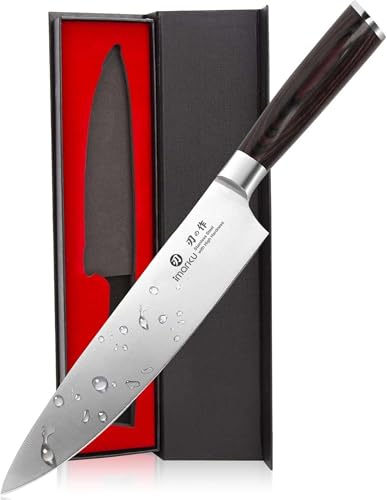
Its listed dimensions are 13.0 by 3.0 by 1.0 inches, and the weight is 0.41 pounds. The 8-inch size fits the familiar Japanese gyuto role: enough blade length for larger prep jobs without forcing a buyer toward a separate vegetable knife. The deep-brown Pakka handle is advertised as ergonomic, while the blade is described only as high-carbon stainless steel; the exact alloy, grind, Rockwell C hardness, and warranty are not listed.
That missing steel information is the central compromise. The relatively low listed weight should appeal to smaller hands and buyers who dislike a heavy chef knife, but balance cannot be judged from weight alone because handle dimensions and blade distribution are absent. Compared with the 0.3-pound IGNITED CUTLERY knife, the imarku is heavier on paper; compared with the 0.7-pound HOSHANHO, it is the less demanding option for everyday prep. I would treat the sharpness language as marketing until the edge can be maintained with a suitable sharpener.
Pros:
- Versatile 8-inch format — Suitable on paper for one-knife prep across common kitchen tasks.
- 0.41-pound listed weight — A lighter choice than the HOSHANHO 7-inch knife at 0.7 pounds.
- Pakka handle — The listing specifically focuses on reducing fatigue and finger discomfort.
- High-carbon stainless steel claim — Offers a useful starting description, even though the alloy is unnamed.
- Deep-brown finish — Gives the handle a distinct appearance instead of a plain silver presentation.
Cons:
- Unspecified steel grade — Buyers cannot compare its edge-retention or rust-resistance potential precisely.
- Missing warranty information — The listing does not state warranty coverage for the blade or handle.
Why It Stands Out
Best for: Beginners seeking a light, multipurpose 8-inch knife; it is my strongest candidate for a good budget chef knife. Pass on this if: You need a named steel, hardness figure, or clearly documented grind before buying.
IGNITED CUTLERY Gyuto Chef Knife (8 Inch)
- BrandIGNITED CUTLERY
- Modela204-niudao
- Weight0.3 Pounds
- Size / capacity8"
- Colourslivery
In a nutshell: This is the specification-led pick for buyers who would rather see a steel designation and edge angle than rely on broad sharpness wording.
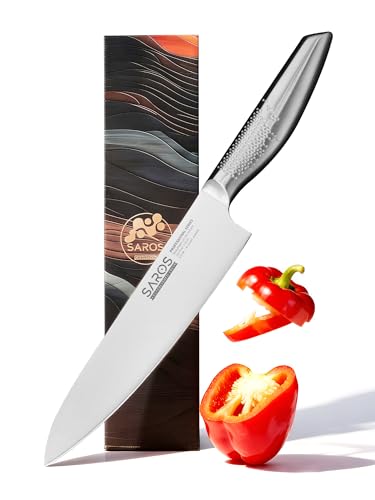
The IGNITED CUTLERY model is listed as a204-niudao, with an 8-inch size and a very light 0.3-pound weight. Its all-steel anti-slip handle is advertised as ergonomic, and the manufacturer identifies the blade as German 1.4116 high-carbon stainless steel. That named steel is a meaningful advantage over listings that stop at high-carbon stainless steel, although the page does not provide dimensions, warranty information, or a Rockwell C hardness figure.
The stated 13-degree edge per side gives the buyer a clearer idea of the intended geometry than most products here. A Japanese gyuto can suit slicing and a rocking motion, but the listing does not disclose the grind or blade height, so balance and clearance remain open questions. At 0.3 pounds, this is the lightest knife in the roundup; that may suit smaller hands, while buyers who prefer a weightier blade should look toward the OAKSWARE or HOSHANHO.
Pros:
- Named 1.4116 steel — More informative than an unnamed high-carbon stainless steel label.
- 13-degree edge per side — Gives sharpening decisions a documented geometry to work from.
- 0.3-pound weight — The lightest listed option for buyers who dislike a substantial knife.
- All-steel handle — The listing presents an anti-slip design without a separate handle material claim.
- 8-inch gyuto profile — Provides the familiar full-length format for general preparation.
Cons:
- Missing dimensions — Blade height and overall size cannot be checked before ordering.
- No hardness or warranty figure — Edge-retention expectations and post-purchase support remain unclear.
The Real Deal
Ideal for: Buyers who want a good steel designation and a documented edge angle in an affordable knife. Think twice if: You prefer a heavier blade or need published dimensions for storage and hand-fit decisions.
OAKSWARE 8 Inch Chef Knife (Workhorse Design)

- BrandOAKSWARE
- Model6628
- Dimensions13.39 inches x 1.97 inches x 0.79 inches
- Weight0.53 pounds
- Size / capacity8"
- ColourSilver
Here’s the deal: OAKSWARE makes the strongest workhorse argument on paper, but several of its biggest promises are still manufacturer claims rather than independently verified specifications.
The model 6628 measures 13.39 by 1.97 by 0.79 inches and weighs 0.53 pounds. The listing says it is forged from premium German stainless steel and has a hand-polished edge of 14–16 degrees; Amazon does not separately verify the material, and no warranty is listed. That weight is notably greater than the imarku at 0.41 pounds and the IGNITED CUTLERY knife at 0.3 pounds, so this option may suit cooks who prefer more blade presence.
OAKSWARE also claims the edge stays sharp three times longer and offers increased corrosion resistance. Those statements should not be treated as measured results because the listing does not supply a hardness value, exact alloy, test method, or supporting standard. The 14–16-degree range is useful for sharpening, yet the absence of a stated grind and balance point means the knife’s handling cannot be judged from the dimensions alone.
Pros:
- Forged-construction claim — Gives the knife a more substantial workhorse positioning than a generic blade listing.
- 14–16-degree edge — Supplies a practical range for choosing a sharpening approach.
- 0.53-pound weight — Offers more listed mass than the lighter imarku and IGNITED CUTLERY options.
- 13.39-inch overall length — Makes the complete footprint clear for storage planning.
- Multipurpose design — The manufacturer positions it for broad kitchen use rather than a single task.
Cons:
- Exact alloy not disclosed — German stainless steel is useful context, not a full steel specification.
- Performance claims lack supporting detail — The advertised sharpness and corrosion figures have no stated test basis.
Our Take
Great match for: Buyers wanting an 8-inch knife with a little more listed weight and a documented 14–16-degree edge. Not great if: You need verifiable edge-life data, a Rockwell C value, or a clearly named alloy.
Sunnecko 8 Inch Chef Knife (Vegetable Prep)

- BrandSunnecko
- Model2010103S
- Dimensions13 inches x 0.01 Inches x 0.01 Inches
- Weight0.44 Pounds
- Size / capacity8 inch
- Colour8 inch Chef Knife
Why it earns a spot: Sunnecko suits shoppers who want an 8-inch multipurpose knife with a vegetable-prep emphasis, provided they are comfortable with incomplete technical details.
The Sunnecko model 2010103S is listed at 13 inches long and 0.44 pounds. The listing describes the blade as high-carbon stainless steel and says the edge is hand-sharpened, but it does not give the alloy, edge angle, grind, handle material, warranty, or a useful blade-width measurement; the displayed dimensions also include 0.01-inch values that do not meaningfully describe the cutting profile. The advertised 8-inch size remains the clearest usable specification.
The manufacturer calls this an all-in-one workhorse for most prep and highlights precision cutting. Those claims make sense as positioning, not proof of edge retention. The 0.44-pound weight places it close to the imarku and above the IGNITED CUTLERY knife, while the missing handle and balance details make it harder to recommend for long prep sessions or smaller hands. A buyer choosing among budget kitchen knives should not let the ultra-sharp wording outweigh the absent steel designation.
Pros:
- 8-inch size — A familiar length for general vegetable, herb, and meat preparation.
- 0.44-pound weight — Falls between the lightest option and the heavier knives in this group.
- High-carbon stainless steel claim — Provides a broad material description for shoppers comparing affordable knives.
- Hand-sharpened claim — Indicates that edge preparation is part of the product positioning.
- All-in-one design — Targets buyers who want one multipurpose tool instead of several single-task gadgets.
Cons:
- Incomplete geometry information — The edge angle, grind, and meaningful blade profile are not listed.
- Unspecified handle — Buyers cannot assess handle material, maintenance, or fit from the listing.
Who Should Buy This
Perfect for: A cook seeking a vegetable-focused 8-inch generalist and willing to accept broad specifications. Skip if: Sharpening guidance, handle construction, and corrosion expectations need to be documented before purchase.
HOSHANHO 7 Inch Chef Knife (Santoku)

- BrandHOSHANHO
- Model7 inch Santoku Knife
- Weight0.7 pounds
- Size / capacity7"
- ColourSilver
Quick take: The HOSHANHO is the shorter, heavier Santoku choice for cooks who prefer compact prep and a substantial listed weight.
Amazon identifies this as a 7-inch Santoku knife weighing 0.7 pounds. The listing describes a triple-layer laminated steel blade, high-end Japanese steel, a frosted finish, and a hand-sharpened 15-degree edge; it does not name the exact alloy, provide dimensions, or state a warranty. A Santoku generally favors a more vertical chopping style and compact blade control, while an 8-inch gyuto gives more length for slicing and a rocking motion.
The 0.7-pound listing makes HOSHANHO the heaviest product here despite its shorter blade. That may appeal to buyers who like a weightier knife, but blade length alone does not determine comfort: handle fit, balance, blade height, and grind matter too, and the listing does not provide those details. Its Pakkawood handle is described as smooth and ergonomic, though wood-based handles should not be left in extended water contact and may need appropriate care.
Pros:
- 7-inch Santoku profile — Offers a shorter alternative to the 8-inch chef knives for compact prep.
- Triple-layer laminated steel claim — Gives the construction a more specific description than a bare stainless label.
- 15-degree edge — Supplies a clear angle for future sharpening decisions.
- 0.7-pound weight — Provides the most substantial listed mass in this roundup.
- Pakkawood handle — The listing describes a smooth ergonomic handle intended for comfort.
Cons:
- Heaviest listed knife — The 0.7-pound weight may feel excessive to buyers seeking a nimble, light tool.
- Exact steel remains unnamed — Laminated construction does not by itself establish edge retention or rust resistance.
Final Thoughts
Best for: Cooks who prefer a 7-inch Santoku and a weightier knife for controlled chopping. Pass on this if: You want a lighter 8-inch blade or regularly rely on a pronounced rocking motion.
DDF iohEF Chef Knife (7 Inch)

- BrandDDF iohEF
- ModelDDFGS-2020-005
- Dimensions11.81 inches x 1.97 inches x 0.08 inches
- Weight0.5 pounds
- Size / capacity7"
- ColourSantoku Knife
In a nutshell: DDF iohEF is the straightforward choice for left- or right-handed users who want a shorter double-edged blade.
The DDFGS-2020-005 is listed as a 7-inch Santoku knife with dimensions of 11.81 by 1.97 by 0.08 inches and a weight of 0.5 pounds. The manufacturer calls the blade professional Japanese stainless steel and the design double-edged, while the handle is described as ergonomic and the balance as well balanced. Exact steel, handle material, warranty, grind, and edge angle are not listed.
Its double-edged design is the clearest practical differentiator because it suits left- and right-handed users. At 0.5 pounds, DDF iohEF sits between the light imarku and the heavier HOSHANHO, but the extremely thin displayed dimension should not be read as a complete statement of blade thickness or grind without further listing clarification. This could be a good inexpensive chef knife for a shared kitchen, yet the sparse steel information limits confidence about sharpening and rust prevention.
Pros:
- Double-edged blade — Suitable in principle for both left-handed and right-handed users.
- 7-inch length — Offers a compact alternative to the full-size 8-inch models.
- 0.5-pound weight — Gives a middle-ground option between the lightest and heaviest knives.
- Japanese stainless steel claim — Identifies a broad material category for comparison.
- Ergonomic handle claim — The listing connects the handle design with balance and kitchen control.
Cons:
- Unnamed steel grade — The listing does not provide enough detail to predict edge retention precisely.
- Unclear blade geometry — Grind, edge angle, and handle material are absent.
The Short Version
Ideal for: Shared kitchens and left-handed or right-handed cooks wanting a shorter Santoku-style knife. Think twice if: You need a full-size gyuto for slicing or detailed sharpening specifications.
How to Choose the Best Affordable Chef Knife
Best affordable chef knife: start with the steel designation
High-carbon steel means an iron-based alloy containing about 1% carbon, while stainless steel generally contains iron, less than 1% carbon, and roughly 10–15% of nickel, molybdenum, and/or chromium. Those broad categories do not tell you the complete alloy, so the IGNITED CUTLERY listing has the clearest steel information here with German 1.4116. The imarku and Sunnecko listings use high-carbon stainless steel language without naming an alloy. Rockwell C hardness could help indicate edge-retention characteristics, but none of these listings provides a credible value.
Stainless steel can reduce maintenance concerns compared with a plainly described carbon-steel blade, but rust resistance still depends on the actual alloy, exposure, and care. Hand washing and immediate drying are the safer default; dishwasher use can damage an edge and may promote corrosion or handle deterioration even where a listing permits it. Food-contact questions should be checked against the FDA’s food-contact requirements and guidance, rather than inferred from a marketing phrase.
Choose geometry, not a sharpness slogan
Edge angle is one of the few useful geometry details in these listings. IGNITED CUTLERY states 13 degrees per side, OAKSWARE gives 14–16 degrees, and HOSHANHO lists 15 degrees; the others do not disclose an angle. A narrower advertised edge may suit precise slicing, but edge durability also depends on steel, grind, cutting technique, and what reaches the board. A rolled edge, chipped edge, or rapid dulling is more likely when the knife is mismatched to the job.
Blade length also needs context. An 8-inch Japanese gyuto offers more reach and can suit slicing or rocking, while a 7-inch Santoku tends to favor compact, more vertical chopping. Our comparison of 6- and 8-inch chef knives explains why length alone does not decide comfort. Handle fit, balance, blade height, and grind matter just as much, particularly for smaller hands.
Match the knife to your cutting style
For general meal preparation, the imarku is the easiest recommendation because its 8-inch size, 0.41-pound weight, and multipurpose positioning avoid an overly narrow use case. The HOSHANHO and DDF iohEF make more sense for buyers who specifically want a 7-inch Santoku format. A Santoku is not automatically better than a chef knife; the right choice depends on whether compact chopping or longer slicing and rocking feels more natural to the user. See our guide to Santoku versus chef knives for that distinction.
None of these knives should be used on bones, frozen food, or as a cleaver unless its construction is specifically intended for those tasks. Hard misuse can roll or chip an edge. A proper cutting board, careful grip, and suitable storage such as a block, blade guard, or magnetic storage matter more than a dramatic sharpness claim.
Budget for maintenance, not only the purchase
Affordability includes sharpening and replacement costs. A honing rod can help realign an edge, but it does not replace sharpening; a whetstone or suitable pull-through sharpener must match the knife’s geometry. The stated 13-, 14–16-, and 15-degree edges give some guidance, while the other listings leave more of that decision to the buyer. Hand washing, drying, and rust prevention are sensible defaults, and a Pakkawood handle such as HOSHANHO’s should not remain in extended water contact because varnished hardwood can warp or crack with prolonged exposure.
For readers searching for the best chef knife under 100, the strongest value is not automatically the product with the most dramatic advertising. The best inexpensive chef knife is the one whose steel, geometry, handle, and intended cutting style match your habits. Buyers comparing broader affordable knives can also review our Japanese chef knife shortlist, while the imarku remains my preferred starting point for a beginner seeking a versatile tool.
Our Final Recommendation
The imarku is my overall winner for a beginner who wants one light, versatile 8-inch knife, even though its steel designation is incomplete. IGNITED CUTLERY is the best value for specification-minded buyers because it names German 1.4116 steel and a 13-degree-per-side edge. OAKSWARE is the premium-leaning pick for those who prefer more listed weight and a 14–16-degree edge, but its performance claims remain unverified. HOSHANHO is the right specialist choice for a heavier 7-inch Santoku. For a best inexpensive chef knife decision, buy the clearest match for your cutting style, not the loudest sharpness claim.
Frequently Asked Questions
What is the best budget chef knife for a beginner?
The imarku is the most balanced beginner choice in this group because it combines an 8-inch multipurpose format, a listed 0.41-pound weight, and a Pakka handle. Its weakness is the unnamed steel grade, so buyers who prioritize documented material should consider the IGNITED CUTLERY gyuto instead. Neither option should be used on bones, frozen food, or as a cleaver.
Are a 7-inch Santoku and an 8-inch chef knife interchangeable?
They overlap, but they suit different preferences. The HOSHANHO and DDF iohEF are 7-inch Santoku-style knives, which favor compact chopping, while the imarku, IGNITED CUTLERY, OAKSWARE, and Sunnecko are 8-inch chef knives suited to broader general preparation. An 8-inch blade offers more reach for slicing and rocking; a Santoku may feel more manageable for users who prefer shorter, more vertical cuts.
How should these affordable knives be maintained?
Hand wash and dry the blade promptly rather than relying on dishwasher use, which can damage an edge and promote corrosion or handle deterioration. Use a suitable cutting board, avoid bones and frozen food, and store the knife in a block, blade guard, or magnetic system. Track the stated edge angle where available, and budget for a honing rod, whetstone, or appropriate sharpener as part of ownership.