



The Victorinox Swiss Classic 3.25" Paring Knife is my top kitchen pick here because its dedicated blade format makes more sense for food prep than any pocket tool. This guide to swiss knife brands also includes compact Swiss Army knives, a boning knife, and one Alox model, so the right choice depends heavily on the job.
My overall winner is the Victorinox Swiss Classic 3.25" Paring Knife: it has the clearest kitchen purpose, the lightest listed weight among the kitchen knives, and a lifetime warranty against original manufacturer defects. For pocket carry, the Victorinox Rambler is the more useful small-tool choice, while the Swiss Army 1 Alox is the cleanest option for buyers who mainly want one blade.
easycookingways.com is funded by affiliate commission. Our picks come from comparing published specifications and documented features against what matters in the category — no brand pays for a place on this page. If you buy through a link here we may earn a commission at no extra cost to you, and it pays for the research behind the next guide. Full disclosure.
As an Amazon Associate we earn from qualifying purchases. This does not affect the price you pay.
Victorinox Swiss Classic Paring Knife (dedicated kitchen precision)

The short answer
- Best overall: Swiss-Army Brands Boning Knife — focused fish and poultry preparation in a long kitchen format
- Best multi-tool value: Victorinox Swiss Army Tinker Pocket Knife — broad camping and hiking tool configuration
- Best kitchen knife: Victorinox Swiss Classic 3.25" Paring Knife — compact precision work with a non-slip handle
- Best compact tool: Victorinox Rambler Swiss Army Knife — ten functions in a small 58mm format
- Best for tool variety: Victorinox Explorer Swiss Army Knife — 16 functions and a magnifying glass
- Best road-trip pick: Victorinox Rally Swiss Army Knife — small format with a bottle opener
- Best single-blade carry: Victorinox Swiss Army 1 Alox — one large blade with Alox scales
How We Chose These Swiss Knife Brands Picks
These recommendations come from comparing published specifications, materials, warranties, and documented features against the demands of kitchen and pocket-knife use. The key question is always configuration: a dedicated paring or boning blade should not be judged by the same standard as a pocket tool with several small implements. Blade edge retention, corrosion resistance, and the ease of returning a stainless-steel blade to a sharp edge matter more to me than a large function count. For pocket models, handle construction, slipjoint tension, tool access, overall thickness, and the relationship between blade and carry format receive the most weight. The listings do not provide complete steel grades, blade hardness, or pivot details, so I won’t invent a performance verdict from missing information. Buyers should check local everyday-carry knife laws, confirm the dimensions against their pocket or keyring needs, and decide whether food preparation is genuinely part of the job. Function counts also need caution: individual tools and combinations may be counted differently, so the named tool list matters more than the headline number. For background on older makers and collecting, our guide to old knife brands and their lasting appeal is a useful companion.
Swiss-Army Brands Boning Knife (focused kitchen blade)

Quick take: This is the most purpose-built kitchen option in the group for buyers who need the listing’s stated fish and poultry-cleaning role rather than a pocket tool.
The Swiss-Army Brands Boning Knife is listed under the Swiss Army brand, model 40019, with dimensions of 11.0 x 2.0 x 0.75 inches and a weight of 0.15 pounds. Its listed finish is Silver/Brown, the category is Kitchen, and the listing states a manufacturer warranty. Material is not listed, which matters because blade steel is central to edge retention, corrosion resistance, and sharpening behavior.
The name Swiss-Army Brands should not be treated as proof of a separate knife manufacturer. Most of the other products here are explicitly Victorinox, while this listing uses Swiss-Army Brands and describes cleaning fish and poultry; that makes brand identity and replacement support worth checking before ordering. The 11-inch overall dimension also does not prove a 6-inch blade, so buyers wanting a particular blade length should verify the seller’s current details. A boning knife is the right category for separating meat from bone; a pocket knife is not a substitute for its dedicated blade shape, handle, or food-preparation format.
Pros:
- Dedicated kitchen category — the listing specifically positions the knife for cleaning fish and poultry.
- Light listed weight — at 0.15 pounds, the knife is specified as lighter than the Tinker and Explorer pocket tools.
- Manufacturer warranty — warranty coverage is listed, giving buyers a documented support point.
Cons:
- Material not listed — the buyer cannot compare the blade steel directly with other kitchen knives.
- Unclear blade length — the listing gives an 11.0-inch overall dimension, not a confirmed 6-inch blade measurement.
Who Should Buy It
Ideal for: A cook who specifically cleans fish or poultry and wants a dedicated kitchen knife. Pass on this if: You need a compact everyday-carry tool, a confirmed blade steel, or a clearly stated blade length.
Victorinox Swiss Army Tinker Pocket Knife (camping tool set)


In a nutshell: The Tinker suits buyers who want a traditional multi-tool arrangement for camping and hiking, not a substitute for a kitchen paring knife.
Victorinox lists the Tinker as model 1.46, in red, with a stated weight of 0.15 pounds. The size/capacity field says 3.6 x 1.0 x 0.6 inches, while another dimensions field gives 3.58 x 1.02 x 55.0 inches; that inconsistency should be resolved with the seller before purchase. Material is not listed, although the product belongs to the Swiss Army Knife family and is categorized for Outdoors.
The Tinker demonstrates why function counts can mislead: the useful question is which tools are included and how accessible they are, not simply how many functions a title suggests. Its broad camping-and-hiking positioning gives it a wider role than the one-blade Swiss Army 1 Alox, but the larger configuration also makes it less focused for a kitchen drawer. The pocket knives in this roundup use non-locking slipjoint blades, so the Tinker is not equivalent to a modern locking folder; controlled, deliberate use matters, particularly during cutting tasks.
Pros:
- Camping and hiking focus — the listing gives the Tinker an outdoor purpose rather than presenting it as a chef knife.
- Compact stated size — the 3.6 x 1.0 x 0.6-inch size/capacity entry supports pocket-oriented carry.
- Lifetime defect warranty — Victorinox AG states lifetime coverage for material or manufacturer defects during normal use, with listed exclusions.
Cons:
- Conflicting dimensions — the separate 55.0-inch entry is plainly inconsistent with the 3.6-inch size listing.
- Material not listed — buyers cannot confirm the scale material from this Amazon specification set.
Our Take
Great match for: Campers and hikers who want a multi-tool rather than a dedicated kitchen blade. Think twice if: Your main goal is food preparation, one-handed blade control, or the thinnest possible pocket carry.
Victorinox Swiss Classic Paring Knife (dedicated kitchen precision)
Why it earns a spot: This is the clearest recommendation for kitchen precision because it is designed as a dedicated paring knife, not a pocket tool with a small blade.
The Victorinox Swiss Classic 3.25" Paring Knife is model 6.76, listed in black with a 3.2-inch size, dimensions of 7.44 x 0.79 x 0.43 inches, and a weight of only 0.04 pounds. The listing does not state the material, but it documents a contemporary textured handle, a non-slip grip, ergonomic shaping, dishwasher-safe cleaning, and NSF approval. Victorinox also lists a lifetime warranty against original manufacturer’s defects.
That specification mix gives the Swiss Classic a more credible kitchen role than the Tinker, Rambler, Explorer, Rally, or Swiss Army 1 Alox. The 3.2-inch listed size is suited to precision work in principle, while the handle features are directly relevant when ingredients or hands are wet. Dishwasher-safe labeling is convenient, but a sharp stainless-steel edge still deserves careful drying and appropriate sharpening; repeated rough treatment is not a reason to ignore edge maintenance. Material remains the missing piece for anyone comparing steel quality closely.
Pros:
- Dedicated paring format — the 3.2-inch listed size is aimed at precision kitchen work rather than general pocket tasks.
- Non-slip textured handle — the listing specifically documents grip support when wet.
- Lifetime warranty — original manufacturer defects are covered for the product’s lifetime.
Cons:
- Material not listed — the steel grade and exact blade composition are not provided.
- Not a pocket knife — its 7.44 x 0.79 x 0.43-inch kitchen format lacks the multi-tool function of the outdoor models.
Final Thoughts
Perfect for: Home cooks who need a small precision knife for kitchen prep and value a documented non-slip handle. Not great if: You want a folding tool for camping, repairs, or everyday pocket carry.
Victorinox Rambler Swiss Army Knife (compact everyday tool)

Here’s the deal: The Rambler is the most balanced small-tool choice here for everyday pocket tasks because its 58mm format carries ten documented functions without the Explorer’s larger listed size.
Victorinox lists the Rambler as model 0.64, in red, with a 58mm size/capacity, dimensions of 2.28 x 0.77 x 0.41 inches, and a weight of 0.07 pounds. The listing names ten functions and highlights a magnetic Phillips screwdriver, but it does not provide the complete function list in the supplied data. Material is also not listed.
Compared with the Rally, the Rambler is heavier at 0.07 pounds versus 0.04 pounds and is described with ten functions rather than the Rally’s road-trip and bottle-opener emphasis. Compared with the Explorer, it is much smaller by the listed dimensions and weight, although the Explorer offers 16 functions and a magnifying glass. The Rambler’s non-locking slipjoint blade keeps it in the traditional Swiss Army Knife category, so deliberate two-handed handling is a better expectation than modern locking-knife behavior.
Pros:
- Small 58mm format — the 2.28 x 0.77 x 0.41-inch dimensions favor unobtrusive everyday carry.
- Ten documented functions — more versatile than the single-function Swiss Army 1 Alox.
- Magnetic Phillips screwdriver — a named feature that gives the compact tool a clear repair-oriented use.
Cons:
- Incomplete tool list in the supplied listing — the headline count cannot replace checking the exact included implements.
- Material not listed — scale construction and blade steel cannot be compared directly from the specification sheet.
Why It Stands Out
Best for: Everyday pocket carry where a small tool set is more useful than a single blade. Skip if: You need a dedicated kitchen knife, a confirmed locking blade, or the broader function set of the Explorer.
Victorinox Explorer Swiss Army Knife (16-function configuration)
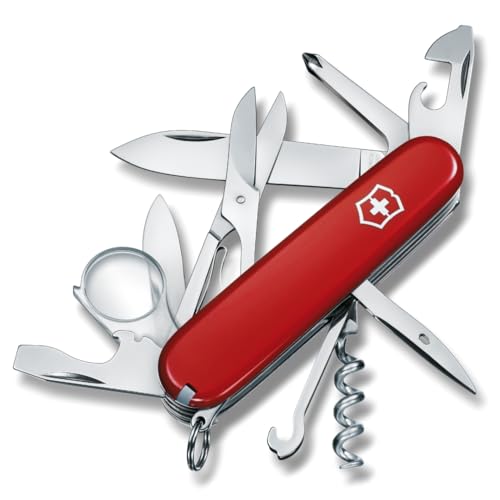
Quick take: The Explorer is the choice for buyers who genuinely need a broad pocket-tool configuration, including the listed magnifying glass, and don’t mind a thicker profile.
The Victorinox Explorer is model 1.67, listed in red with a 4-inch size/capacity, dimensions of 3.58 x 0.87 x 1.04 inches, and a weight of 0.18 pounds. The manufacturer describes it as Swiss Made and lists 16 functions, including a Phillips screwdriver and magnifying glass. Material is not listed in the Amazon data, though the warranty says Victorinox guarantees its knives and tools to be first-class stainless steel.
At 0.18 pounds, the Explorer is the heaviest pocket model in this group, exceeding the Tinker and Swiss Army 1 Alox. That extra tool density only makes sense if those tools will earn their space; function counts are not directly comparable across models because manufacturers can count individual tools or combinations differently. The Explorer’s non-locking slipjoint blade remains a controlled-use tool rather than a locking folder, and its 1.04-inch listed thickness is the clearest warning for buyers prioritizing slim carry.
Pros:
- 16-function configuration — the broadest stated tool count among the listed pocket knives.
- Magnifying glass — a documented feature that separates the Explorer from the Tinker, Rambler, Rally, and Swiss Army 1 Alox.
- Swiss Made listing — the product description explicitly identifies the Explorer as Swiss Made.
Cons:
- Heaviest pocket model — the 0.18-pound weight is higher than the other listed outdoor knives.
- Thickest stated profile — the 1.04-inch dimension can be awkward for buyers seeking discreet, slim carry.
The Real Deal
Ideal for: Campers, travelers, and repair-minded buyers who will use the broader tool selection. Pass on this if: You mainly need a blade and a few basic tools; the Rambler or Swiss Army 1 Alox is less excessive on paper.
Victorinox Rally Swiss Army Knife (road-trip essentials)

In a nutshell: The Rally is a light, compact option for basic everyday tasks, with a documented bottle opener that gives it a more specific road-trip role.
Victorinox lists the Rally as model 0.62, in red, with a 58mm size/capacity, dimensions of 2.36 x 1.02 x 0.67 inches, and a weight of just 0.04 pounds. The listing highlights a bottle opener and describes the product for road trips, while material is not listed. Warranty coverage is given as a manufacturer warranty without further detail in the supplied data.
The Rally is lighter than the Rambler despite sharing the listed 58mm size/capacity, but its dimensions are not identical: the Rally is 2.36 inches long and 0.67 inches thick in the supplied figures, compared with the Rambler’s 2.28-inch length and 0.41-inch thickness. The practical difference between these Swiss pocket knife brands is therefore not just function count; carry dimensions and named tools matter. Like the other pocket knives here, the Rally uses a non-locking slipjoint blade and should not be treated as a locking modern folder.
Pros:
- 0.04-pound weight — the lightest listed weight among the pocket models.
- 58mm size/capacity — a compact format for buyers who dislike bulky pocket tools.
- Documented bottle opener — a clear reason to choose the Rally over a single-blade model.
Cons:
- Limited documented detail — the supplied data does not provide a complete function list.
- Material not listed — the buyer cannot verify scale construction or blade steel from the listing.
Who Should Buy This
Great match for: Road-trip users wanting a very light, compact tool with a bottle opener. Not great if: You need the Rambler’s named magnetic Phillips screwdriver, the Explorer’s 16-function set, or a dedicated kitchen blade.
Victorinox Swiss Army 1 Alox Medium Pocket Knife (single-blade carry)
Why it earns a spot: The Swiss Army 1 Alox is the cleanest pick for someone who wants one large blade and does not need a pile of extra implements.
Victorinox lists this model as 0.8 .26, in silver, with dimensions of 3.7 x 0.9 x 0.4 inches, a weight of 0.1 pounds, and a 4-inch size/capacity entry. The listing describes a Swiss Made pocket knife with one function, a large blade, and Victorinox Alox scales. It also says the knife slices rope, wood, or on-the-go snacks; the listing does not provide a separate material specification beyond the Alox scale description.
Alox changes the trade-off from the red multi-tool models: the scales are aluminum-bodied and generally more resistant to pocket abrasion, while Cellidor scales are lighter and traditional. That does not automatically make Alox the better buy, especially when the stated configuration has only one function. At 0.1 pounds and 0.4 inches thick, the Alox is slimmer than the Explorer’s 1.04-inch profile, but buyers still get a non-locking slipjoint blade rather than a locking folder. The higher cost of an Alox model is easier to justify when scale wear and a focused blade matter more than tool variety.
Pros:
- Alox scales — the listing identifies aluminum-bodied Alox construction, a different wear trade-off from traditional Cellidor scales.
- One-function focus — the configuration avoids paying in pocket space for tools that won’t be used.
- 0.4-inch listed thickness — slimmer than the Explorer’s 1.04-inch dimension.
Cons:
- No extra tools — the one-function design cannot replace a Rambler, Tinker, or Explorer for repairs.
- Material detail remains limited — the listing names Alox scales but does not give a full blade-material specification.
Our Take
Best for: Minimalist everyday carry focused on one large blade and Alox scales. Think twice if: You expect a bottle opener, screwdriver, magnifying glass, or other multi-tool functions.
Swiss Knife Brands Comparison
| Product | Best for | Listed weight | Key configuration |
|---|---|---|---|
| Swiss-Army Brands Boning Knife Check price | Fish and poultry prep | 0.15 pounds | 11.0-inch dimensions; material not listed |
| Victorinox Swiss Army Tinker Check price | Camping and hiking | 0.15 pounds | 3.6 x 1.0 x 0.6-inch size; material not listed |
| Victorinox Swiss Classic Paring Knife Check price | Kitchen precision | 0.04 pounds | 3.2-inch size; non-slip textured handle |
| Victorinox Rambler Check price | Compact everyday carry | 0.07 pounds | 58mm; ten functions |
| Victorinox Explorer Check price | Broad tool variety | 0.18 pounds | 4-inch size; 16 functions |
| Victorinox Rally Check price | Road trips | 0.04 pounds | 58mm; bottle opener |
| Victorinox Swiss Army 1 Alox Check price | Single-blade carry | 0.1 pounds | 4-inch size; one function and Alox scales |
How to Choose Among Swiss Knife Brands
Choosing the right configuration from swiss knife brands
Start with the job, not the function count. The Swiss Classic is a dedicated kitchen paring knife, and the Swiss-Army Brands model is listed for fish and poultry; neither should be replaced by a pocket knife simply because a pocket model has more tools. For everyday carry, the Rambler’s 58mm size and ten functions offer a different compromise from the Rally’s 58mm road-trip format, the Tinker’s camping-and-hiking configuration, and the Explorer’s 16 functions. The Swiss Army 1 Alox is the opposite approach: one large blade, one stated function, and Alox scales. Buyers should confirm the exact tool list because function counts may include individual implements or combinations differently. A higher number is not automatically a better fit.
Blade steel, sharpening, and food preparation
Edge retention depends on steel quality, heat treatment, blade geometry, and use, but the supplied listings do not identify complete steel grades or blade hardness for these products. That missing information should temper any claim that one blade will stay razor sharp longer than another. The Explorer warranty does state that Victorinox knives and tools are first-class stainless steel, while the other listings provide less detail; that is useful, but it is not a substitute for a full steel specification. A dedicated paring or boning knife remains the sensible kitchen choice because blade shape, handle ergonomics, hygiene, and access differ from a folding pocket tool. The NSF is the relevant body to consult for the meaning of NSF approval; the Swiss Classic listing specifically uses that label.
Cellidor, Alox, and pocket wear
Cellidor and Alox scales make different promises. Victorinox Cellidor scales are lightweight and traditional, while Victorinox Alox scales are aluminum-bodied and generally more resistant to pocket abrasion, though the Alox choice may add cost and alter grip feel. The red models in this roundup are not identified as Cellidor in the supplied Amazon specifications, so buyers should not assume a scale material from colour alone. Alox is most defensible for the minimalist buyer who values a slim one-blade format and the stated 0.4-inch thickness of the Swiss Army 1 Alox. Someone needing screwdrivers, a magnifying glass, or a bottle opener should accept the extra configuration of a Rambler or Explorer instead.
Slipjoint use and maintenance
These pocket knives use non-locking slipjoint blades. A slipjoint relies on spring tension rather than a blade lock, so the blade should be used with controlled pressure and deliberate opening and closing; local everyday-carry laws also deserve a check before carrying any pocket knife. Stainless-steel blades and tools should be cleaned according to the maker’s care guidance, dried fully, sharpened with a suitable edge angle, and lubricated at moving joints only with a product intended for that purpose. Do not treat dishwasher-safe labeling on the Swiss Classic as proof that every knife in this roundup belongs in a dishwasher.
Published construction facts also explain why tool feel can vary across a Swiss Army Knife. Brass flanged bushings and rivets assemble the scales, separators, additional tools, and machined steel components; aluminium alloy has been used for tool separators since 1951. The steel hardness listed for nail files, scissors, and wood saws is HRC 53, while tin openers, awls, and screwdrivers are HRC 52, and springs and corkscrews are HRC 49. Those figures apply to the named tool groups, not automatically to every blade, so they should not be used as a blade-edge prediction.
Our Final Recommendation
The Victorinox Swiss Classic 3.25" Paring Knife is my overall winner because its 3.2-inch kitchen format, non-slip textured handle, dishwasher-safe listing, NSF approval, and lifetime defect warranty align with precision prep. For a budget-friendly focused kitchen choice, the Swiss-Army Brands Boning Knife is worth considering only after confirming its blade length and material. The premium pick is the Victorinox Swiss Army 1 Alox, provided one blade is enough. For pocket versatility, our recommendation is the Rambler; the Explorer is better only when its extra tools genuinely earn their space. The Tinker and Rally remain sensible specialist choices for camping and road trips.
Frequently Asked Questions
Are Victorinox and Swiss-Army Brands the same company?
Most products here are explicitly Victorinox models, including the Tinker, Swiss Classic, Rambler, Explorer, Rally, and Swiss Army 1 Alox. The boning knife is listed under Swiss-Army Brands, model 40019, but the supplied data does not establish that Swiss-Army Brands is a separate manufacturer or a Victorinox product. Treat the retailer or listing name as unconfirmed brand information and check warranty support, material, and seller details before ordering.
Which brands of Swiss Army knives are best for everyday pocket carry?
The Rambler is the strongest everyday-carry fit among these products because its listed 58mm size, 0.07-pound weight, and ten functions balance compactness with utility. The Rally is lighter at 0.04 pounds and has a bottle opener, while the Swiss Army 1 Alox is slimmer at a listed 0.4 inches thick but has only one function. None is a locking folder; all require deliberate slipjoint use.
How should stainless-steel blades and tools be maintained?
Clean residue promptly, dry the stainless-steel blade and tools thoroughly, and use suitable lubrication at moving joints when needed. Sharpen the blade with a consistent angle rather than waiting for heavy dulling. The Swiss Classic listing says dishwasher safe, but that label applies to that listed kitchen product and should not be extended to the pocket knives or the boning knife, whose supplied listings do not make the same claim.
Is the Explorer better than the Rambler or Swiss Army 1 Alox?
The Explorer is better only for buyers who need its listed 16 functions and magnifying glass. It weighs 0.18 pounds and has a listed 1.04-inch thickness, making it a less compact choice than the Rambler at 0.07 pounds and 0.41 inches thick. The Swiss Army 1 Alox weighs 0.1 pounds, has a listed 0.4-inch thickness, and provides one function with Alox scales. Function count is not a quality score; configuration decides the better buy.