



Here’s the truth most roundups won’t say: henckels japanese knives is a marketing phrase more than a factual category. Henckels is German to its core — a Solingen name with nearly three centuries of Western blade craft. Their Miyabi line is genuinely made in Japan. The Forged Premio Santoku, by contrast, is a Western knife wearing Japanese geometry. That’s not a knock. It just matters when you’re about to spend money.
Skip the guesswork: the HENCKELS Forged Premio 7-inch Hollow Edge Santoku is my top pick for most home cooks. Forged bolster, a proper Granton edge, and German stainless that stays forgiving. If you want true Japanese steel character, the VG-10 Damascus set on this page is the one I’d reach for first.
📌 This article contains affiliate links. As an Amazon Associate I earn from qualifying purchases, at no extra cost to you. Product prices and availability are accurate as of the date of publication. Full disclosure.
| Product | Best For | Buy Link |
|---|---|---|
| imarku 3 Pieces Knife set | Budget starter trio | Check Price |
| HOSHANHO Kitchen Knife in Japanese High Carbon Steel | Single hard blade | Check Price |
| Japanese Chef Knife Set 3 Pcs | Authentic Damascus VG-10 | Check Price |
| HENCKELS Forged Premio 7-inch Hollow Edge Santoku Knife | Daily driver | Check Price |
How These Knife Picks Were Chosen
Every knife on this page was selected by comparing published materials, documented construction methods, and spec-sheet numbers against what actually separates a knife you’ll reach for daily from one that gathers dust. The heaviest weight went to blade steel hardness — specifically, the Rockwell range between 60 and 62 HRC holds an edge through weeks of prep without chipping on routine ingredients. Below about 57 HRC, you’re sharpening twice as often. Above 63 HRC, and you’re flirting with chips on anything harder than a carrot.
Edge geometry matters just as much. Thin, acute grinds slice cleanly; thick shoulders wedge. Forged construction tends to beat stamped for long-term durability, and a well-finished hollow edge is a sign the manufacturer sweat the details rather than slapping a Granton pattern onto a slab. Handle comfort gets undersold in spec-driven reviews — a full tang with a properly contoured Pakkawood or wood handle is the difference between a knife that feels like an extension of your hand and one you set down halfway through a dinner prep. Before ordering, check the blade thickness at the spine. A kitchen knife under 2mm at the spine will flex; over 3.5mm and it starts to wedge in dense vegetables.
HOSHANHO Kitchen Knife in Japanese High Carbon Steel — Hard Single Blade


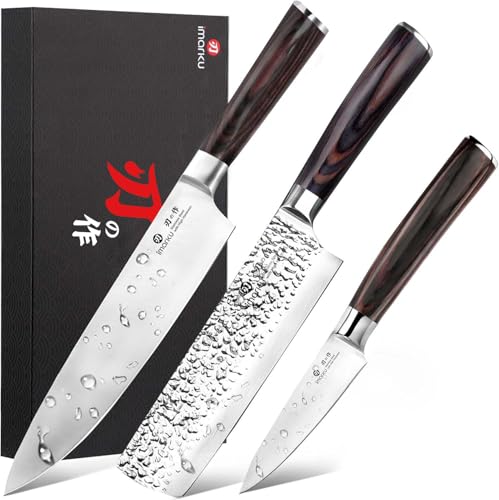
imarku 3 Pieces Knife set — Budget Entry Point
Here’s the deal: This is a starter set for cooks who want knife coverage without committing to serious sharpening habits, and the 57±1 HRC hardness actually works in that favor.
The imarku trio runs on high-carbon Japanese stainless at a measured 57±1 HRC — deliberately soft by Japanese-knife standards. That number means the edges dull faster than the VG-10 Damascus set below, but they’re also far less likely to chip when someone reaches for the edge to scrape a cutting board or slices into a tomato with too much downward force. A hand-polished professional edge on each blade means the out-of-the-box sharpness is better than the price suggests, though the listing never states the blade stock thickness.
What you give up with this softer steel is precisely what a harder blade buys: edge retention through long prep sessions. If you cook once or twice a week, that’s a non-issue — a few passes on a honing rod bring the edge back. If you’re prepping daily for a family, you’ll be sharpening more often than you’d like. Our team sees this trade as honest: 57 HRC tells you exactly what this set is, without pretending to be something it isn’t. For quick weeknight meals, including slicing that slow-roasted beef blade steak into thin strips, this trio handles the task without drama.
Pros:
- 57±1 HRC high-carbon Japanese stainless — forgiving steel that resists chipping under routine kitchen abuse
- Hand-polished professional edge — arrives sharper than most budget sets, per the manufacturer’s stated finish work
- Three-piece coverage — the essential shapes covered for everyday tasks without a drawer full of redundancy
- Softer steel is easier to maintain — a honing rod brings back the edge quickly, no whetstone skills needed
Cons:
- Blooms dull faster than 60+ HRC steel — the 57 HRC ceiling means more frequent touch-ups in a busy kitchen
- No blade thickness listed — the spec sheet omits spine width, which is exactly what determines flex in a chef knife
In a nutshell:
Ideal for: Beginners or intermediate cooks who want a practical starter set without pretension. Not great if: You already own a decent chef knife and want a genuine upgrade rather than a side-grade.
HOSHANHO Kitchen Knife in Japanese High Carbon Steel — Hard Single Blade
Quick take: One knife, one job — high-carbon 10Cr15CoMoV steel with a matte finish and a sloped bolster. This is the pick for cooks who’d rather own one great blade than three average ones.
The HOSHANHO chef’s knife is built from Japanese 10Cr15CoMoV high-carbon steel, a grade that runs harder than the imarku set’s 57 HRC by a meaningful margin. The matte blade finish isn’t just aesthetic — it reduces friction drag through wet ingredients and hides the fine scratches that a polished blade picks up within weeks. A sloped bolster design and ultra-durable wood handle create a forward grip that suits pinch-style cutting, which is the control posture most chefs and experienced home cooks adopt.
Hard steel means this blade will hold an edge through repeated use, but it also behaves like a Japanese knife under stress: lateral torque on hard items or frozen food is the fastest way to see a micro-chip. The listing doesn’t state a Rockwell number explicitly, which is the one gap I’d call out on a steel this hard. Knowing whether you’re working with 60 or 62 HRC changes how you treat the edge. This isn’t a set — it’s a single utilitarian blade — which fits my preference for versatile tools over single-purpose gadgets. A single well-made knife like this covers 90% of prep, including fine garnishing for dishes like sheet pan chicken shawarma where clean cucumber and tomato slicing matters.
Pros:
- 10Cr15CoMoV high-carbon Japanese steel — a harder grade than the imarku set, holding an edge far longer between sharpenings
- Matte finish blade — practical drag reduction and scratch-resistant for real-world use
- Sloped bolster and wood handle — forward-balanced grip that suits the pinch-style cutting most cooks use
- Single versatile design — one well-chosen blade replaces the clutter of a mediocre multi-knife block
Cons:
- No Rockwell number published — for steel this hard, the exact HRC is a number a serious buyer needs before committing
- Single blade, not a set — if you need a paring knife or a Santoku to round out your station, budget for them separately
Why it earns a spot:
Perfect for: Cooks who believe in one good knife and prefer hard steel with the discipline to match. Pass on this if: You want a complete set, or you’re the type who leaves knives in the sink overnight.
Japanese Chef Knife Set 3 Pcs — Real Damascus, Real VG-10
What sets it apart: A 67-layer Damascus build with a VG-10 steel core at 62 HRC. This is the closest thing on this list to an authentic Japanese knife experience without flying to Seki City.
The Atumuryou-branded set packages an 8-inch chef knife, 7-inch Santoku, and 3.5-inch paring knife around a core of Japanese VG-10 steel hardened to 62 HRC. VG-10 is the steel most people mean when they say “Japanese knife steel” — it holds a razor-class edge through weeks of normal prep and sharpens back to fine keenness on a whetstone without excessive effort. The 67-layer Damascus cladding isn’t decorative marketing alone; the layered steel distributes stress and gives the blade a subtle flexible resilience that a single-piece slab of the same hardness wouldn’t have.
What you’re accepting with 62 HRC is the tradeoff Japanese knife users know well: the edge will chip before it bends. Cut on glass or bamboo, and you’ll see micro-chips within a session. Use it on bones or frozen food, and the chip becomes a gouge. Hand washing is mandatory — not a suggestion. We’d place this set squarely in the “serious home cook” camp. It rewards proper technique: pinch grip, rolled wrist, and a whetstone maintenance routine. It punishes carelessness with visible damage. For anyone already cutting on a soft wood board and comfortable with a honing rod, this is the set to beat for pure steel character.
Pros:
- VG-10 steel core at 62 HRC — true Japanese edge retention that stays sharp through heavy prep workloads
- 67-layer Damascus construction — layered steel that reduces brittleness while holding a fine edge longer than mono-steel
- Complete three-piece kit — chef, Santoku, and paring cover every cutting task from butterflying to fine brunoise
- Authentic Japanese knife geometry — thin, acute edge grinds that slice rather than wedge
Cons:
- 62 HRC chips, it doesn’t bend — hard edge is unforgiving on glass, bamboo, frozen food, or anything with bones
- Real Damascus requires real care — hand wash only, dry immediately, and oil the blade if you live in a humid climate
Who should buy this:
Great match for: Cooks who understand edge maintenance and want the genuine article — VG-10 core, Damascus cladding, and a 62 HRC edge that rewards discipline. Think twice if: Your household treats knives like screwdrivers, or you’ve never used a whetstone and don’t plan to learn.
HENCKELS Forged Premio 7-inch Hollow Edge Santoku Knife — The German Answer

The real deal: Henckels took the Santoku profile, kept the German steel forgiving, and added a forged bolster and Granton edge. For everyday cooking, it’s the most practical knife on this list — and it’s honest about what it is.
The Forged Premio Santoku measures 7 inches — the sweet spot for a knife that’s long enough to slice a cabbage but short enough to mince garlic without feeling like a sword. Fabricated from German stainless steel, the blade carries a professional satin finish that reduces drag through starchy vegetables. The hollow edge — what the industry calls a Granton edge — creates air pockets along the blade face that break suction between steel and food, so thin slices of zucchini, potato, or tomato fall away instead of clinging.
This knife’s forged bolster construction is the real story. A forged bolster isn’t just a visual feature; it adds weight at the junction where blade meets handle, shifting the balance point forward and giving the knife predictable control. It also protects the pinch grip — your index finger and thumb rest against the bolster rather than the blade spine, which matters during long prep sessions. Compared against the imarku and HOSHANHO options, the Henckels is less exotic. It won’t hold a 62 HRC edge. What it does is stay sharp enough through a week of home cooking and shrug off the minor mishandling that would chip harder blades. This is a Western workhorse with Japanese-inspired geometry. One honest distinction, and it’s worth saying clearly: this is not a Miyabi. It is not made in Japan. It’s Henckels applying what they know about forging to a Santoku profile.
Pros:
- Forged bolster construction — added balance point and pinch-grip protection for extended cutting sessions
- 7-inch hollow edge Granton blade — air pockets reduce food sticking on starchy vegetables and thin-sliced proteins
- German stainless steel — forgiving edge retention that tolerates the occasional bamboo-board slip without chipping
- Satin-finished blade — precision cutting geometry with a finish that resists drag
Cons:
- Not a true Japanese blade — German steel and Western construction, the Santoku shape is inspirations, not identity
- Single knife only — if you need a paring knife or bread knife to round out your station, this is one purchase of several
Our take:
Ideal for: Home cooks who want Santoku versatility with German steel reliability, especially anyone who has chipped a harder Japanese knife before. Skip if: You demand authentic Japanese single-bevel sharpening or are building a complete knife set from scratch.
Buying Guide: What Actually Matters in Japanese-Style Knives
Steel Hardness: The HRC Number You Can’t Ignore
Rockwell hardness is the single most telling spec on any knife listing. Between 60 and 62 HRC, a blade holds a fine edge through weeks of regular use and still resists chips on normal ingredients. Dip below 57 HRC and you’ll be reaching for the honing rod twice a week. Push past 63 HRC and the edge becomes brittle — it will chip on a frozen chicken breast or a winter squash before it’ll ever dull. The imarku set sits at 57±1 HRC, which explains its forgiving nature. The Damascus set at 62 HRC is at the top edge of practical for daily cooking. The Henckels Premio doesn’t publish a number, which for German stainless typically lands somewhere between 56 and 60 HRC — softer than VG-10 but far more tolerant of average kitchen handling.
Handle Material: What You’re Actually Gripping
Handle choice determines how long you can hold the knife before fatigue sets in — and how much maintenance the tool demands. Plain wood handles must be cleaned by hand, never soaked, and occasionally treated. What most people call “Pakkawood” is a laminated wood composite infused with plastic resin, which makes it waterproof — a meaningful difference if your knife lives next to a sink. Stainless steel handles offer the greatest durability of any handle type; they’ll survive dishwasher cycles that would destroy wood, though they get slippery with wet or oily hands. Oriental-style knives can use D-shaped, circular, oval, or rounded octagonal cross-sections, each designed for a different grip style. Western knives are bilaterally flattened on the sides, which suits the pinch grip most Western-trained cooks already use. If you’re choosing between these picks, the HOSHANHO wood handle needs hand washing; the Henckels bolster offers pinch protection; and any Pakkawood option you encounter elsewhere should be resin-infused and waterproof.
Hollow Edge vs. Flat Blade: Does Granton Actually Work?
The hollow edge — Granton, to use the industry term — exists to break the suction that makes wet slices cling to a flat blade. It works best on starchy or water-rich foods: potatoes, cucumbers, zucchini, smoked salmon. On a wine-dry blade, it does almost nothing. Where the Granton pattern matters is raw meat and fish, where adhesion is strongest. The Henckels Premio carries a properly machined hollow edge, which is an argument in its favor compared against the imarku set, which the listing never describes as having one. If you process a lot of potatoes or slice raw fish at home, a Granton edge is worth the premium. If your prep leans toward onions and herbs, you’ll never notice the difference.
Forged vs. Stamped: What You’ll Feel Down the Line
Forged construction — where a single piece of steel is heated and shaped rather than cut from a sheet — generally produces a denser, more durable blade with a bolster that adds balance weight. Stamped knives are lighter, often cheaper, and perfectly serviceable for light prep. The Henckels Premio is forged, which contributes to its predictable feel under a pinch grip. The Damascus set is also forged, constructed from 67 layers of steel folded around a VG-10 core. The imarku set’s listing doesn’t specify construction method, which at its price point suggests stamped — and that’s fine for what it is, but it means you’re not getting the longevity forged steel provides. If your household treats knives as multi-purpose tools, buy forged. If you’re careful and want a lightweight blade, stamping works.
One more thing to check before you order: blade spine thickness. A spine under 2mm flexes under torque; over 3.5mm wedges in dense vegetables. The sweet spot for a chef knife or Santoku is between 2mm and 3mm. Cross-check that number against any knife you’re considering — especially the HOSHANHO and imarku listings, which don’t publish it.
Our Final Recommendation
Budget pick: the imarku set at 57 HRC gets a beginner through everyday prep without demanding whetstone discipline. Premium pick: the VG-10 Damascus set delivers genuine Japanese steel character and a complete kit for serious cooks. Overall winner: the HENCKELS Forged Premio 7-inch Hollow Edge Santoku — forged German steel, a proper Granton blade, and a balance point that suits long prep sessions. It’s the knife most people will actually use every day without babying it.
Frequently Asked Questions
What’s the difference between a Santoku and a Chef’s knife?
Santoku knives run shorter — typically 5 to 7 inches — with a flatter belly and a sheep’s-foot tip that slices straight down through vegetables. Chef knives run longer with a curved belly designed for rocking cuts. In these picks, the 7-inch Henckels Premio Santoku fills the shorter, chop-focused role, while the 8-inch chef knife in the Damascus set handles longer slicing tasks. For most home cooks with limited counter space, a Santoku covers 80% of what a chef knife does.
Can I put my Japanese-style knife in the dishwasher?
No — and that goes double for any blade above 60 HRC. Dishwasher detergent is abrasive, and the heat and humidity inside a cycle cause hard Japanese steel to micro-chip and pit at the edge. The imarku at 57 HRC might survive it for a while; the VG-10 Damascus set won’t. Hand wash with warm water and mild soap, dry immediately, and store in a sheath or on a magnetic strip.
Why does my Japanese knife keep chipping at the edge?
Because hard steel chip instead of bending — that’s the tradeoff for edge retention. If you’re seeing micro-chips, check your cutting board material. Glass, bamboo, and ceramic boards are the usual culprits. Also check your technique: sideways scraping with the edge, cutting through frozen food, or hitting bone will produce chips on any knife above 60 HRC. Switch to a soft wood or rubber board and reserve your hard-bladed knives for produce and boneless proteins only.