
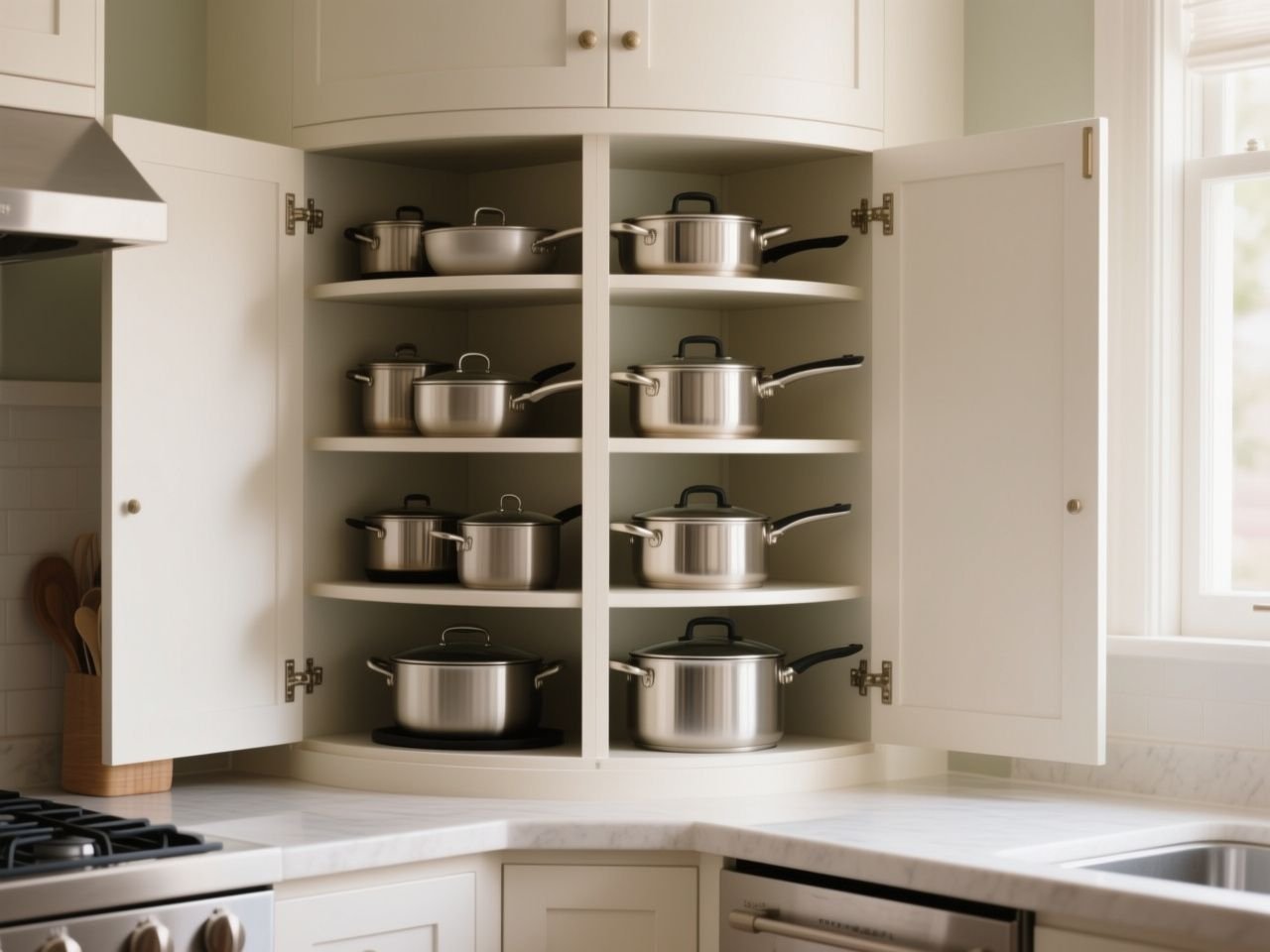
A shelf that fits inside a corner cabinet can still fail the moment it turns. The key distinction is between a shelf that physically fits inside a corner cabinet and one that can complete its full rotation without colliding with the face frame, door, hinges, or adjacent cabinetry. A useful guide should treat a lazy susan as a system of cabinet geometry, shelf shape, load distribution, and pivot or bearing alignment—not merely as a round shelf that spins.
That distinction matters in any lazy susan cabinet kitchen project. A poor fit wastes the corner, traps pantry goods, and can damage doors or hardware every time the shelf moves.
Key Takeaways
- Measure the opening, interior, frame, door swing, hinges, and nearby clearances.
- Choose a full-round, D-shaped, or kidney-shaped shelf according to the cabinet geometry.
- Keep heavy pantry items distributed across the shelf instead of concentrated at the rim.
- Level the base, protect the pivot or bearing, and follow the mechanism maker’s care instructions.
What a Lazy Susan Cabinet Actually Does
A lazy susan cabinet uses one or more rotating shelves to bring stored items toward the opening of a corner cabinet. A regular corner cabinet relies on fixed shelves or an empty recess, so items placed deep inside can become difficult to see and reach. Rotation changes access, but it also introduces moving clearances that fixed shelving does not need.
The usable dimensions are determined by the cabinet’s interior width, depth, height, face frame, door swing, hinge position, and clearance from adjacent cabinets—not just the nominal cabinet size. That is the first principle to keep beside the tape measure.
Corner storage is a geometry problem
Cabinet labels can hide important differences. Frameless cabinet construction may provide a different opening from a framed cabinet, while a face frame can reduce the usable passage even if the cabinet box has generous internal space. A nearby handle can also occupy the path of a rotating shelf. The shelf may clear the back wall yet strike the front edge as it approaches the doorway.
A rotating shelf can collide with a door, hinge, face frame, or neighboring handle even when the shelf itself fits inside the cabinet. That collision is usually a layout problem rather than a defect in the shelf.
Brands such as Rev-A-Shelf, Häfele, Kesseböhmer, and Blum are associated with cabinet organization hardware, but a brand name does not remove the need for site measurements. Their product families can include different shelf shapes, mounting arrangements, and cabinet requirements. The relevant question is always how the selected configuration relates to the actual cabinet opening.
How the mechanism supports the shelf
A rotating shelf normally depends on a central pivot, a ball-bearing swivel mechanism, or another guided mounting arrangement. The cabinet floor and mounting points must be strong and level enough for the mechanism. Particleboard damage, an uneven base, or loose fasteners can prevent smooth rotation even when the shelf dimensions are suitable.
The mechanism keeps the shelf centered by maintaining a defined relationship between the shelf and its mounting point. That relationship changes under load. A heavy jar placed at the outer edge creates more turning force than a lighter item placed near the center, so uneven loading can contribute to rubbing, wobble, or premature wear.
Do not assume that a shelf’s appearance reveals its capacity. The manufacturer does not list a universal weight limit for every lazy susan arrangement, and capacity depends on the shelf, pivot, fasteners, cabinet base, and mounting method. Use the stated limit for the exact mechanism when one is provided; otherwise, avoid treating an unknown capacity as permission to store dense loads.
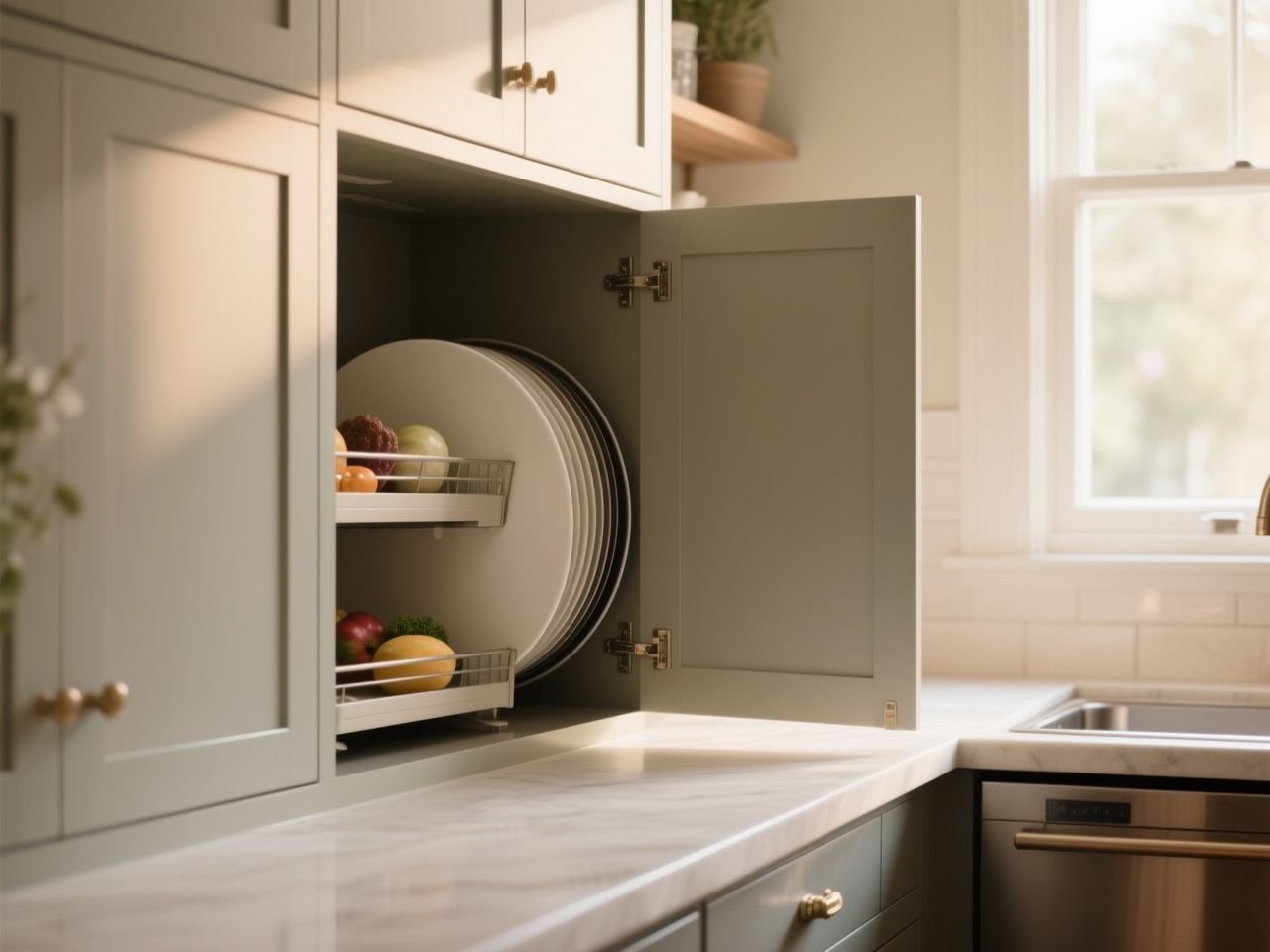
How to Measure Before Choosing a Lazy Susan Configuration
Measure the cabinet as an operating space, not as an empty box. Record the figures on paper and mark obstructions before comparing a shelf shape or lazy susan cabinet organizer.
Step 1: Record the opening
Measure the clear width and clear height of the cabinet opening with the doors open as far as the hardware allows. Measure at more than one point if the frame, hinges, or door construction changes the opening. The smallest usable reading is more important than a larger reading taken in an unobstructed area.
- Measure from the inside edge of one obstruction to the inside edge of the other.
- Note the position and projection of each hinge.
- Record the face-frame thickness and any lip that narrows the entry.
- Write down the door swing and the point where the door stops.
The cabinet opening controls whether a shelf can enter during installation and whether stored items can pass through the doorway. A shelf that fits the interior but cannot be installed through the opening is the wrong configuration.
Step 2: Measure the interior depth and corner clearance
Measure from the front obstruction to the back wall, then check the distance from the cabinet corner to each nearby obstruction. Include the neighboring cabinet, exposed end panel, handles, plumbing, and any structural block. A diagonal measurement can help describe the space, but it does not replace a rotation check.
Mark the sweep of the proposed shelf with cardboard or a strip of stiff material. Turn the template by hand through the full path while the door is open and closed. The template should clear the face frame, hinges, door, and adjacent cabinetry at every point in its rotation, not merely at its starting position.
Step 3: Measure height and mounting surfaces
Measure the clear interior height from the actual mounting surface to the lowest obstruction above it. Check shelves, rails, cabinet lighting, plumbing, and the underside of the countertop. If the design uses more than one rotating shelf, record the height required by each shelf and the height of the items you intend to store.
Inside the corner cabinet, individual Wood Super Susans are positioned upon a shelf. Depending on the height of stored items and the storage requirement, a layout may include one to three Wood Super Susans. That arrangement is useful only when the vertical spacing and mounting surface support it without blocking the door or reducing access.
A level mounting surface matters because the pivot axis must remain aligned with the shelf’s intended path. A cabinet floor that slopes, flexes, or has damaged particleboard can shift the assembly out of alignment. The result may be a shelf that rubs at one point of its rotation and clears the cabinet at another.
Step 4: Map the door and adjacent cabinets
Open the door through its complete permitted swing and identify the narrowest point. Include soft-close cabinet hardware in the movement check because the damper may stop the door before it reaches a fully flat position. Adjacent pantry shelving, handles, or a nearby blind-corner base cabinet can reduce the available path.
Door clearance is part of the shelf specification. A lazy susan cabinet door can block access even when the shelf rotates freely, and a shelf can scrape the door if its outer edge follows a wider path than expected.
Choosing the Shelf Shape for the Cabinet Layout
Shelf shape determines how much of the corner can be used while preserving clearance at the opening. The main choices are a full-round shelf, a D-shaped shelf, and a kidney-shaped shelf. None is automatically correct for every corner cabinet.
Full-round shelf
A full-round shelf uses a circular footprint around the pivot. Its continuous edge can make good use of an open interior, but the widest part of the circle may approach the face frame, hinges, or neighboring cabinet during rotation. The full-round shape therefore demands careful clearance mapping.
A full-round shelf requires enough front clearance for its widest arc to pass without contacting the cabinet opening. This shape can be sensible where the opening is broad and unobstructed, but the cabinet geometry must confirm that choice.
D-shaped shelf
A D-shaped shelf has a straight section and a rounded outer section. The straight edge can sit toward the opening or another restricted area, depending on the hardware design, while the curved portion uses the deeper corner. Its value comes from fitting a particular boundary, not from the letter-shaped profile alone.
Use the template to determine which edge faces the opening and how the shelf rotates. A D-shaped shelf can still strike a hinge if the pivot location and straight edge are poorly aligned. The shape reduces some interference risks only when it matches the cabinet’s measured restrictions.
Kidney-shaped shelf
A kidney-shaped shelf has a curved, indented profile intended to improve access around a corner opening. The recess can create space near the front while allowing the shelf to reach into the deeper corner. Its fit still depends on the pivot location, cabinet frame, door, and neighboring clearances.
A kidney-shaped shelf is useful when the opening needs a relieved section for access, but its curved profile does not guarantee a full rotation. Test the complete path rather than judging the shelf from a top-down view.
Match the shape to pantry zoning
Storage planning should follow the shelf’s usable path. Place frequently reached pantry items in the zone that comes forward easily, and reserve deeper or less convenient areas for items used less often. Adjustable pantry shelving may handle tall or irregular goods more efficiently than a rotating shelf if the cabinet does not provide a clean rotation path.
Pull-out shelves, swing-out shelves, and fixed corner shelving each solve a different access problem. A pull-out shelf moves contents forward in a straight line, a swing-out system brings a frame or shelf outward, and fixed shelving has no moving mechanism to maintain. A lazy susan is preferable only when circular access suits the cabinet and the contents.
For a base blind corner cabinet, the Lemans II pull-out is available as a selection. Current Lemans Corner Pull-out models may also include integrated soft-close features. That information illustrates the larger design choice: a corner pull-out can be more suitable than rotation when the cabinet has a blocked or narrow front path.
Loading, Alignment, and Rotation Problems
Load the shelf with the mechanism in mind. Dense cans, bottles, and jars should be distributed around the shelf rather than clustered at the outer edge. A balanced load reduces the tendency for the shelf to tilt or rub as it turns.
Weight should be spread around the shelf because an uneven load can increase rubbing, wobble, and wear in the rotating mechanism. The outer edge offers convenient storage, but it also places the load farther from the pivot and can make alignment problems more noticeable.
Why a shelf wobbles
Wobble can come from a loose fastener, damaged mounting material, an uneven cabinet floor, a pivot that is not centered, or loading that is concentrated on one side. The listing may identify a ball-bearing swivel mechanism, but that term does not correct a tilted base or loose attachment point.
Remove the stored items and rotate the empty shelf slowly. If the wobble remains, inspect the mounting points and base. If the wobble changes with the load, redistribute the contents and check that heavy items are not concentrated at the rim.
Why a shelf scrapes or stops
Scraping usually indicates an obstruction or a change in alignment. Check the full path for a face frame, door, hinge, adjacent handle, shelf edge, or cabinet wall. Then inspect the pivot area for food particles, spilled liquids, loose screws, or damaged material.
A shelf that stops at the same point in every rotation is likely meeting a fixed obstruction. A shelf that feels rough throughout its path may have contamination or a mechanism problem. These observations narrow the repair rather than justify adding force.
Never force a shelf past a resistance point. Forcing the rotation can enlarge a damaged mounting hole, bend hardware, chip a shelf edge, or place extra stress on the pivot. Empty the shelf, identify the contact point, and correct the obstruction before using it again.
How to protect the cabinet base
Melamine-faced particleboard is common in cabinet construction and provides a clean surface, but damaged edges and enlarged fastener holes can weaken a mounting point. Keep spilled food and liquid from sitting around the pivot or bearing. Clean gently and dry the area before checking alignment.
The cabinet floor supports the assembly and its stored load. A level, intact base is part of the rotating system, not a cosmetic detail.
Installation and Maintenance That Prevent Waste
Installation should begin with an empty cabinet and a verified rotation path. Mark the pivot center from the cabinet’s measured geometry rather than estimating from the wall or face frame. Confirm the center with the shelf or template before making permanent holes.
Set the mounting points carefully
- Remove loose contents, shelf liners, and debris from the cabinet floor.
- Inspect the mounting surface for swelling, cracks, soft areas, or damaged fastener holes.
- Use the supplied mounting pattern for the exact mechanism, if available.
- Place the shelf or template on the proposed pivot and check the full rotation.
- Secure the hardware without overtightening or crushing the mounting surface.
- Rotate the empty shelf, then add a light and evenly distributed load.
The exact fastener type, pilot-hole size, and permitted load must come from the mechanism manufacturer or installation instructions. The available information does not establish a universal specification, so do not substitute a guessed hardware schedule.
Clean the shelf and mechanism
Use a soft cloth and a cleaner compatible with the shelf surface. Melamine-faced particleboard should not be left wet, especially at exposed edges or around mounting holes. Wipe spills promptly and remove crumbs from the pivot area before they become packed into the moving parts.
Lubrication should follow the mechanism manufacturer’s instructions because some lubricants attract dust or damage plastic components. Do not spray an unknown lubricant into a bearing or pivot simply because the shelf feels rough. Cleaning the contact area and correcting alignment may be the appropriate first step.
Replace the part that failed
Common service points include the pivot or bearing assembly, mounting fasteners, shelf supports, and damaged shelf panels. A repair can be sensible when the shelf panels remain sound and the cabinet floor is intact. Replacement becomes less attractive when the mounting area is swollen, the cabinet geometry prevents full rotation, or the hardware no longer matches the shelf.
Repair versus replacement depends on the failed component, not on the word “lazy susan.” A replaceable mechanism may restore access, while a damaged cabinet base or obstructed opening may require a different storage layout. Pull-out hardware or fixed corner shelving can be more practical in a cabinet that cannot provide a clear rotational path.
Keep safety and compliance claims in perspective
Cabinet organizers do not automatically carry a universal safety certification. If a project involves anchoring, child access, or a broader furniture tip-over concern, consult the consumer safety information published by the U.S. Consumer Product Safety Commission rather than assuming that a rotating shelf has been evaluated for every household risk.
Food-contact claims also require care. A pantry shelf stores packaged goods, but that does not make every surface suitable for direct food contact. The U.S. Food and Drug Administration publishes information on food-contact substances and materials; use the manufacturer’s surface guidance for any item that may touch unpackaged food.
When Rotation Is the Wrong Answer
A lazy susan cabinet can improve visibility in a deep corner, but rotation is not always the most efficient use of space. A pantry pull-out may suit narrow access because the contents move forward in a straight path. A swing-out shelf can bring a blind corner toward the opening. Fixed shelves may be preferable for heavy storage when the cabinet geometry cannot support a smooth moving assembly.
The right organizer is the one that gives the contents a reliable path to the user. A rotating shelf is a poor choice if the door must remain at an awkward angle, the shelf repeatedly scrapes, or the mechanism requires careful balancing for ordinary pantry goods.
Use the following decision sequence before committing to hardware:
- If the shelf cannot complete a full rotation, change the shape, pivot location, or storage method.
- If the opening is narrow but the cabinet is deep, evaluate a corner cabinet pull-out or swing-out arrangement.
- If the contents are heavy and rarely moved, fixed shelving may reduce mechanical complexity.
- If visibility is the main problem, organize by pantry zoning before adding hardware.
Minimalist organization favors the simplest system that solves the access problem. A clean, well-fitted rotating shelf earns its space; a complicated mechanism that collides with the door becomes another object to work around.
Frequently Asked Questions
What is the most important measurement for a lazy susan cabinet?
The most important measurement is the narrowest operating clearance, not the nominal cabinet width. Record the opening, interior depth, height, face-frame projection, hinge position, door swing, and distance to adjacent cabinetry. A shelf must enter the cabinet and complete its full rotation without contact. A full-size cardboard template is a practical way to check the measured path before drilling.
Should I choose a full-round, D-shaped, or kidney-shaped shelf?
Choose the shape that matches the cabinet’s restricted areas. A full-round shelf needs clearance for its widest circular arc. A D-shaped shelf can place a straight edge toward a controlled boundary, while a kidney-shaped shelf provides a relieved front section for access. The correct choice depends on the pivot, face frame, hinges, door, and neighboring cabinets, so test the complete rotation rather than relying on shape names.
Why does my rotating pantry shelf wobble or scrape?
Wobble or scraping can result from an uneven cabinet floor, loose fasteners, damaged particleboard, an off-center pivot, contamination near the bearing, or an uneven load. Empty the shelf first and rotate it slowly. Identify whether the problem occurs at one fixed point or throughout the path, then inspect the obstruction, mounting surface, and hardware. Follow the mechanism manufacturer’s lubrication instructions instead of applying an unknown product.

