



I’ll never forget that cold winter night when I was rummaging through my pantry.
Tucked behind the flour and sugar, I found a forgotten jar of pistachio butter. I’d bought it weeks ago and completely forgotten about it.
That little jar changed everything.
See, I’d been wanting to make a pistachio cheesecake for ages. But every recipe I found online used those artificial pudding mixes. You know the ones. Bright neon green. Tasting nothing like actual pistachios.
I wanted something different. Something real.
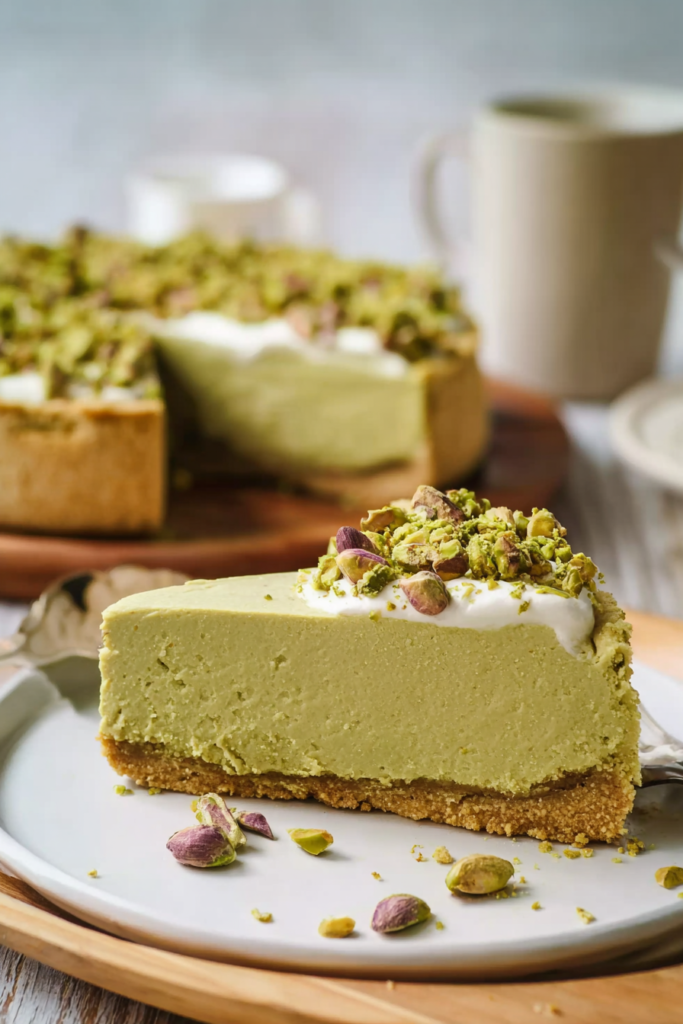
My first try? A complete disaster.
The pistachio extract contains a blend of flavorings and sugar. It does not mimic the flavor profile of raw pistachios.
The obvious next move? Chopping the pistachios super fine and mixing them straight in. Better, but still wrong. Chopped nuts stay as solid particles in a smooth filling, so the texture comes out grainy instead of silky.
Then it hit me.
Why not use the pistachio butter straight in the filling?
And friends… that’s when the magic happened.
Why You’ll Love This Recipe
Let me be honest with you. Cheesecakes scare people.
They crack. They sink in the middle. Sometimes they turn out rubbery and gross.
I’ve been there. I’ve made every mistake possible.
But here’s what I figured out:
The secret is three simple techniques that change everything.
First? Room temperature ingredients. All of them. No exceptions.
Cold cream cheese = lumpy batter = lumpy cheesecake. Not good.
Second? The water bath. I know it sounds fancy, but trust me on this.
Third? Slow, gradual cooling. No sudden temperature changes.
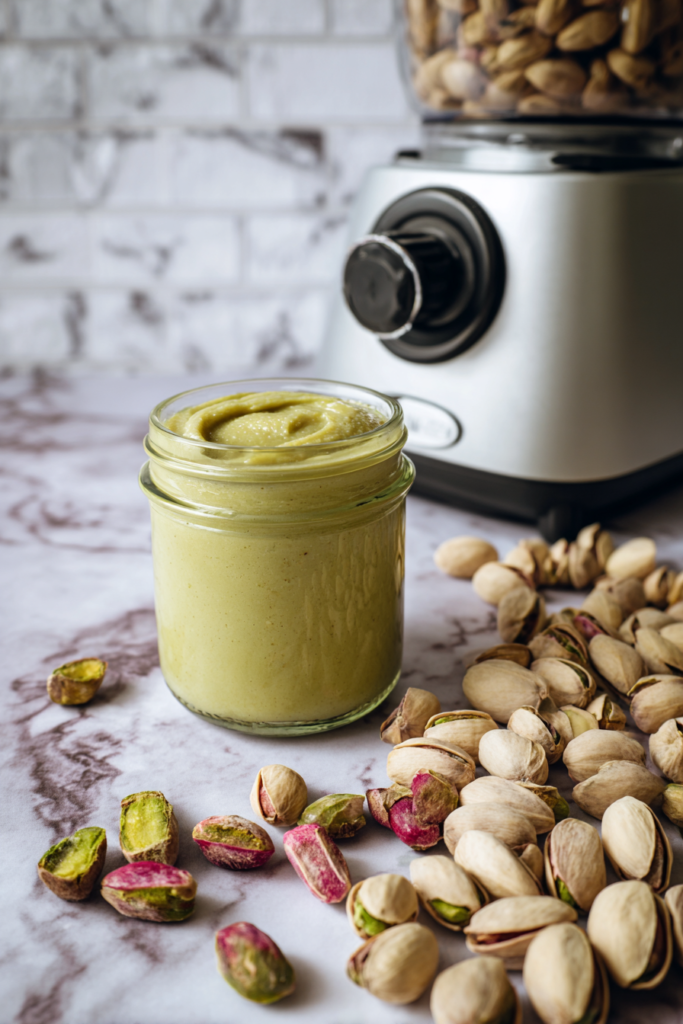
That pistachio butter does something incredible to the filling.
The natural oils keep everything insanely creamy. Like, melt-in-your-mouth creamy.
And it stays that way for days.
I’ve served this at probably two dozen family dinners by now. Every single time, someone pulls me aside afterward.
“You have to give me this recipe.”
“This must be so complicated.”
“Where did you find those special ingredients?”
The funny thing?
Everything’s from a regular grocery store. The only tricky part is the pistachio butter, and even that’s easy to make at home.
What Makes This Different
Most pistachio cheesecake recipes take shortcuts.
Pudding mix. Food coloring. Artificial flavoring.
Not this one.
This cheesecake gets its gorgeous pale green color from actual pistachios. The flavor? Pure, nutty, slightly sweet pistachio goodness.
No fake stuff.
I added a bit of lemon zest to mine. Just a tiny amount.
Here’s why:
The citrus oils wake up the pistachio flavor. They work together like best friends. Creating layers of flavor you wouldn’t get otherwise.
But if you’re a pistachio purist? Skip the lemon. It’s totally optional.
The graham cracker crust is my go-to. Simple, sweet, buttery.
Though digestive biscuits work just as well, and their coarser crumb sets into a slightly sturdier base.
Now, I need to be straight with you about something.
This isn’t a quick dessert.
You need to plan ahead. That 8-hour chill time is essential. No shortcuts there.
But oh man… when you slice into it the next day?
Totally worth the wait.
Ingredients You’ll Need
| Ingredient | Quantity | Notes |
|---|---|---|
| Cookie crumbs (graham crackers or digestive) | 300g | Process until super fine |
| Unsalted butter | 113g (1/2 cup) | Melt it, then let it cool slightly |
| Powdered sugar (crust) | 1 tablespoon | Makes the crust a bit sweeter |
| Fine sea salt (crust) | Pinch | Just a tiny bit |
| Cream cheese | 453g (2 bricks) | Must be room temperature |
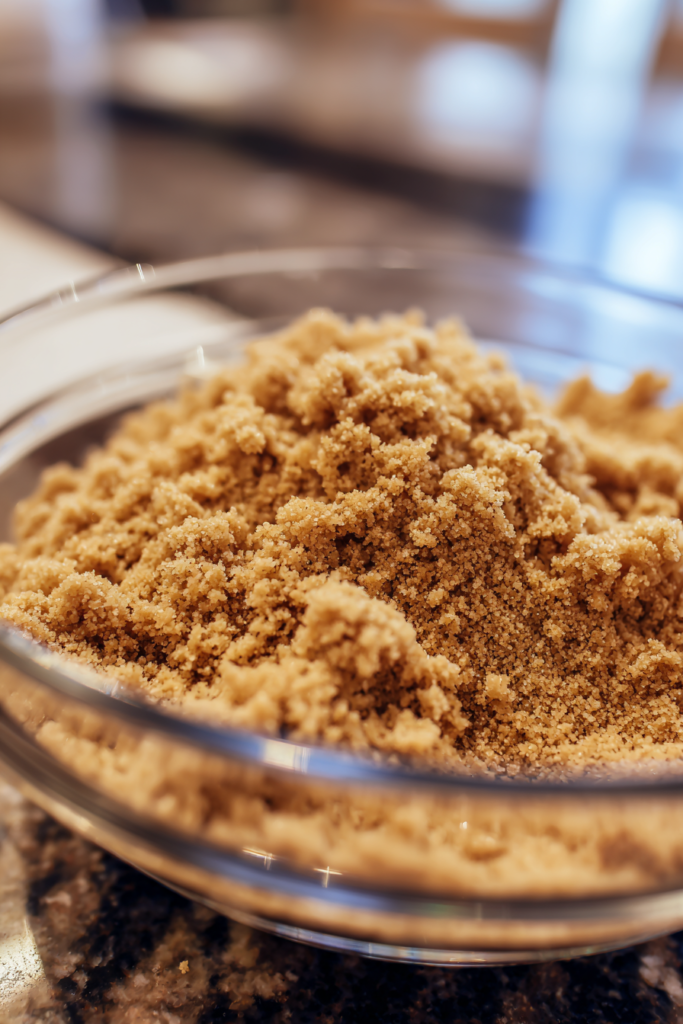
| Granulated sugar | 200g (1 cup) | The fine kind works best |
| Fine sea salt (filling) | 1/2 teaspoon | Don’t skip this |
| Pure vanilla extract | 2 teaspoons | Real vanilla, not the fake stuff |
| Pistachio butter | 200g (1 scant cup) | Store-bought or make your own |
| Sour cream | 240g (1 cup) | Full-fat only, please |
| Large eggs | 2 | Leave them out for an hour first |
| Lemon zest | From 1 lemon | Optional, but I love it |
IPrep Time: 30 minutes | Cook Time: 1 hour | Chill Time: 8 hours | Total Time: 9 hours 30 minutes
Servings: 10 | Difficulty: Intermediate
mage Prompt 3: All ingredients laid out in small glass bowls on a white countertop, organized and measured, with whole lemons, eggs in shells, and blocks of cream cheese prominently displayed
Making Your Own Pistachio Butter
Can’t find pistachio butter at your store?
No problem.
Making it at home is actually pretty easy. Just takes a bit of time.
Here’s how:
Heat your oven to 350°F. Spread 8-10 oz of raw pistachios (already shelled) on a baking sheet.
Toast them for 10 minutes. You want them hot and smelling amazing.
The moment they come out of the oven, dump them into your food processor.
Start blending.
At first, nothing much happens. The pistachios turn into a coarse powder. Kind of like almond flour.
Keep going.
Every few minutes, stop and scrape down the sides. This is important.
After about 10-15 minutes, something cool happens. The oils start releasing. The powder gets clumpy, then wet-looking.
Keep blending.
Eventually, it transforms into a smooth, pourable paste. Like natural peanut butter.
This whole process can take up to 20 minutes. Maybe longer if your food processor isn’t super powerful.
Be patient. It’s worth it.
Step-by-Step Instructions
Making the Crust
Turn your oven to 350°F.
Grab an 8-inch cake pan. Make sure it has tall sides. At least 3 inches.
Cut a circle of parchment paper and line the bottom.
In a bowl, dump your cookie crumbs, melted butter, powdered sugar, and that pinch of salt.
Mix it up really well.
The texture should look like wet sand at the beach. If you squeeze a handful, it should stick together.
Now press this mixture into your pan. Bottom first, then up the sides.
Here’s a trick I learned:
Use the bottom of a measuring cup to pack it down tight. Really tight.
Why? Because loose crusts crumble when you cut slices later. Not fun.
Pop it in the oven for 10 minutes.
When it comes out, it should smell toasty and look set.
Let it cool completely. Seriously, wait until it’s room temperature.
While it’s cooling, turn your oven down to 325°F.
Creating the Filling
This part determines whether your cheesecake turns out smooth or lumpy.
Put your room-temperature cream cheese in a food processor or stand mixer bowl.
Before you do anything else, grab a rubber spatula.
Press the cream cheese hard against the sides of the bowl. Smash it around a bit.
I know it seems weird, but this step is crucial. It breaks up lumps before they even form.
Add the sugar and salt.
If you’re using lemon zest (and I really think you should), rub it into the sugar with your fingers first. This releases all those citrus oils.
Beat everything for 2-3 minutes.
It should look completely smooth. No lumps anywhere.
Stop and scrape down the bowl. Get every corner.
Add the vanilla and pistachio butter.
Process again until the whole mixture turns this gorgeous pale green color. Silky smooth.
Scrape down again.
Now add the sour cream. Blend just until it’s mixed in. The mixture should look uniform and creamy.
Here comes the most important part:
Add the eggs.
Listen carefully. This is where most people mess up.
Pulse just until the eggs disappear into the batter. That’s it.
No more than 30 seconds. Maybe less.
Why?
Because overmixing eggs pumps air into the batter. That air creates bubbles. Those bubbles cause cracks and sinking.
The Baking Process
Pour your filling into that cooled crust.
Now grab a 13×9-inch baking pan. Something bigger than your cheesecake pan.
Place your cheesecake pan inside the bigger pan.
Carefully pour hot water into the bigger pan. Fill it until the water comes halfway up the sides of your cheesecake pan.
This is called a water bath.
And no, you can’t skip it.
The water creates gentle, even heat. It protects the eggs from cooking too fast.
Without it? You get rubbery, overcooked cheesecake. Not what we’re going for.
Slide the whole setup into your 325°F oven.
Set a timer for 50 minutes.
But here’s the thing about cheesecakes…
Time is just a guideline. Your eyes are better.
Watch for these signs:
- The edges look set and matte (not shiny)
- The center still jiggles a bit when you shake the pan gently
- No browning on top
When you see all that? It’s done.
Turn off the oven.
Don’t take the cheesecake out yet.
Crack the oven door open. I use a wooden spoon to prop it.
Let the cheesecake hang out in there for 30 minutes.
This slow cooling prevents cracking. Trust the process.
After 30 minutes, close the door and wait another 15 minutes.
Now you can take it out of the water bath.
Set it on your counter to cool to room temperature. This takes 30-45 minutes.
Once it’s completely cool, cover it with plastic wrap.
Into the fridge it goes.
Minimum 8 hours. Overnight is even better.
I know the wait is hard. But this is when everything sets up properly. The flavors blend together. The texture becomes perfect.
Pro Tips That Actually Matter
Check your cream cheese. Press it with your finger. If it’s cold and firm? Wait longer. It needs to be soft.
Scrape, scrape, scrape. Ingredients love hiding at the bottom of bowls. Check often.
Keep that oven door closed. Every time you open it, the temperature drops. That causes problems.
Run a knife around the edges before you refrigerate. The cheesecake contracts as it cools. If it’s stuck to the pan, it can crack.
How to Serve This Beauty
Honestly? This cheesecake is perfect all by itself.
But if you want to fancy it up a bit…
I love adding a dollop of lightly sweetened whipped cream on top of each slice. The light, airy texture plays perfectly against the dense, creamy filling.
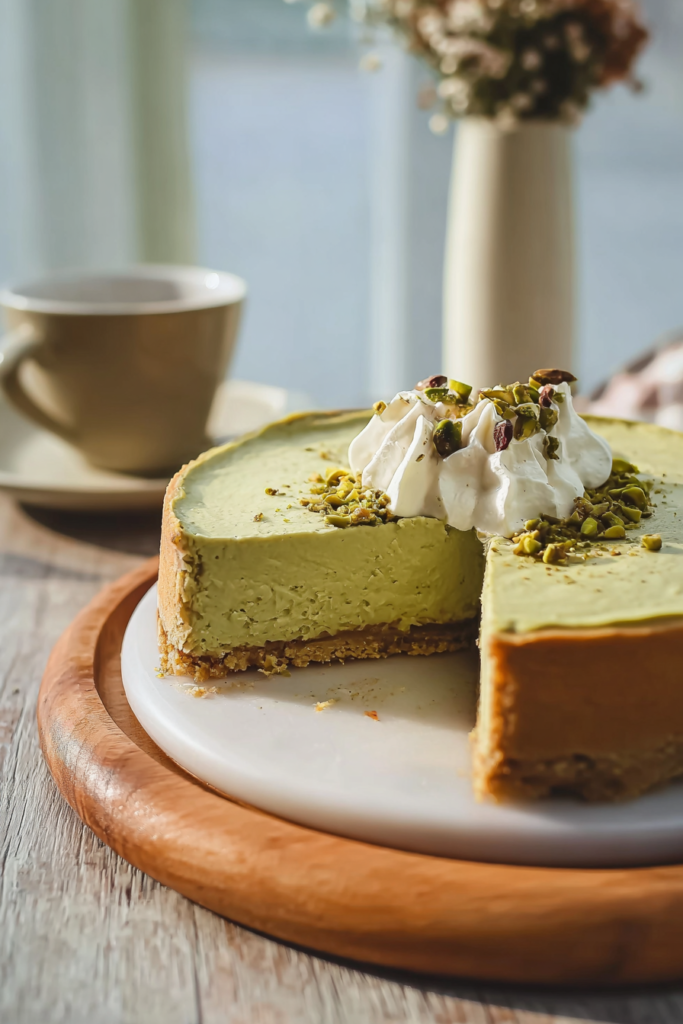
Sometimes I’ll sprinkle crushed pistachios over everything. Extra pistachio flavor never hurt anyone.
A drizzle of honey is nice too. Or a light chocolate ganache if you’re feeling adventurous.
My favorite pairing? Fresh raspberries on the side.
The tartness cuts through all that richness. It’s like they were made for each other.
Storing Your Cheesecake
Keep it covered in the fridge. It’ll stay good for up to a week.
Actually, it gets better after a couple days. The flavors have time to develop.
Want to keep it longer?
Cut it into slices. Wrap each slice tightly in plastic wrap. Put them all in a freezer bag.
They’ll keep for up to three months in the freezer.
To serve, just move a slice to the fridge the night before. Let it thaw slowly.
Your Questions Answered
Can I use yogurt instead of sour cream?
Yep. Greek yogurt works great. Use the full-fat kind for best results.
Plain kefir is another good option. It has that same tangy flavor.
What if I can’t find pistachio butter?
Make your own using the instructions I gave earlier. It’s easier than you think.
Some specialty stores carry it too. Look for pure pistachio butter. No added oils or sugars.
Why did my cheesecake crack?
Three main reasons this happens:
- You overmixed the eggs
- Your oven was too hot
- You cooled it too fast
The water bath and gradual cooling should prevent this. But sometimes cracks happen anyway. They don’t affect the taste!
Can I use a springform pan instead?
Sure. But here’s the thing…
Don’t put it directly in the water bath. Springform pans can leak.
Instead, put your water pan on the rack below your cheesecake. The steam still helps, but you avoid the leak risk.
How do I know it’s done baking?
Look at the edges. They should be set and matte.
Now look at the center. Give the pan a gentle shake. The middle should jiggle like Jell-O.
If it’s still liquid-looking, give it more time.
Remember, it keeps cooking as it cools. So you actually want it slightly underdone when you take it out.
The combination of creamy texture and real pistachio flavor makes this dessert absolutely incredible. I hope you love it as much as I do!
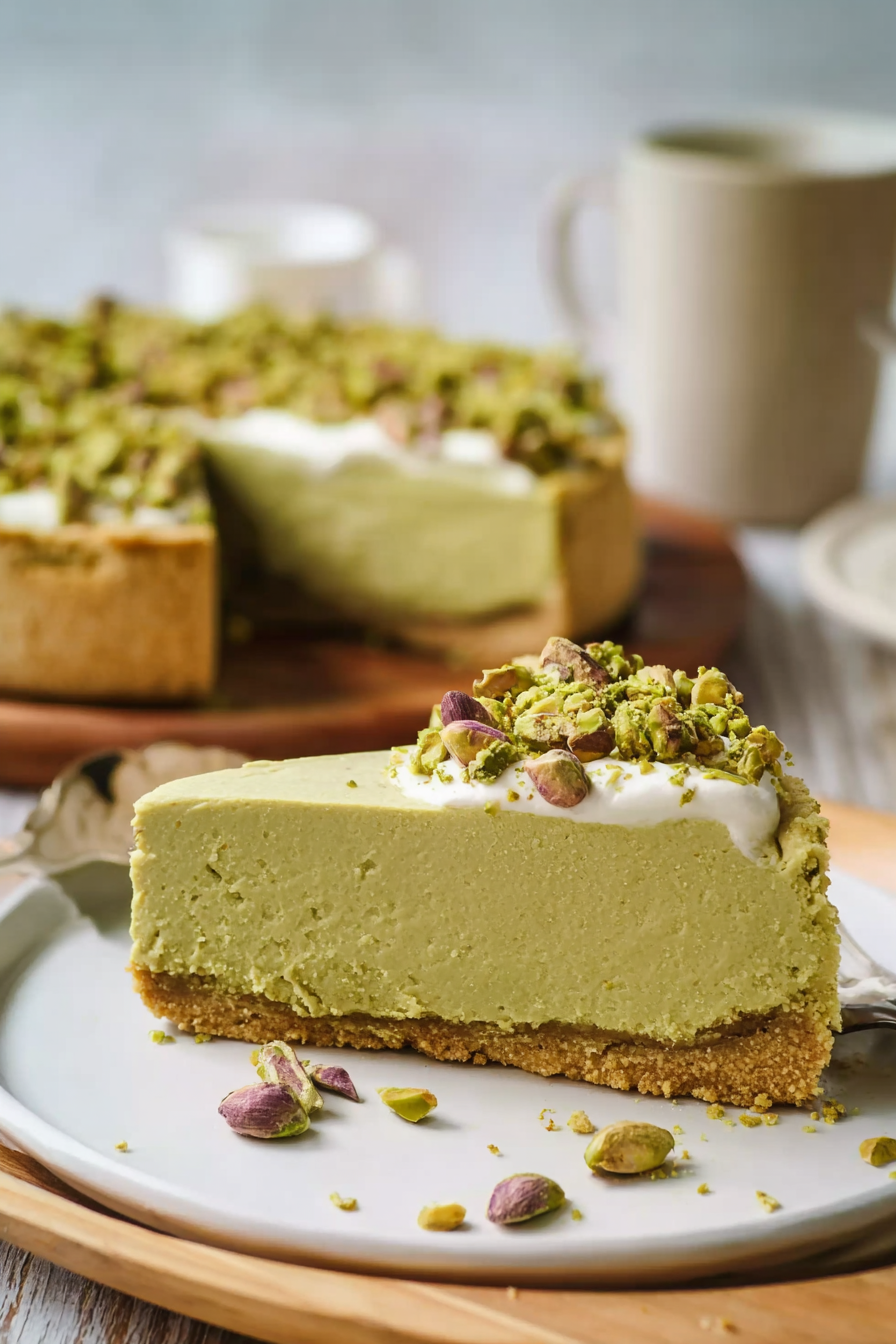
Pistachio Cheesecake
Ingredients
Method
- Preheat oven to 350°F. Line the bottom of an 8-inch cake pan (at least 3 inches tall) with parchment paper.
- In a bowl, combine cookie crumbs, melted butter, powdered sugar, and salt. Mix until the texture resembles wet sand that sticks together when squeezed.
- Press the mixture firmly into the bottom and up the sides of the pan using the bottom of a measuring cup to pack it down tight.
- Bake for 10 minutes until toasty and set. Let cool completely to room temperature. Reduce oven temperature to 325°F.
- Place room-temperature cream cheese in a food processor or stand mixer. Press it hard against the sides with a rubber spatula to break up lumps.
- If using lemon zest, rub it into the sugar with your fingers to release citrus oils. Add sugar and salt to the cream cheese.
- Beat for 2-3 minutes until completely smooth with no lumps. Stop and scrape down the bowl thoroughly.
- Add vanilla and pistachio butter. Process until the mixture turns pale green and silky smooth. Scrape down the bowl again.
- Add sour cream and blend just until mixed in and uniform.
- Add eggs and pulse just until they disappear into the batter, no more than 30 seconds. Do not overmix to avoid incorporating air bubbles.
- Pour filling into the cooled crust. Place cheesecake pan inside a larger 13×9-inch baking pan.
- Carefully pour hot water into the larger pan until it comes halfway up the sides of the cheesecake pan (water bath method).
- Bake at 325°F for 50 minutes, or until edges are set and matte while the center still jiggles slightly when gently shaken. No browning on top.
- Turn off the oven and crack the door open (prop with a wooden spoon). Let cheesecake rest in oven for 30 minutes.
- Close the oven door and wait another 15 minutes. Remove from water bath and let cool to room temperature on the counter (30-45 minutes).
- Run a knife around the edges, cover with plastic wrap, and refrigerate for at least 8 hours or overnight before serving.

